
Fraction Division: a ÷ b (Partitive)
Loading the math board and drawing, please wait…
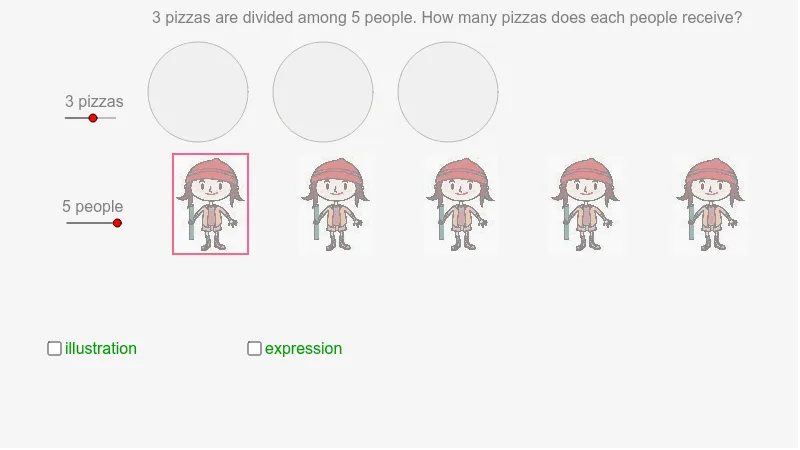
This example demonstrates the understanding of fraction division a ÷ b in the context of partitive division, showing that a ÷ b = a/b. It involves core mathematical concepts like fraction division and partitive division. GeoGebra commands and objects such as Point, Segment, Sequence, Polygon, and GCD are used in the construction. Suitable for middle school mathematics education to help students grasp the geometric meaning of fraction division.
GeoGebra Commands & Parameters
Point(Segment[(x(D) + 2 / 5, y(D)), (x(D) + 1, y(D))]) → SSegment(A, (x(A) + 1, y(A))) → l1Point(Segment[(x(A) + 1 / 5, y(A)), (x(A) + 1, y(A))]) → PSegment(B, (x(B) + 1, y(B))) → l2Point(Segment[(x(B) + 2 / 6, y(B)), (x(B) + 1, y(B))]) → QPoint(Segment[(x(C) + 1 / 6 - 0.0050, y(C)), (x(Q) - 1 / 6, y(C))]) → RSegment(C, (x(C) + 1, y(C))) → l3Sequence(Circle[(2.5 * (i - 1), 0), 1], i, 1, a) → list1Sequence(Segment[(2.5 * a, 0), (2.5 * a - sin(j * θ), cos(j * θ))], j, 1, c - 1) → list2Segment(D, (x(D) + 1, y(D))) → l4Polygon((-0.5, -3.24), (1, -3.24), (1, -1.24), (-0.5, -1.24)) → poly1, e, g, h, iGCD(a, d) → kSegment(A, P) → jSegment(C, R) → lSegment(B, Q) → mSegment(D, S) → nPoint(Segment[(x(A_1) + 1 / 7, y(A_1)), (x(A_1) + 1, y(A_1))]) → P_1Segment(A_1, P_1) → j_1Point(Segment[(x(D_1) + 2 / 5, y(D_1)), (x(D_1) + 1, y(D_1))]) → S_1Point(Segment[(x(A_2) + 1 / 7, y(A_2)), (x(A_2) + 1, y(A_2))]) → P_2GCD(a_1, d_1) → k_1Segment(A_2, P_2) → j_2Segment(D_1, S_1) → n_1Point(Segment[(x(D_2) + 2 / 5, y(D_2)), (x(D_2) + 1, y(D_2))]) → S_2Point(Segment[(x(A_3) + 1 / 7, y(A_3)), (x(A_3) + 1, y(A_3))]) → P_3GCD(a_2, d_2) → k_2Segment(A_3, P_3) → j_3Segment(D_2, S_2) → n_2Sequence(Sequence[CircleSector[(-1 * f * sin((2 * k - 1) * θ / 2) + 2.5 * (m - 1), f * cos((2 * k - 1) * θ / 2)), (-1 * f * sin((2 * k - 1) * θ / 2) - sin((k - 1) * θ) + 2.5 * (m - 1), f * cos((2 * k - 1) * θ / 2) + cos((k - 1) * θ)), (-1 * f * sin((2 * k - 1) * θ / 2) - sin(k * θ) + 2.5 * (m - 1), f * cos((2 * k - 1) * θ / 2) + cos(k * θ))], k, 1, 1], m, 1, a) → list4Sequence(Sequence[CircleSector[(f * sin((2 * k - 1) * θ / 2) + 2.5 * (m - 1), f * cos((2 * k - 1) * θ / 2)), (f * sin((2 * k - 1) * θ / 2) + sin(k * θ) + 2.5 * (m - 1), f * cos((2 * k - 1) * θ / 2) + cos(k * θ)), (f * sin((2 * k - 1) * θ / 2) + sin((k - 1) * θ) + 2.5 * (m - 1), f * cos((2 * k - 1) * θ / 2) + cos((k - 1) * θ))], k, 1, b], m, 1, a) → list3