
Fraction Division 2: Partitive Division p/q ÷ b
Loading the math board and drawing, please wait…
In collections
Primary School Mathematics Collection
Division of Fractions
Division of Fractions
Division of Fractions
Fraction Division
Fraction Division
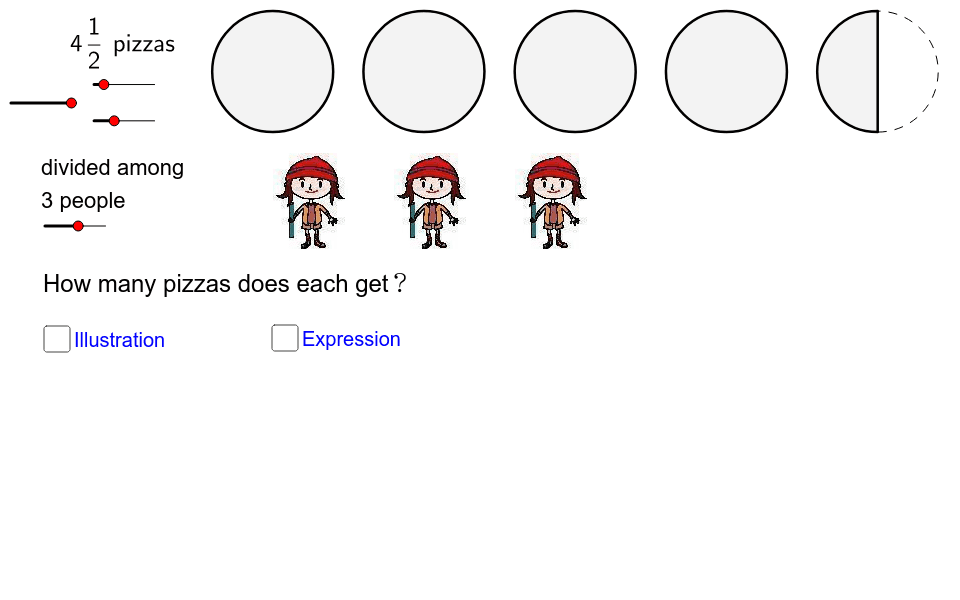
This example illustrates the geometric interpretation of partitive fraction division, showing that p/q ÷ b equals p/q × 1/b. It uses GeoGebra commands such as Segment, Point, Sequence, Polygon, and GCD to construct an interactive visual model. The core concepts include fraction division, reciprocal multiplication, and linear representation of division. Designed for middle and high school students and teachers to intuitively grasp fraction division through dynamic graphics.
GeoGebra Commands & Parameters
Segment(A, (x(A) + 1, y(A))) → l1Point(Segment[(x(A), y(A)), (x(A) + 1, y(A))]) → PSegment(B, (x(B) + 1, y(B))) → l2Point(Segment[(x(B) + 2 / 6, y(B)), (x(B) + 1, y(B))]) → QPoint(Segment[(x(C) + 1 / 6 - 0.005, y(C)), (x(Q) - 1 / 6, y(C))]) → RSegment(C, (x(C) + 1, y(C))) → l3Sequence(Circle[((2.5 * (i - 1)), 0), 1], i, 1, a) → list1Sequence(Sequence[CircleSector[((f * sin((((2 * k) - 1) * θ / 2))) + (2.5 * (m - 1)), (f * cos((((2 * k) - 1) * θ / 2)))), ((f * sin((((2 * k) - 1) * θ / 2))) + sin((k * θ)) + (2.5 * (m - 1)), (f * cos((((2 * k) - 1) * θ / 2))) + cos((k * θ))), ((f * sin((((2 * k) - 1) * θ / 2))) + sin(((k - 1) * θ)) + (2.5 * (m - 1)), (f * cos((((2 * k) - 1) * θ / 2))) + cos(((k - 1) * θ)))], k, 1, b], m, 1, a) → list4Sequence(CircleSector[(((-1 * f) * sin((((2 * k) - 1) * θ / 2))) + (2.5 * a), (f * cos((((2 * k) - 1) * θ / 2)))), (((-1 * f) * sin((((2 * k) - 1) * θ / 2))) - sin(((k - 1) * θ)) + (2.5 * a), (f * cos((((2 * k) - 1) * θ / 2))) + cos(((k - 1) * θ))), (((-1 * f) * sin((((2 * k) - 1) * θ / 2))) - sin((k * θ)) + (2.5 * a), (f * cos((((2 * k) - 1) * θ / 2))) + cos((k * θ)))], k, 1, c) → list5CircleSector(((2.5 * a), 0), ((2.5 * a), 1), ((2.5 * a) - sin((c * θ)), cos((c * θ)))) → s1Sequence(Segment[((2.5 * a), 0), ((2.5 * a) - sin((j * θ)), cos((j * θ)))], j, 1, c - 1) → list2Sequence(Segment[((2.5 * a), 0), ((2.5 * a) - sin((j * θ)), cos((j * θ)))], j, c + 1, b - 1) → list3CircleSector(((2.5 * a), 0), ((2.5 * a) - sin((c * θ)), cos((c * θ))), ((2.5 * a), 1)) → s2Segment(D, (x(D) + 1, y(D))) → l4Point(Segment[(x(D) + 2 / 5, y(D)), (x(D) + 1, y(D))]) → SSequence(Sequence[CircleSector[(((-1 * f) * sin((((2 * k) - 1) * θ / 2))) + (2.5 * (m - 1)), (f * cos((((2 * k) - 1) * θ / 2)))), (((-1 * f) * sin((((2 * k) - 1) * θ / 2))) - sin(((k - 1) * θ)) + (2.5 * (m - 1)), (f * cos((((2 * k) - 1) * θ / 2))) + cos(((k - 1) * θ))), (((-1 * f) * sin((((2 * k) - 1) * θ / 2))) - sin(((k - 1) * θ) + θ / d) + (2.5 * (m - 1)), (f * cos((((2 * k) - 1) * θ / 2))) + cos(((k - 1) * θ) + θ / d))], k, 1, b], m, 1, a) → list6Sequence(CircleSector[(((-1 * f) * sin((((2 * k) - 1) * θ / 2))) + (2.5 * a), (f * cos((((2 * k) - 1) * θ / 2)))), (((-1 * f) * sin((((2 * k) - 1) * θ / 2))) - sin(((k - 1) * θ)) + (2.5 * a), (f * cos((((2 * k) - 1) * θ / 2))) + cos(((k - 1) * θ))), (((-1 * f) * sin((((2 * k) - 1) * θ / 2))) - sin(((k - 1) * θ) + θ / d) + (2.5 * a), (f * cos((((2 * k) - 1) * θ / 2))) + cos(((k - 1) * θ) + θ / d))], k, 1, c) → list7Sequence(Sequence[Sequence[Segment[(((-1 * f) * sin((((2 * k) - 1) * θ / 2))) + (2.5 * (m - 1)), (f * cos((((2 * k) - 1) * θ / 2)))), (((-1 * f) * sin((((2 * k) - 1) * θ / 2))) - sin(((k - 1) * θ) + (n * θ / d)) + (2.5 * (m - 1)), (f * cos((((2 * k) - 1) * θ / 2))) + cos(((k - 1) * θ) + (n * θ / d)))], n, 1, d - 1], k, 1, b], m, 1, a) → list8Sequence(Sequence[Segment[(((-1 * f) * sin((((2 * k) - 1) * θ / 2))) + (2.5 * a), (f * cos((((2 * k) - 1) * θ / 2)))), (((-1 * f) * sin((((2 * k) - 1) * θ / 2))) - sin(((k - 1) * θ) + (n * θ / d)) + (2.5 * a), (f * cos((((2 * k) - 1) * θ / 2))) + cos(((k - 1) * θ) + (n * θ / d)))], n, 1, d - 1], k, 1, c) → list9Polygon((0.016528925619834656, -3), (1.2165289256198346, -3), (1.2165289256198346, -1.3), (0.016528925619834656, -1.3)) → poly1, e, g, h, iGCD((a * b) + c - ((floor(((a * b) + c) / ((b * d))) * b) * d), (b * d)) → kSegment(A, P) → jSegment(C, R) → lSegment(B, Q) → mSegment(D, S) → n