
Fraction Comparison by Neil
Loading the math board and drawing, please wait…
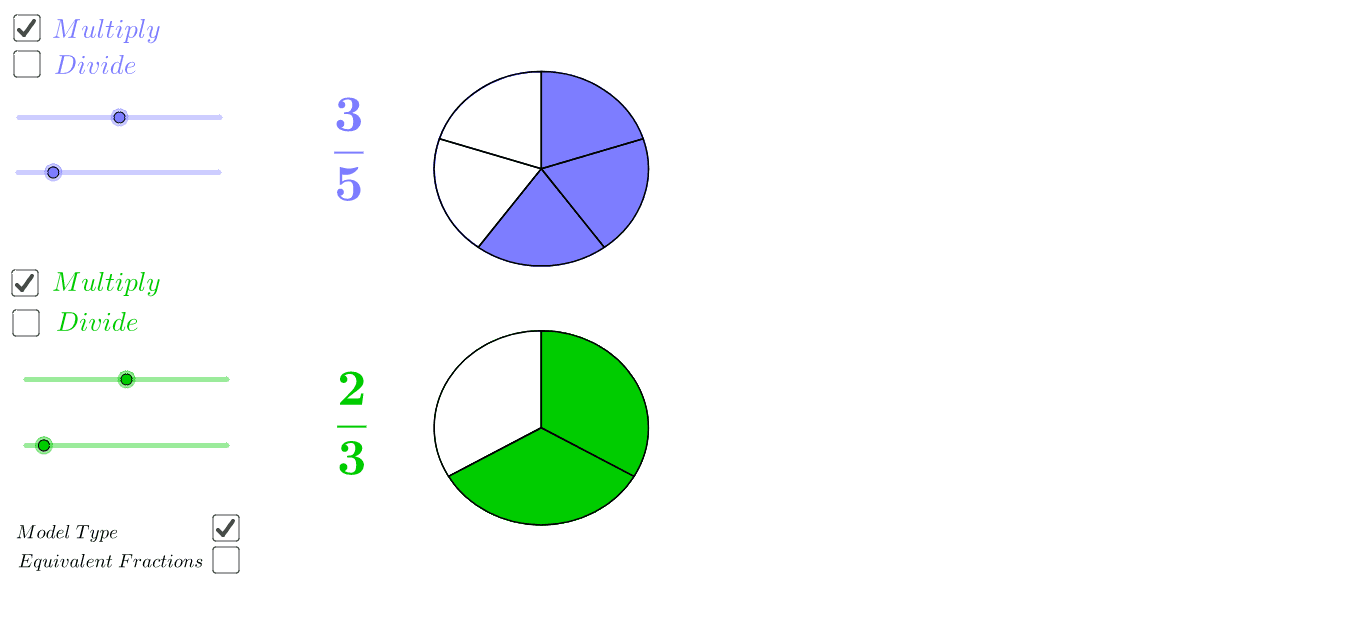
This example demonstrates how to visually compare fractions using geometric methods. It involves core math concepts like fractions, circles, spheres, secant lines, quadratic equations, and area. Construction highlights include GeoGebra commands such as If, Division, Intersect, Point, Sequence, Circle, Translate, BarFraction, Improp. Suitable for middle school and above, helping learners understand geometric and algebraic approaches to fraction comparison.
GeoGebra Commands & Parameters
If(m, (a_1 * b), If[d, a_1 / b, If[a, a_1 + b, If[s, a_1 - b]]]) → iIf(m, (n * g), If[d, n / g, If[a, n + g, If[s, n - g]]]) → jDivision(a_1, n) → list8Intersect(xAxis, yAxis) → APoint(yAxis) → BSequence(Rotate[B, (((-i) * 360) * ° / n), A], i, 0, n) → list1Circle(A, B) → cSequence(Rotate[D, (((-i) * 360) * ° / If[m, (n * g), If[d, n / g, If[a, n + g, If[s, n - g]]]]), C], i, 0, If[m, (n * g), If[d, n / g, If[a, n + g, If[s, n - g]]]]) → list4Circle(C, D) → fSequence(Sector[c, Element[list1, i + 1], Element[list1, i]], i, 1, n) → list2Sequence(Sector[f, Element[list4, i + 1], Element[list4, i]], i, 1, If[m, (n * g), If[d, n / g, If[a, n + g, If[s, n - g]]]]) → list5Division(i, j) → list11If(n > a_1, Sequence[Sector[c, Element[list1, i + 1], Element[list1, i]], i, 1, a_1], Sequence[Sector[c, Element[list1, i + 1], Element[list1, i]], i, 1, a_1]) → list3Circle(E, G) → pCircle(F, H) → qSequence(Rotate[G, (((-i) * 360) * ° / o), E], i, 0, o) → list14Sequence(Sector[p, Element[list14, i + 1], Element[list14, i]], i, 1, o) → list12If(l > o, Sequence[Sector[p, Element[list14, i + 1], Element[list14, i]], i, 1, l], Sequence[Sector[p, Element[list14, i + 1], Element[list14, i]], i, 1, l]) → list15Sequence(Sector[p, Element[list14, i + 1], Element[list14, i]], i, 1, o) → list16Sequence(Rotate[H, (((-i) * 360) * ° / If[u, (o * t), If[w, o / t, If[a, o + t, If[s, o - t]]]]), F], i, 0, If[u, (o * t), If[w, o / g, If[a, o + t, If[s, o - t]]]]) → list17Sequence(Sector[q, Element[list17, i + 1], Element[list17, i]], i, 1, If[u, (o * t), If[w, o / t, If[a, o + t, If[s, o - t]]]]) → list18If(u, (l * r), If[w, l / r, If[a, a_1 + b, If[s, a_1 - b]]]) → b_1If(u, (o * t), If[w, o / t, If[a, n + g, If[s, n - g]]]) → c_1Division(b_1, c_1) → list20Sequence(Element[list10, i] - (0, 8), i, 1, Length[list10]) → list22If(j ≥ i, Sequence[Sector[f, Element[list4, n + 1], Element[list4, n]], n, 1, i], Sequence[Sector[f, Element[list4, i + 1], Element[list4, i]], i, 1, Element[list11, 2]]) → list6If(i > j, Sequence[Circle[Element[list10, i], 0.8], i, 0, Element[list11, 1], 1]) → list9If(b_1 > c_1, Sequence[Circle[Element[list22, i], 0.8], i, 0, Element[list20, 1], 1]) → list21Translate({list3, list15}, (v, 0)) → list13Translate({list6}, (0, g_1)) → list23BarFraction(a_1, n, I) → list24, list25BarFraction(l, o, J) → list26, list27If(m ≟ 1, (a_1 * b), a_1 / b) → r_5If(m ≟ 1, (n * g), n / g) → s_5If(u ≟ 1, (o * t), o / t) → v_5If(u ≟ 1, (l * r), l / r) → t_5Translate(list24, (v, ((1 / 20 * v) * (v - 8)))) → list25'Translate(list26, (v, ((1 / 20 * v) * (v - 8)))) → list26'If(c_1 ≥ b_1, Sequence[Sector[q, Element[list17, o + 1], Element[list17, o]], o, 1, b_1], Sequence[Sector[q, Element[list17, i + 1], Element[list17, i]], i, 1, Element[list20, 2]]) → list19Improp(v_5, t_5, L) → list31_3, list31, list32If(t_5 > v_5, Sequence[Polygon[P - (0, i), P - (0, i) + (3, 0), P - (0, i) + (3, 0.5), P - (0, i) + (0, 0.5)], i, 0, Element[list32, 1] - 1]) → list30If(t_5 > v_5, Sequence[Polygon[P - (0, i), P - (0, i) + (3, 0), P - (0, i) + (3, 0.5), P - (0, i) + (0, 0.5)], i, 0, Element[list32, 1] - 1]) → list33Improp(s_5, r_5, K) → list28, list29, list34If(r_5 > s_5, Sequence[Polygon[O - (0, i), O - (0, i) + (3, 0), O - (0, i) + (3, 0.5), O - (0, i) + (0, 0.5)], i, 0, Element[list34, 1] - 1]) → list35If(r_5 > s_5, Sequence[Polygon[O - (0, i), O - (0, i) + (3, 0), O - (0, i) + (3, 0.5), O - (0, i) + (0, 0.5)], i, 0, Element[list34, 1] - 1]) → list36If(i > j, Sequence[Circle[Element[list10, i], 0.8], i, 0, Element[list11, 1], 1]) → list37If(b_1 > c_1, Sequence[Circle[Element[list22, i], 0.8], i, 0, Element[list20, 1], 1]) → list38Translate(list28, (0, (1.045 * g_1))) → list28'
AI Drawing Prompt Reference
Draw two concentric circles to represent two fractions. First, draw a circle and then divide it into sectors representing the first fraction. Next, draw a concentric circle and divide it into sectors representing the second fraction. Finally, use bar charts to compare the sizes of the two fractions.
The prompt above was compiled from the original drawing commands and is for reference only.