
Fraction Addition by Ian Cantley
Loading the math board and drawing, please wait…
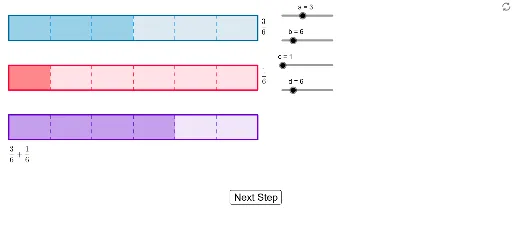
This example demonstrates the geometric representation and calculation process of fraction addition. It involves core mathematical concepts such as fraction operations, Least Common Multiple (LCM), Greatest Common Divisor (GCD), and sequence generation. GeoGebra commands like Point, Polygon, LCM, Sequence, GCD are used, creating objects like points, polygons, and sequences. Suitable for middle school and above students to understand the essence and geometric meaning of fraction addition.
GeoGebra Commands & Parameters
Point(Circle[A, 1]) → BPolygon(A, B, C, D) → poly1, a_1, b_1, c_1, d_1Point(Circle[E, 10]) → FPolygon(E, F, G, H) → poly2, e, f, g, hPolygon(I, J, K, L) → poly3, i, j, k, lPolygon(A, B, M, N) → poly4, a_2, b_2, m, nPolygon(H, E, O, P) → poly5, h_1, e_1, o, pPolygon(I, J, Q, R) → poly6, i_1, j_1, q, rLCM(b, d) → sSequence(Segment[(((10 * i)) / b, 0), (((10 * i)) / b, 1)], i, 1, b - 1) → list1Sequence(Segment[(((10 * i)) / d, -1), (((10 * i)) / d, -2)], i, 1, d - 1) → list2GCD(g_1, s) → l_1Polygon(K, L, T, S) → poly7, k_2, l_2, t_1, s_1Sequence(Segment[(((10 * i)) / s, -3), (((10 * i)) / s, -4)], i, 1, s) → list3Sequence(Segment[(((10 * i)) / n_1, -3), (((10 * i)) / n_1, -4)], i, 1, n_1 - 1) → list4Sequence(Segment[(((10 * i)) / s, -3), (((10 * i)) / s, -4)], i, 1, (2 * s)) → list3_1Sequence(Segment[((10 * i / n_1), -3), ((10 * i / n_1), -4)], i, 1, (2 * n_1) - 1) → list4_1Sequence(((10 * i / s), -3), i, 1, s) → list5_2Sequence(((10 * i / n_1), -3), i, 1, n_1) → list5_1Sequence(((10 * i / n_1), -4), i, 1, n_1) → list6_1Sequence(((10 * i / s), -4), i, 1, s) → list6_2Sequence(((10 * i / s), -3), i, 1, (2 * s) - 1) → list5_4Sequence(((10 * i / n_1), -3), i, 1, (2 * n_1) - 1) → list5_3Sequence(((10 * i / n_1), -4), i, 1, (2 * n_1) - 1) → list6_3Sequence(((10 * i / s), -4), i, 1, (2 * s) - 1) → list6_4Sequence(Segment[list5(i), list6(i)], i, 1, s - n_1) → list7Sequence(Segment[list5_5(i), list6_5(i)], i, 1, (2 * s) - (2 * n_1)) → list7_1
AI Drawing Prompt Reference
This is a geometric representation of fraction addition. The figure consists of points, line segments, and shapes. First, draw some points, then connect them to form line segments. Next, create rectangles and triangles to represent different fraction parts. By calculating the lengths of these shapes, you can obtain the result of fraction addition. The line segments and shapes are connected to form a whole, illustrating the process and meaning of fraction addition.
The prompt above was compiled from the original drawing commands and is for reference only.