
Fraction Addition by Ian Cantley (2)
Loading the math board and drawing, please wait…
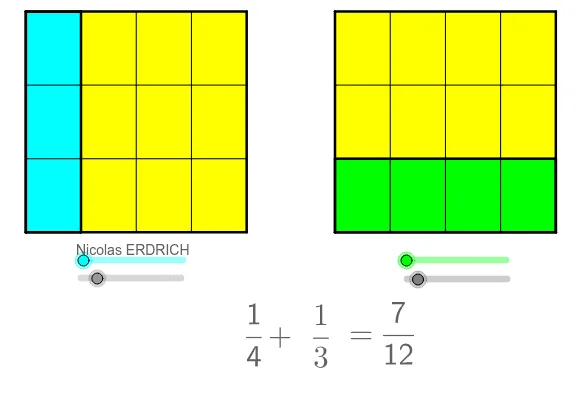
This example demonstrates the geometric representation of fraction addition, visually showing the process of adding fractions through shapes; Core math concepts include fraction operations, circles, incircles, complex numbers, and coordinate geometry; Construction highlights use of GeoGebra commands/objects like Line, Circle, Intersect, OrthogonalLine, Polygon, Sequence, GCD, Vector, Translate, If, and Text; Suitable for high school mathematics teaching, helping students understand the geometric meaning of fraction addition and complex number operations.
GeoGebra Commands & Parameters
Line(A, xAxis) → a_2Circle(A, 5) → c_2Intersect(c_2, a_2) → B_1, BCircle(B, 2) → d_3Intersect(d_3, a_2, 2) → ECircle(E, 5) → eIntersect(e, a_2, 2) → FCircle(F, 2) → fIntersect(f, a_2, 2) → ICircle(I, 5) → gIntersect(g, a_2, 2) → JOrthogonalLine(A, xAxis) → b_1Intersect(c_2, b_1, 2) → DOrthogonalLine(J, a_2) → hOrthogonalLine(D, b_1) → iIntersect(h, i) → KOrthogonalLine(B, i) → jOrthogonalLine(E, i) → kOrthogonalLine(F, i) → lOrthogonalLine(I, i) → mIntersect(i, j) → CIntersect(l, i) → GIntersect(m, i) → LIntersect(k, i) → HPolygon(A, D, C, B) → poly1, a_1, h_1, j_1, c_1Polygon(E, F, G, H) → poly2, d_1, e_1, k_1, m_1Sequence(A + k * (B - A) / b, k, 0, b) → liste1Sequence(D + k * (C - D) / b, k, 0, b) → liste2Sequence(Segment[Element[liste1, k], Element[liste2, k]], k, 0, b) → liste3Polygon(A, Element[liste1, a + 1], Element[liste2, a + 1], D) → poly4, a_3, n, p, d_2Sequence(E + (H - E) * k / d, k, 0, d) → liste4Sequence(F + (G - F) * k / d, k, 0, d) → liste5Sequence(Segment[Element[liste4, k], Element[liste5, k]], k, 0, d) → liste6Polygon(E, Element[liste4, c + 1], Element[liste5, c + 1], F) → poly5, e_2, q, r, f_2Sequence(I + (J - I) * k / b, k, 0, b) → liste7Sequence(L + (K - L) * k / b, k, 0, b) → liste8Sequence(I + (L - I) * k / d, k, 0, d) → liste9Sequence(J + (K - J) * k / d, k, 0, d) → liste10Sequence(A + (D - A) * k / d, k, 0, d) → liste13Sequence(B + (C - B) * k / d, k, 0, d) → liste14Sequence(Segment[Element[liste13, k], Element[liste14, k]], k, 0, d) → liste15Sequence(E + (F - E) * k / b, k, 0, b) → liste16Sequence(H + (G - H) * k / b, k, 0, b) → liste17Sequence(Segment[Element[liste16, k], Element[liste17, k]], k, 0, b) → liste18GCD(val1, val2) → val3Polygon(I, J, K, L) → poly3, i_1, j_2, k_2, l_1Vector(E, I) → uTranslate(liste6, u) → liste6'Translate(liste18, u) → liste18'Vector(A, I) → vTranslate(I, v) → I'Translate(J, v) → J'Translate(K, v) → K'Translate(L, v) → L'If(floor(val1 / val2) ≟ val1 / val2, val1 / val2, false) → val5Text("=" + val5) → texte3
AI Drawing Prompt Reference
Draw a figure with two concentric circles, where the larger circle has a radius of 5 and the smaller circle has a radius of 2. Use the intersection points of these circles with the x-axis to construct a series of squares and rectangles, each square with a side length of 2 and each rectangle with a length-to-width ratio of 1:2. Finally, use the vertices of these squares and rectangles to construct a complex polygon, illustrating the geometric meaning of fraction addition.
The prompt above was compiled from the original drawing commands and is for reference only.