
Fehr Problem 11: Complex Intersection of Disjoint Circles
Loading the math board and drawing, please wait…
In collections
Phantom Graphs
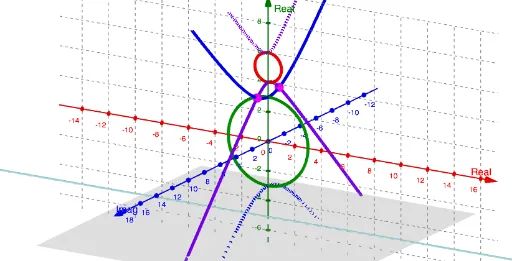
①This example demonstrates how to explore the intersection of two disjoint circles using complex numbers in GeoGebra, visualizing the geometric relationships on the complex plane via parametric curves. ②Core mathematical concepts include complex number representation, circle equations, intersection solving, ratios, geometric mean, secant lines, and hypothesis testing as a mathematical reasoning tool. ③Construction details: Based on the summary, the example uses the CurveCartesian command to create curves (c, g, etc.), defines points A and B, and includes multiple text objects (text1–text5) likely for labeling coordinates or ratio values; parametric equations are employed to depict circles or related loci, integrating complex arithmetic to handle the 'imaginary' intersections of non-overlapping circles. ④This is suitable for high school to undergraduate mathematics, particularly for analytic geometry, complex numbers, and geometric problem-solving, and can be used in classrooms or competitions to illustrate the power of complex methods in geometric constructions.
GeoGebra Commands & Parameters
CurveCartesian(0, (3 * cosh(t)), (3 * sinh(t)), t, -25, 25) → bCurveCartesian(0, (-3 * cosh(t)), (3 * sinh(t)), t, -25, 25) → fCurveCartesian(0, 5 + cosh(t), sinh(t), t, -25, 25) → hCurveCartesian(0, 5 - cosh(t), sinh(t), t, -25, 25) → i