
Flatland Geometry Demo
Loading the math board and drawing, please wait…
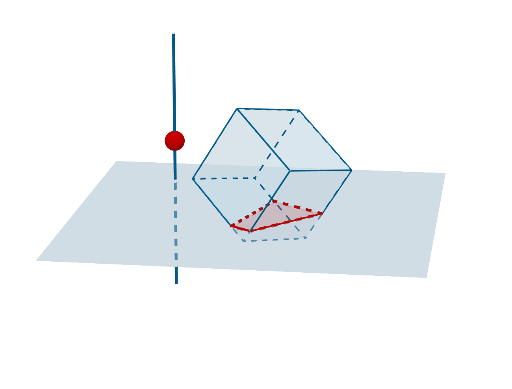
This example demonstrates the interaction between polygons, lines, and points in plane geometry. It involves core math concepts like linear functions, trigonometric functions, coordinate geometry, and geometric transformations. Construction highlights the use of GeoGebra commands and objects such as Line, Point, Polygon, Translate, Plane, Cube, and IntersectPath. Suitable for high school mathematics teaching and geometric construction learning.
GeoGebra Commands & Parameters
Line((-1.5, -1.5, 0), (-1.5, -1.5, 1)) → ePoint(e) → APolygon(G, H, I, J) → poly1, g, h, i, jTranslate(D1, Vector[(0, 0, z(A))]) → E1Translate(D2, Vector[(0, 0, z(A))]) → E2Translate(D3, Vector[(0, 0, z(A))]) → E3Plane(E1, E2, E3) → lCube(E1, E2, l) → m, B, faceBE2EF, faceBCKF, faceDEFK, edgeCE1, edgeE1E2, edgeBE2, edgeBC, edgeDE1, edgeCK, edgeDK, C, edgeDE, edgeEE2, edgeEF, edgeBF, edgeFK, D, E, F, K, faceBCE1E2, faceCE1DK, faceDEE2E1Translate(D4, Vector[(0, 0, z(A))]) → E4Translate(D5, Vector[(0, 0, z(A))]) → E5Translate(D6, Vector[(0, 0, z(A))]) → E6Translate(D7, Vector[(0, 0, z(A))]) → E7Translate(D8, Vector[(0, 0, z(A))]) → E8IntersectPath(f, m) → poly2, L, q, r, s, M, N, O, P, Q, k, n, p