
Flag Perimeter and Area Dynamic Demo
Loading the math board and drawing, please wait…
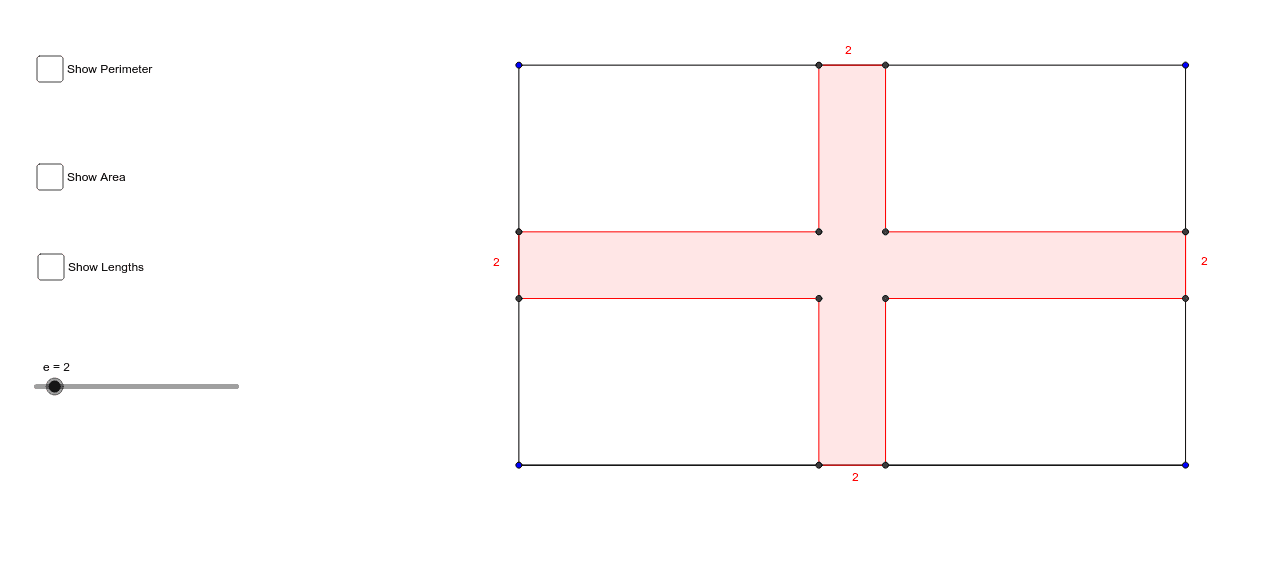
① This example demonstrates the construction of a flag‑shaped figure and the real‑time computation of its perimeter and area. ② Core mathematical concepts include perimeter, area, integral calculus, 2D vectors, intersection solving, quadratic equations, and dilation transformations. ③ Construction highlights: the GeoGebra commands Segment, Point, Circle, Intersect, OrthogonalLine, Polygon, and PointIn are employed together with a large set of point objects (A, B, C, D, E, F, G, H, I, J, K, L, M, N, O, P, Q, R, S, T, U, V, W, Z, A_1, B_1, C_1, D_1, etc.) to build the flag outline and mark the interior region. ④ Suitable for high‑school geometry, calculus, and vector courses, as well as university‑level geometric modeling and dynamic illustration.
GeoGebra Commands & Parameters
Segment(A, B) → aSegment(A, C) → bSegment(C, D) → cSegment(D, B) → dPoint(b) → ECircle(E, e / 2) → fPoint(d) → FCircle(F, e / 2) → gPoint(a) → GCircle(G, e / 2) → hPoint(c) → HCircle(H, e / 2) → kIntersect(f, b) → I, JIntersect(h, a) → K, LIntersect(d, xAxis) → MIntersect(d, xAxis) → NIntersect(d, xAxis) → OIntersect(d, xAxis) → PIntersect(d, xAxis) → QIntersect(d, xAxis) → RIntersect(d, xAxis) → SIntersect(k, c) → T, UIntersect(d, xAxis) → VIntersect(d, xAxis) → WIntersect(d, xAxis) → ZIntersect(d, xAxis) → A_1Segment(B, D) → iIntersect(d, i) → B_1Intersect(d, i) → C_1Intersect(d, i) → D_1OrthogonalLine(I, b) → jOrthogonalLine(J, b) → lIntersect(j, d) → E_1Intersect(l, d) → F_1Segment(I, E_1) → mSegment(J, F_1) → nIntersect(b, n) → G_1Segment(K, T) → pSegment(U, L) → qIntersect(p, m) → H_1Intersect(q, m) → I_1Intersect(p, n) → J_1Intersect(q, n) → K_1Intersect(a, p) → L_1Polygon(I, H_1, J_1, G_1, L_1, L, I_1, E_1, F_1, K_1, U, T) → poly1, i_1, t, j_1, g_1, h_1, l_1, l_2, i_2, e_1, f_1, k_1, uPointIn(poly1) → Pointpoly1Segment(I, G_1) → rSegment(L_1, H_1) → a_1Segment(I, H_1) → b_1Segment(L_1, L) → c_1Intersect(a_1, b_1) → N_1Segment(L_1, N_1) → q_1Segment(L, I_1) → r_1Segment(I_1, E_1) → s_1Segment(K_1, U) → t_1Segment(G_1, J_1) → a_2Segment(I, N_1) → b_2Segment(K_1, F_1) → c_2Segment(J_1, T) → d_2