
Find Angles Using Trigonometry
Loading the math board and drawing, please wait…
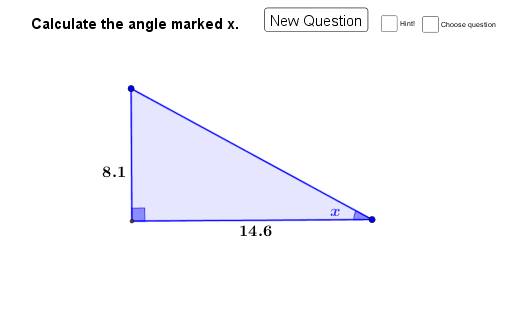
This example demonstrates how to find angles using trigonometry. It covers core math concepts such as trigonometric functions and angle calculations. GeoGebra commands used include Random, Line, OrthogonalLine, Segment, Intersect, Polygon, Angle, Midpoint, Length, If, etc. Suitable for high school math education and learning.
GeoGebra Commands & Parameters
Random(1, 4) → randnLine(A, B) → fOrthogonalLine(C, f) → gSegment(C, B) → hIntersect(f, g) → DPolygon(C, D, B) → poly1, b, c, dAngle(D, C, B) → αAngle(C, B, D) → βAngle(B, D, C) → γRandom(1, 6) → questionrandMidpoint(C, B) → EMidpoint(B, D) → FMidpoint(D, C) → GLength(Segment[C, D]) → SegbLength(Segment[D, B]) → SegcLength(Segment[B, C]) → SegdLine(A_1, B_1) → f_1OrthogonalLine(C_1, f_1) → g_1Segment(C_1, B_1) → h_1Intersect(f_1, g_1) → D_1Polygon(C_1, D_1, B_1) → poly1_1, b_1, c_1, d_1Angle(D_1, C_1, B_1) → α_1Angle(C_1, B_1, D_1) → β_1Angle(B_1, D_1, C_1) → γ_1Midpoint(C_1, B_1) → E_1Midpoint(B_1, D_1) → F_1Midpoint(D_1, C_1) → G_1Line(A_2, B_2) → f_2OrthogonalLine(C_2, f_2) → g_2Segment(C_2, B_2) → h_2Intersect(f_2, g_2) → D_2Polygon(C_2, D_2, B_2) → poly1_2, b_2, c_2, d_2Angle(D_2, C_2, B_2) → α_2Angle(C_2, B_2, D_2) → β_2Angle(B_2, D_2, C_2) → γ_2Midpoint(C_2, B_2) → E_2Midpoint(B_2, D_2) → F_2Midpoint(D_2, C_2) → G_2If(j ≟ 1 ∨ j ≟ 2, "CAH", If[j ≟ 3 ∨ j ≟ 4, "SOH", If[j ≟ 5 ∨ j ≟ 6, "TOA", "ANSWERS"]]) → captionSliderLine(A_5, B_5) → f_5OrthogonalLine(C_5, f_5) → g_5Segment(C_5, B_5) → h_3Intersect(f_5, g_5) → D_5Polygon(C_5, D_5, B_5) → poly1_4, b_4, c_4, d_4Angle(D_5, C_5, B_5) → α_3Angle(C_5, B_5, D_5) → β_4Angle(B_5, D_5, C_5) → γ_3Midpoint(C_5, B_5) → E_3Midpoint(B_5, D_5) → F_3Midpoint(D_5, C_5) → G_3Line(A_4, B_4) → f_4OrthogonalLine(C_4, f_4) → g_4Segment(C_4, B_4) → h_4Intersect(f_4, g_4) → D_4Polygon(C_4, D_4, B_4) → poly1_5, b_5, c_5, d_5Angle(D_4, C_4, B_4) → α_4Angle(C_4, B_4, D_4) → β_3Angle(B_4, D_4, C_4) → γ_4Midpoint(C_4, B_4) → E_4Midpoint(B_4, D_4) → F_4Midpoint(D_4, C_4) → G_4Line(A_8, B_8) → f_8OrthogonalLine(C_8, f_8) → g_8Segment(C_8, B_8) → h_6Intersect(f_8, g_8) → D_8Polygon(C_8, D_8, B_8) → poly1_7, b_7, c_7, d_7Angle(D_8, C_8, B_8) → α_6Angle(C_8, B_8, D_8) → β_7Angle(B_8, D_8, C_8) → γ_6Midpoint(C_8, B_8) → E_6Midpoint(B_8, D_8) → F_6Midpoint(D_8, C_8) → G_6Line(A_7, B_7) → f_7OrthogonalLine(C_7, f_7) → g_7Segment(C_7, B_7) → h_7Intersect(f_7, g_7) → D_7Polygon(C_7, D_7, B_7) → poly1_8, b_8, c_8, d_8Angle(D_7, C_7, B_7) → α_7Angle(C_7, B_7, D_7) → β_6Angle(B_7, D_7, C_7) → γ_7Midpoint(C_7, B_7) → E_7Midpoint(B_7, D_7) → F_7Midpoint(D_7, C_7) → G_7Line(A_{11}, B_{11}) → f_{11}OrthogonalLine(C_{11}, f_{11}) → g_{11}Segment(C_{11}, B_{11}) → h_9Intersect(f_{11}, g_{11}) → D_{11}Polygon(C_{11}, D_{11}, B_{11}) → poly1_{10}, b_{10}, c_{10}, d_{10}Angle(D_{11}, C_{11}, B_{11}) → α_9Angle(C_{11}, B_{11}, D_{11}) → β_{10}Angle(B_{11}, D_{11}, C_{11}) → γ_9Midpoint(C_{11}, B_{11}) → E_9Midpoint(B_{11}, D_{11}) → F_9Midpoint(D_{11}, C_{11}) → G_9Line(A_{10}, B_{10}) → f_{10}OrthogonalLine(C_{10}, f_{10}) → g_{10}Segment(C_{10}, B_{10}) → h_{10}Intersect(f_{10}, g_{10}) → D_{10}Polygon(C_{10}, D_{10}, B_{10}) → poly1_{11}, b_{11}, c_{11}, d_{11}Angle(D_{10}, C_{10}, B_{10}) → α_{10}Angle(C_{10}, B_{10}, D_{10}) → β_9Angle(B_{10}, D_{10}, C_{10}) → γ_{10}Midpoint(C_{10}, B_{10}) → E_{10}Midpoint(B_{10}, D_{10}) → F_{10}Midpoint(D_{10}, C_{10}) → G_{10}