
Feynman Path Reflection Demo
Loading the math board and drawing, please wait…
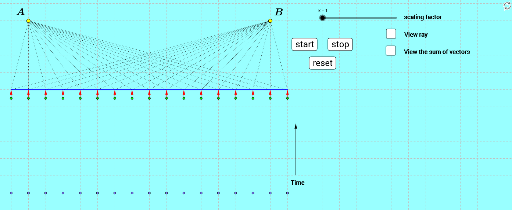
This example demonstrates the multi-path characteristics of Feynman paths in geometric reflection. It involves core mathematical concepts like reflection, statistical characteristics, multiplication, real numbers, volume, and set theory. The construction utilizes commands and objects such as Point, Intersect, PointIn, Segment, Mirror, Midpoint, Circle, Vector, OrthogonalLine from GeoGebra. Suitable for high school and above students to understand complex geometric transformations and applications in probability & statistics.
GeoGebra Commands & Parameters
Point(xAxis) → FPoint(xAxis) → GPoint(xAxis) → HPoint(xAxis) → IPoint(xAxis) → JPoint(xAxis) → KPoint(xAxis) → LPoint(xAxis) → MIntersect(xAxis, yAxis) → NPoint(xAxis) → OPoint(xAxis) → PPoint(xAxis) → QPoint(xAxis) → RPoint(xAxis) → SPoint(xAxis) → TPoint(xAxis) → UPoint(xAxis) → VPointIn(y ≥ 0) → DSegment(D, F) → aPointIn(y ≥ 0) → ESegment(F, E) → bSegment(D, G) → dSegment(G, E) → eSegment(D, H) → fSegment(H, E) → gPoint(a) → WPoint(b) → ZMirror(A_1, yAxis) → B_1Midpoint(A_1, B_1) → C_1Midpoint(A_1, C_1) → D_1Midpoint(C_1, B_1) → E_1Midpoint(B_1, E_1) → F_1Midpoint(E_1, C_1) → G_1Midpoint(C_1, D_1) → H_1Midpoint(D_1, A_1) → I_1Midpoint(A_1, I_1) → J_1Midpoint(I_1, D_1) → K_1Midpoint(D_1, H_1) → L_1Midpoint(H_1, C_1) → M_1Midpoint(C_1, G_1) → N_1Midpoint(G_1, E_1) → O_1Midpoint(E_1, F_1) → P_1Midpoint(F_1, B_1) → Q_1Circle(A_1, 0.5) → hCircle(J_1, 0.5) → k_3Circle(I_1, 0.5) → pCircle(K_1, 0.5) → qCircle(D_1, 0.5) → rPoint(h) → R_1Point(k_3) → S_1Point(p) → T_1Point(q) → U_1Point(r) → V_1Vector(A_1, R_1) → vVector(J_1, S_1) → wVector(I_1, T_1) → iVector(K_1, U_1) → jVector(D_1, V_1) → lPoint(e) → W_1Point(g) → Z_1Point(d) → A_2Point(f) → B_2Circle(L_1, 0.5) → sCircle(H_1, 0.5) → tCircle(M_1, 0.5) → c_1Circle(C_1, 0.5) → d_1Circle(N_1, 0.5) → e_1Circle(G_1, 0.5) → f_1Circle(O_1, 0.5) → g_1Circle(E_1, 0.5) → h_1Circle(P_1, 0.5) → k_1Circle(F_1, 0.5) → p_1Circle(Q_1, 0.5) → q_1Circle(B_1, 0.5) → r_1Point(s) → C_2Point(t) → D_2Point(c_1) → E_2Point(d_1) → F_2Point(e_1) → G_2Point(f_1) → H_2Point(g_1) → I_2Point(h_1) → J_2Point(k_1) → K_2Point(q_1) → M_2Point(r_1) → N_2Point(p_1) → L_2Segment(D, I) → mSegment(I, E) → nPoint(m) → O_2Point(n) → P_2Segment(D, J) → a_1Segment(J, E) → b_1Segment(D, K) → i_1Segment(K, E) → j_1Segment(D, L) → l_1Segment(L, E) → m_1Segment(D, M) → n_1Segment(M, E) → s_1Segment(D, N) → t_1Segment(N, E) → a_2Segment(D, O) → b_2Segment(O, E) → c_2Segment(D, P) → d_2Segment(P, E) → e_2Segment(D, Q) → f_2Segment(Q, E) → g_2Segment(D, R) → h_2Segment(R, E) → i_2Segment(D, S) → j_2Segment(S, E) → k_2Segment(D, T) → l_2Segment(T, E) → m_2Segment(D, U) → n_2Segment(U, E) → p_2Segment(D, V) → q_2Segment(V, E) → r_2Point(a_1) → Q_2Point(b_1) → R_2Point(i_1) → S_2Point(j_1) → T_2Point(l_1) → U_2Point(m_1) → V_2Point(n_1) → W_2Point(s_1) → Z_2Point(t_1) → A_3Point(a_2) → B_3Point(b_2) → C_3Point(c_2) → D_3Point(d_2) → E_3Point(e_2) → F_3Point(f_2) → G_3Point(g_2) → H_3Point(h_2) → I_3Point(i_2) → J_3Point(j_2) → K_3Point(k_2) → L_3Point(l_2) → M_3Point(m_2) → N_3Point(n_2) → O_3Point(p_2) → P_3Point(q_2) → Q_3Point(r_2) → R_3Vector(L_1, C_2) → u_1Vector(H_1, D_2) → v_1Vector(M_1, E_2) → w_1Vector(C_1, F_2) → u_2Vector(N_1, G_2) → v_2Vector(G_1, H_2) → w_2Vector(O_1, I_2) → s_2Vector(E_1, J_2) → t_2Vector(F_1, L_2) → u_3Vector(Q_1, M_2) → v_3Vector(B_1, N_2) → w_3Vector(P_1, K_2) → a_3Mirror(E, xAxis) → E'Segment(D, E') → cIntersect(c, xAxis) → ASegment(D, A) → b_3Segment(A, E) → c_3OrthogonalLine(A, xAxis) → d_3Circle(A, 6) → e_3Intersect(e_3, d_3) → C, T_3Segment(T_3, C) → f_3OrthogonalLine(A_1, xAxis) → g_3OrthogonalLine(J_1, xAxis) → h_3OrthogonalLine(I_1, xAxis) → i_3OrthogonalLine(K_1, xAxis) → j_3OrthogonalLine(D_1, xAxis) → l_3Point(yAxis) → S_3OrthogonalLine(S_3, yAxis) → m_3Point(yAxis) → U_3OrthogonalLine(U_3, yAxis) → n_3Intersect(m_3, l_3) → V_3Intersect(m_3, j_3) → W_3Intersect(m_3, i_3) → Z_3Intersect(m_3, h_3) → A_4Intersect(m_3, g_3) → B_4Intersect(n_3, l_3) → C_4Intersect(n_3, j_3) → D_4Intersect(n_3, i_3) → E_4Intersect(n_3, h_3) → F_4Intersect(n_3, g_3) → G_4Segment(G_4, B_4) → p_3Segment(F_4, A_4) → q_3Segment(E_4, Z_3) → r_3Segment(D_4, W_3) → s_3Segment(C_4, V_3) → t_3Point(p_3) → H_4Point(q_3) → I_4Point(r_3) → J_4Point(s_3) → K_4Point(t_3) → L_4Mirror(D_4, t_3) → M_4Mirror(W_3, t_3) → N_4Segment(M_4, N_4) → a_4Mirror(C_4, a_4) → O_4Mirror(V_3, a_4) → P_4Segment(O_4, P_4) → b_4Mirror(M_4, b_4) → Q_4Mirror(N_4, b_4) → R_4Segment(Q_4, R_4) → c_4Mirror(O_4, c_4) → S_4Mirror(P_4, c_4) → T_4Segment(S_4, T_4) → d_4Mirror(Q_4, d_4) → U_4Mirror(R_4, d_4) → V_4Segment(U_4, V_4) → e_4Mirror(S_4, e_4) → W_4Mirror(T_4, e_4) → Z_4Segment(W_4, Z_4) → f_4Mirror(U_4, f_4) → A_5Mirror(V_4, f_4) → B_5Segment(A_5, B_5) → g_4Mirror(W_4, g_4) → C_5Mirror(Z_4, g_4) → D_5Segment(C_5, D_5) → h_4Mirror(A_5, h_4) → E_5Mirror(B_5, h_4) → F_5Segment(E_5, F_5) → i_4Mirror(C_5, i_4) → G_5Mirror(D_5, i_4) → H_5Segment(G_5, H_5) → j_4Mirror(E_5, j_4) → I_5Mirror(F_5, j_4) → J_5Segment(I_5, J_5) → k_4Mirror(G_5, k_4) → K_5Mirror(H_5, k_4) → L_5Segment(K_5, L_5) → l_4Point(a_4) → M_5Point(b_4) → N_5Point(c_4) → O_5Point(d_4) → P_5Point(e_4) → Q_5Point(f_4) → R_5Point(g_4) → S_5Point(h_4) → T_5Point(i_4) → U_5Point(j_4) → V_5Point(k_4) → W_5Point(l_4) → Z_5Vector(A_6, B_6) → uVector(B_6, C_6) → u_4Vector(C_6, D_6) → v_4Vector(D_6, E_6) → w_4Vector(E_6, F_6) → m_4Vector(F_6, G_6) → n_4Vector(G_6, H_6) → p_4Vector(H_6, I_6) → q_4Vector(I_6, J_6) → r_4Vector(J_6, K_6) → s_4Vector(K_6, L_6) → t_4Vector(L_6, M_6) → u_5Vector(M_6, N_6) → v_5Vector(N_6, O_6) → w_5Vector(O_6, P_6) → a_5Vector(P_6, Q_6) → b_5Vector(Q_6, R_6) → c_5Segment(F, V) → d_5Vector(S_6, T_6) → e_5
AI Drawing Prompt Reference
Create multiple points on the horizontal axis and select one on the non-negative half-axis. Connect this point to two adjacent points on the axis to form line segments. Mirror each segment and calculate midpoints, midpoints of midpoints, etc., to form a series of points. Draw circles centered at one point with radii of 0.5 and centered at other midpoints. Finally, connect specific points to form paths, demonstrating multi-path characteristics through geometric reflections.
The prompt above was compiled from the original drawing commands and is for reference only.