
Ferris Wheel Problem
Loading the math board and drawing, please wait…
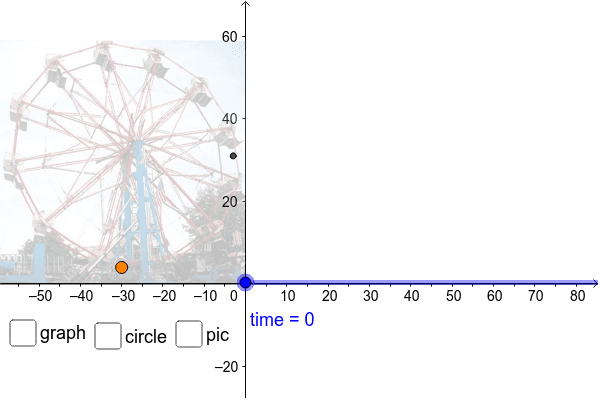
This example dynamically demonstrates the motion of a Ferris wheel to visually illustrate the application of trigonometric functions in real life. It involves core math concepts like trigonometric functions, periodicity, and geometric transformations. Construction highlights include commands like Function, Circle, Intersect, Point, Line, Rotate, Angle, Segment from GeoGebra. Suitable for high school mathematics teaching to help students understand the correlation between trigonometric graphs and real-world motion, enhancing mathematical modeling skills.
GeoGebra Commands & Parameters
Function((a * sin((b * x) + c)) + d, 0, 150) → fCircle(A, a) → eIntersect(xAxis, yAxis) → BPoint(xAxis) → CLine(B, C) → gLine(A, g) → hIntersect(e, h, 2) → DRotate(D, (b * time) + c, A) → D'Angle(D, A, D') → αSegment(A, D') → iSegment(D', YOU) → j
AI Drawing Prompt Reference
Draw a dynamic Ferris wheel showing its motion path and represent its height change with a sine function graph. Draw a line from the wheel's center to the ground, then a perpendicular line from a ground point to meet it, finding the contact point. Rotate this point over time, connect the center to the rotating point, and link the rotating point to an observer's position.
The prompt above was compiled from the original drawing commands and is for reference only.