
Ferris Wheel Model
Loading the math board and drawing, please wait…
In collections
Math Year 4 Unit 1
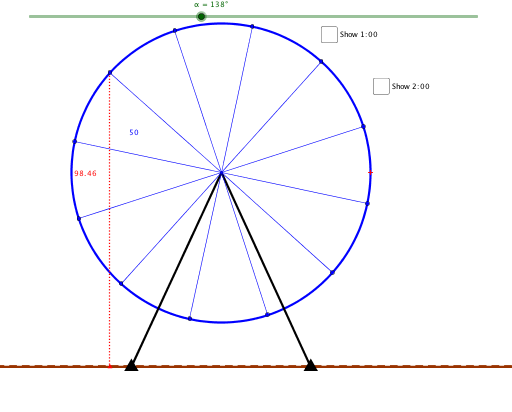
This example dynamically demonstrates the motion of a Ferris wheel, illustrating the relationship between angles, sine functions, and exponential functions. Core mathematical concepts include angle measurement, trigonometric function applications, properties of isosceles and equilateral triangles, and exponentiation. Construction highlights the use of GeoGebra commands such as Circle, Segment, Rotate, Angle, Line, OrthogonalLine, Intersect, and Distance. Suitable for high school mathematics education, exploring the integration of function models and geometric transformations.
GeoGebra Commands & Parameters
Circle(C, 50) → cSegment(C, G1) → aSegment(C, G2) → bRotate(Zero, α, C) → Zero'Angle(Zero, C, Zero') → βSegment(C, Zero') → dRotate(Zero, 30° + α, C) → Zero'_1Angle(Zero, C, Zero'_1) → γSegment(C, Zero'_1) → eRotate(Zero, 60° + α, C) → Zero'_2Angle(Zero, C, Zero'_2) → δSegment(C, Zero'_2) → fRotate(Zero, 90° + α, C) → Zero'_3Angle(Zero, C, Zero'_3) → εSegment(Zero'_3, C) → gRotate(Zero, 120° + α, C) → Zero'_4Angle(Zero, C, Zero'_4) → ζSegment(Zero'_4, C) → hRotate(Zero, 150° + α, C) → Zero'_5Angle(Zero, C, Zero'_5) → ηSegment(Zero'_5, C) → iRotate(Zero, 180° + α, C) → Zero'_6Angle(Zero, C, Zero'_6) → θSegment(Zero'_6, C) → jRotate(Zero, 210° + α, C) → Zero'_7Angle(Zero, C, Zero'_7) → ιSegment(Zero'_7, C) → kRotate(Zero, 240° + α, C) → Zero'_8Angle(Zero, C, Zero'_8) → κSegment(Zero'_8, C) → lRotate(Zero, 270° + α, C) → Zero'_9Angle(Zero, C, Zero'_9) → λSegment(Zero'_9, C) → mRotate(Zero, 300° + α, C) → Zero'_{10}Angle(Zero, C, Zero'_{10}) → μSegment(Zero'_{10}, C) → nRotate(Zero, 330° + α, C) → Zero'_{11}Angle(Zero, C, Zero'_{11}) → νSegment(Zero'_{11}, C) → pLine(G1, G2) → qOrthogonalLine(Zero', q) → rIntersect(r, q) → ASegment(Zero', A) → sOrthogonalLine(Zero'_1, d) → tIntersect(d, t) → BSegment(Zero'_1, B) → a_1Angle(Zero'_1, B, C) → ξAngle(B, C, Zero'_1) → οOrthogonalLine(Zero'_2, d) → b_1Intersect(b_1, d) → DSegment(Zero'_2, D) → c_1Distance(D, C) → distanceDCAngle(D, C, Zero'_2) → ρAngle(Zero'_2, D, C) → σ