
Fermat Point of a Triangle
Loading the math board and drawing, please wait…
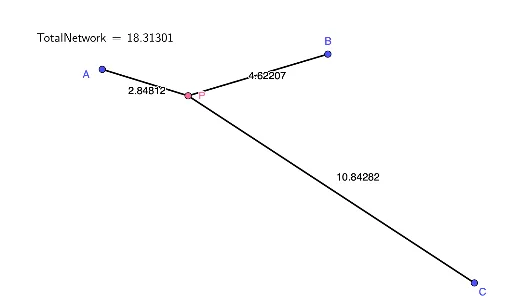
① This example demonstrates how to construct the Fermat point of a triangle, the point inside the triangle that minimizes the sum of distances to the three vertices. ② Core mathematical concepts include the definition of the Fermat point, its property as an equiangular point (when all angles are less than 120°, the Fermat point satisfies ∠AFB = ∠BFC = ∠CFA = 120°), and the geometric meaning of the shortest network (Steiner tree). ③ Construction details: Based on the construction summary, the example uses GeoGebra commands such as Segment and LaTeX, involving objects P, A, B, C, segments g and h, point E, function f, TotalNetwork, and text1. It likely constructs equilateral triangles or rotates segments to locate the Fermat point and computes the total network length. ④ Suitable for high school and above to explore geometric optimization, triangle properties, or mathematical modeling, and also useful for university geometry courses to visualize the Fermat point and Steiner problem.
GeoGebra Commands & Parameters
Segment(B, P) → gSegment(C, P) → hSegment(A, P) → fLaTeX(TotalNetwork, true, true) → text1
AI Drawing Prompt Reference
Draw a triangle ABC and find its Fermat point P such that the sum of distances from P to A, B, and C is minimized. Construct equilateral triangles and rotate segments to locate the Fermat point and compute the total network length.
The prompt above was compiled from the original drawing commands and is for reference only.