
Artificial Neural Network Example: Visualizing a Simple Perceptron
Loading the math board and drawing, please wait…
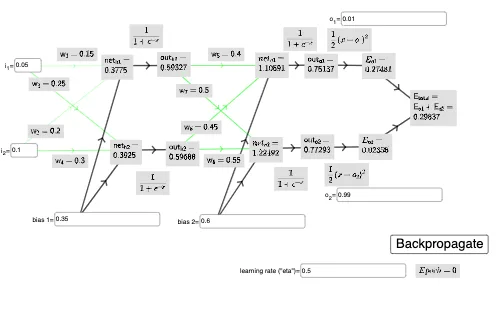
① This GeoGebra example demonstrates a simple artificial neural network with an input layer, a hidden layer, and an output layer, showing how weighted sums and activation functions produce outputs. ② Core mathematical concepts include linear functions, piecewise functions (e.g., step or sigmoid), logistic regression, weights and biases, and the basics of backpropagation. ③ Construction uses GeoGebra commands such as Segment, Point, and Textfield; objects include weights (w_1 to w_8), biases (b_1, b_2), net input (net_{h1}), and output (out_{h1}), allowing interactive adjustment of parameters to observe changes in the network's output. ④ Suitable for high school to university-level mathematics or computer science courses, this example serves as an intuitive teaching tool for understanding linear algebra, function composition, and parameter optimization in neural networks, and as an introductory AI visualization.
GeoGebra Commands & Parameters
Segment(A, C) → fSegment(A, D) → gSegment(B, C) → hSegment(B, D) → iSegment(G, C) → jSegment(G, D) → kSegment(S, E) → lSegment(R, F) → pSegment(H, E) → qSegment(H, F) → rPoint(g) → IPoint(h) → JPoint(f) → KSegment(S, F) → mPoint(m) → MPoint(l) → NPoint(p) → OSegment(R, E) → nPoint(n) → PPoint(i) → LTextfield(i_1) → InputBox1Textfield(i_2) → InputBox2Textfield(o_1) → InputBox3Textfield(o_2) → InputBox4Segment(C, R) → sSegment(D, S) → tPoint(s) → TPoint(t) → USegment(E, Q) → aSegment(F, V) → bPoint(a) → WPoint(b) → ZSegment(Q, A_1) → cSegment(V, B_1) → dPoint(c) → C_1Point(d) → D_1Segment(A_1, E_1) → eSegment(B_1, E_1) → f_1Textfield(b_2) → InputBox5Textfield(b_1) → InputBox6Textfield(eta) → InputBox7
AI Drawing Prompt Reference
Draw a simple neural network diagram with input, hidden, and output layers. Show the process of weighted sums and activation functions. Key objects include weights, biases, net input, and output. Allow interactive adjustment of parameters to observe output changes. Suitable for math or computer science teaching to understand linear algebra, function composition, and parameter optimization.
The prompt above was compiled from the original drawing commands and is for reference only.