
Fastest Descent with 5 Segments
Loading the math board and drawing, please wait…
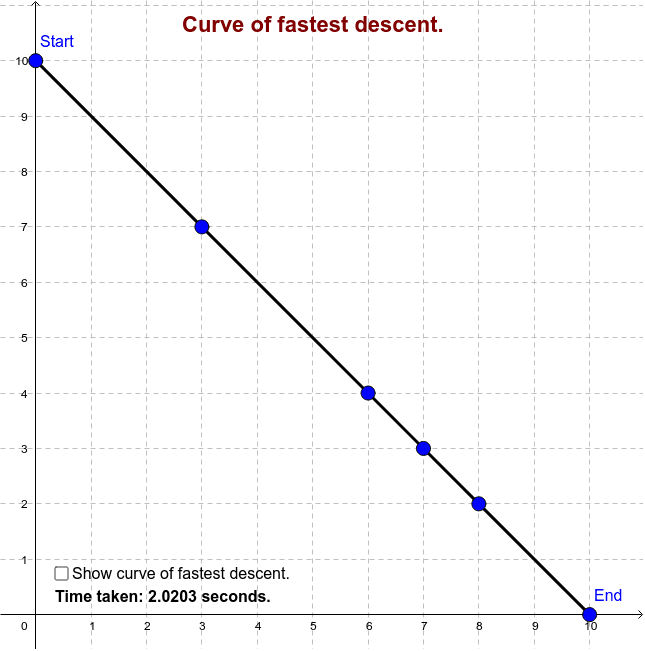
This example demonstrates the trajectory of an object undergoing the fastest descent with a path divided into five line segments. It involves core mathematical concepts such as coordinate geometry, vector operations, and optimization. The construction utilizes GeoGebra commands like Segment, Sum, and CurveCartesian, along with objects like n, P_0 to P_5, S_1 to S_5, v_0 to v_5, and t_1 to t_5. It is suitable for high school and above students studying kinematics, calculus optimization, and parametric equations.
GeoGebra Commands & Parameters
Segment(P_0, P_1) → S_1Segment(P_1, P_2) → S_2Segment(P_2, P_3) → S_3Segment(P_3, P_4) → S_4Segment(P_4, P_5) → S_5Sum({t_1, t_2, t_3, t_4, t_5}) → totaltimeCurveCartesian(5.73 * (theta - sin(theta)), 10 - 5.73 * (1 - cos(theta)), theta, 0, 2.41) → cycloid
AI Drawing Prompt Reference
Draw the trajectory of an object descending at the fastest speed, with its path divided into five line segments, showing the motion from the starting point to the endpoint. The trajectory consists of five consecutive line segments, forming a cycloid shape overall. The cycloid has a height of 10 and is described by the parametric equations x=5.73*(theta-sin(theta)) and y=10-5.73*(1-cos(theta)), with theta ranging from 0 to 2.41.
The prompt above was compiled from the original drawing commands and is for reference only.