
Composition of Two Dilations
Loading the math board and drawing, please wait…
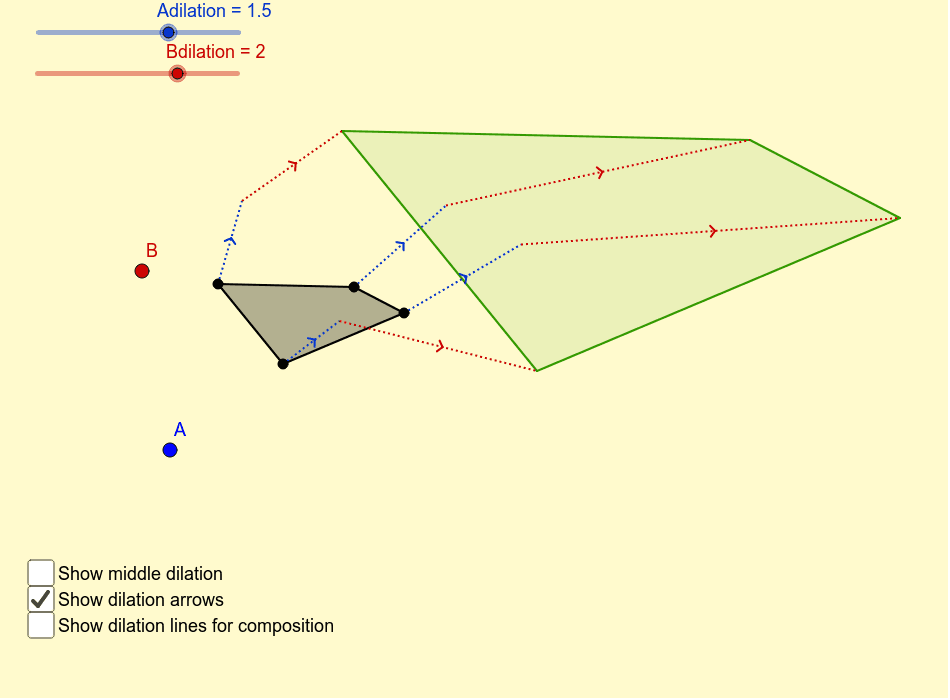
This example demonstrates the effect of combining two dilations, particularly when their centers are different. It involves core math concepts like dilation transformations, geometric transformations, similarity, and central symmetry. The construction uses GeoGebra commands such as Polygon, Dilate, Segment, Line, and Intersect. Suitable for high school students learning about geometric transformations and properties of shapes.
GeoGebra Commands & Parameters
Polygon(C, D, E, F) → poly1, c, d, e, fDilate(C, Adilation, A) → C'Dilate(D, Adilation, A) → D'Dilate(E, Adilation, A) → E'Dilate(F, Adilation, A) → F'Polygon(C', D', E', F') → poly1', c', d', e', f'Dilate(C', Bdilation, B) → C''Dilate(D', Bdilation, B) → D''Dilate(E', Bdilation, B) → E''Dilate(F', Bdilation, B) → F''Polygon(C'', D'', E'', F'') → poly1'', c'', d'', e'', f''Segment(F, F') → aSegment(E, E') → bSegment(D, D') → gSegment(C, C') → hSegment(F', F'') → iSegment(C', C'') → jSegment(D', D'') → kSegment(E', E'') → lLine(F'', F) → mLine(C'', C) → nLine(D'', D) → pLine(E'', E) → qIntersect(m, q) → G
AI Drawing Prompt Reference
Draw the composition of two dilations with different centers. First, dilate quadrilateral CDEF with center A to get C', D', E', and F'. Then, dilate C', D', E', and F' with center B to get C'', D'', E'', and F''. Next, draw segments FF', EE', DD', and CC'. Then, draw segments F'F'', C'C'', D'D'', and E'E''. Finally, draw lines F''F, C''C, D''D, and E''E, and their intersection is point G.
The prompt above was compiled from the original drawing commands and is for reference only.