
Falling Ladder: Dynamic Adjustment and Calculus Application
Loading the math board and drawing, please wait…
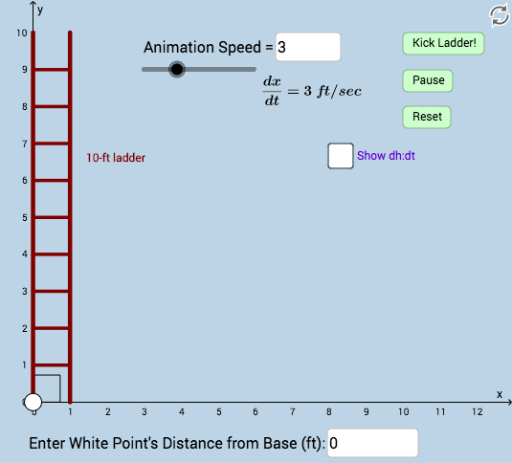
This example demonstrates the phenomenon of a ladder falling from a high point, showing changes in ladder length and support point positions. The core mathematical concepts involved include derivatives, rates of change, and similarity of triangles in geometry. Construction involves GeoGebra commands such as Circle, Intersect, Segment, Ray, Angle, etc., to create the ladder, support points, and dynamic adjustments. Suitable for high school students or college freshmen for learning calculus and geometric applications, as well as for mathematical modeling exercises.
GeoGebra Commands & Parameters
Circle(B, 10) → cIntersect(c, f, 1) → CSegment(B, C) → gRay(A, D) → hRay(A, E) → iCircle(B, 1) → dIntersect(d, i, 2) → FCircle(D, 1) → eIntersect(f, h) → GIntersect(f, h) → HIntersect(f, h) → IIntersect(e, f) → J, KRay(C, J) → jRay(B, F) → kSegment(A, B) → lSegment(A, C) → mAngle(E, A, D) → αPolygon(A, B, C) → poly1, c_1, a_1, bCircle(C, 1) → pIntersect(p, g, 1) → LCircle(L, 1) → qIntersect(q, g, 1) → MCircle(M, 1) → rIntersect(r, g, 1) → NCircle(N, 1) → sIntersect(s, g, 1) → OCircle(O, 1) → tIntersect(t, g, 1) → PCircle(P, 1) → d_1Intersect(d_1, g, 1) → QCircle(Q, 1) → e_1Intersect(e_1, g, 1) → RCircle(R, 1) → f_1Intersect(f_1, g, 1) → SCircle(S, 1) → g_1Intersect(g_1, g, 1) → TOrthogonalLine(L, g) → nOrthogonalLine(M, g) → h_1OrthogonalLine(N, g) → i_1OrthogonalLine(O, g) → j_1OrthogonalLine(P, g) → k_1OrthogonalLine(Q, g) → l_1OrthogonalLine(R, g) → m_1OrthogonalLine(S, g) → n_1OrthogonalLine(T, g) → p_1Intersect(q, n, 1) → UIntersect(r, h_1, 1) → VIntersect(s, i_1, 1) → WIntersect(t, j_1, 1) → ZIntersect(d_1, k_1, 1) → A_1Intersect(e_1, l_1, 1) → B_1Intersect(f_1, m_1, 1) → C_1Intersect(g_1, n_1, 1) → D_1Circle(T, 1) → q_1Intersect(q_1, p_1, 1) → E_1Vector(M, V) → uTranslate(B, u) → B'Translate(C, u) → C'Segment(B', C') → g'Segment(L, U) → r_1Segment(M, V) → s_1Segment(N, W) → t_1Segment(O, Z) → b_1Segment(P, A_1) → f_2Segment(Q, B_1) → g_2Segment(R, C_1) → h_2Segment(S, D_1) → i_2Segment(T, E_1) → j_2Distance(B, C) → distanceBCTextfield(a) → InputBox1Textfield(o) → InputBox2Distance(A, B) → distanceABDistance(A, C) → distanceACDistance(A, B) → vDistance(A, C) → w
AI Drawing Prompt Reference
Draw a falling ladder showing changes in its length and support point positions. Include a circle and intersection points to determine the ladder's position. Illustrate the ladder, support points, and dynamic adjustments, highlighting triangle similarity and angle relationships. Use sliders to demonstrate the changing process, suitable for calculus and geometry learning.
The prompt above was compiled from the original drawing commands and is for reference only.