
External Tangents to a Circle
Loading the math board and drawing, please wait…
In collections
Circles Properties and Angle Properties of Circles
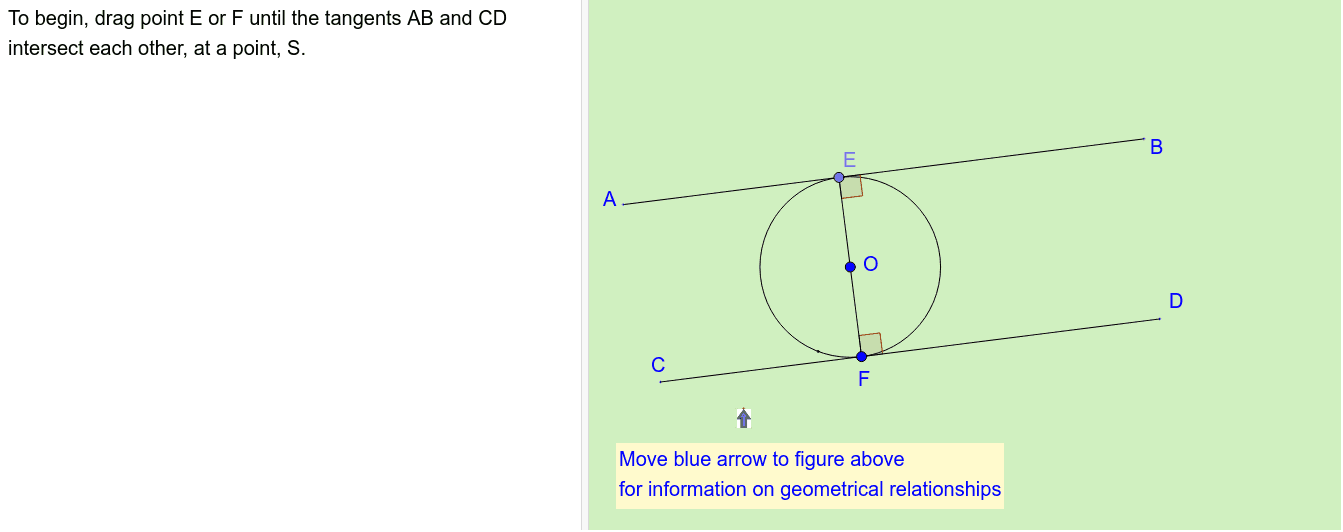
This example demonstrates how to construct external tangents to a circle and explore their geometric properties. It involves core math concepts like circles, tangents, angles, intersecting lines, and coordinate geometry. The construction uses GeoGebra commands and objects such as If, Circle, Point, Segment, Tangent, Intersect, Angle, rectangle2endpointsthin, rectanglefrom2endpoints, Polygon, IsInRegion, Element, and more. Suitable for high school students learning geometric constructions, circle properties, and analytical geometry.
GeoGebra Commands & Parameters
If(SelectedIndex[listAnsQ3] ≟ 4, true, false) → Qn3correctIf(SelectedIndex[listAnsQ1] ≟ 5, true, false) → Qn1correctIf(SelectedIndex[listAnsQ5] ≟ 5, true, false) → Qn5correctIf(SelectedIndex[listAnsQ2] ≟ 3, true, false) → Qn2correctIf(SelectedIndex[listAnsQ4] ≟ 5, true, false) → Qn4correctCircle(O, R) → cPoint(c) → FSegment(O, F) → eTangent(F, c) → b,Point(b) → DPoint(b) → CSegment(C, D) → gPoint(c) → ETangent(E, c) → a,Point(a) → BPoint(a) → ASegment(A, B) → hIntersect(g, h) → SSegment(O, S) → fCircle(O, (0.13 * Distance[O, S])) → c_1Intersect(c_1, e) → I,Intersect(c_1, f) → H,Segment(O, E) → dIntersect(c_1, d) → G,Segment(E, S) → mCircle(S, (0.25 * Distance[O, S])) → pIntersect(p, m) → L,Intersect(p, f) → J,Segment(F, S) → nIntersect(p, n) → K,Angle(O, E, B) → αAngle(O, F, D) → βrectangle2endpointsthin(E, L) → poly1rectangle2endpointsthin(F, K) → poly2rectangle2endpointsthin(O, J) → poly3rectanglefrom2endpoints(O, E) → poly4rectanglefrom2endpoints(O, F) → poly5Polygon(G, H, O) → poly6, t, a_1, b_1Polygon(H, I, O) → poly7, i, d_1, e_1Polygon(J, K, S) → poly8, j, k, qPolygon(J, L, S) → poly9, l, r, sIsInRegion(K_p, poly5) → touchOFIsInRegion(K_p, poly4) → touchOEElement(listFeedbackQ5, SelectedIndex[listAnsQ5]) → txtQ5FElement(listFeedbackQ2, SelectedIndex[listAnsQ2]) → txtQ2FSegment(O, S) → f_dAngle(S, O, E) → γSegment(O, F) → e_dSegment(O, E) → d_dAngle(F, O, S) → δAngle(O, S, F) → εAngle(E, S, O) → ζrectangle2endpointsthin1(C, D) → poly10LineCDrectangle2endpointsthin1(A, B) → poly11LineABIsInRegion(K_p, poly10LineCD) → touchCDIsInRegion(K_p, poly11LineAB) → touchAB