
Exterior Angles of Polygons by LGS teachers
Loading the math board and drawing, please wait…
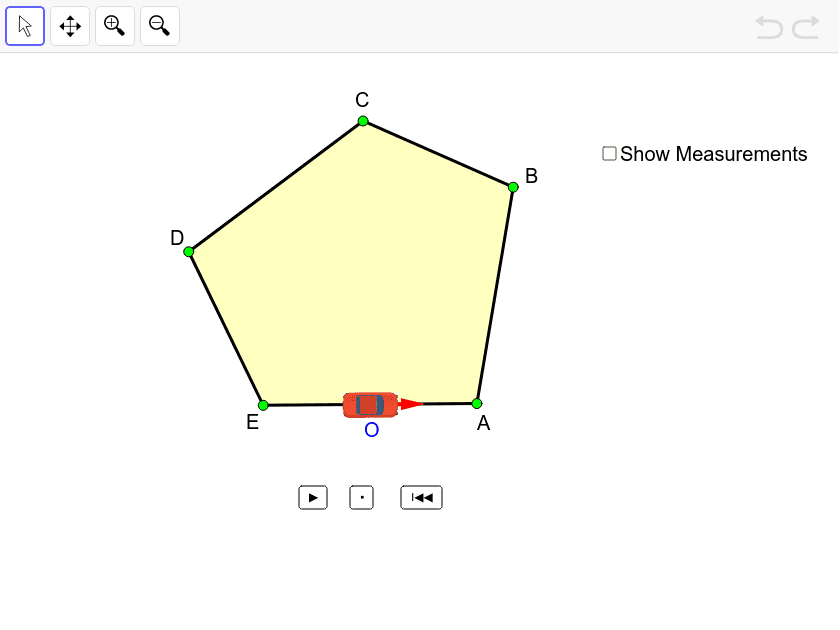
Demonstrates the concept of exterior angles of polygons using the metaphor of a car turning along the sides of a polygon. Key concepts include polygons and exterior angles. Utilizes commands such as Rotate, Vector, Angle, and OrthogonalLine. Suitable for middle school and above students to explore the properties of polygon exterior angles.
GeoGebra Commands & Parameters
Rotate((x(P1) + (x(A) - x(E)) / Distance[E, A], y(P1) + (y(A) - y(E)) / Distance[E, A]), Min[Max[t - 1, 0], 1] * (180° - Angle[B, A, E]), P1) → P1'Rotate((x(P2) + (x(B) - x(A)) / Distance[A, B], y(P2) + (y(B) - y(A)) / Distance[A, B]), Min[Max[t - 3, 0], 1] * (180° - Angle[C, B, A]), P2) → P2'Rotate((x(P3) + (x(C) - x(B)) / Distance[B, C], y(P3) + (y(C) - y(B)) / Distance[B, C]), Min[Max[t - 5, 0], 1] * (180° - Angle[D, C, B]), P3) → P3'Rotate((x(P4) + (x(D) - x(C)) / Distance[C, D], y(P4) + (y(D) - y(C)) / Distance[C, D]), Min[Max[t - 7, 0], 1] * (180° - Angle[E, D, C]), P4) → P4'Rotate((x(P5) + (x(E) - x(D)) / Distance[E, D], y(P5) + (y(E) - y(D)) / Distance[E, D]), Min[Max[t - 9, 0], 1] * (180° - Angle[A, E, D]), P5) → P5'Polygon(E, A, B, C, D) → poly1, a_1, b_1, c_1, d_1, e_1If(t ≤ 2, P1, If[t ≤ 4, P2, If[t ≤ 6, P3, If[t ≤ 8, P4, If[t ≤ 10, P5, P6]]]]) → PIf(t ≤ 2, P1', If[t ≤ 4, P2', If[t ≤ 6, P3', If[t ≤ 8, P4', If[t ≤ 10, P5', P6']]]]) → P'Vector(P, P') → uAngle(P1', P1, (x(P1) + (x(A) - x(E)) / Distance[E, A], y(P1) + (y(A) - y(E)) / Distance[E, A])) → αAngle(P2', P2, (x(P2) + (x(B) - x(A)) / Distance[A, B], y(P2) + (y(B) - y(A)) / Distance[A, B])) → βAngle(P3', P3, (x(P3) + (x(C) - x(B)) / Distance[B, C], y(P3) + (y(C) - y(B)) / Distance[B, C])) → γAngle(P4', P4, (x(P4) + (x(D) - x(C)) / Distance[C, D], y(P4) + (y(D) - y(C)) / Distance[C, D])) → δAngle(P5', P5, (x(P5) + (x(E) - x(D)) / Distance[E, D], y(P5) + (y(E) - y(D)) / Distance[E, D])) → εOrthogonalLine(P, u) → fPoint(f) → FMidpoint(F, P') → GVector(G, P) → vTranslate(P, v) → P'_1Translate(P', v) → P''Segment(A, (x(A) + (x(A) - x(E)) / Distance[E, A], y(A) + (y(A) - y(E)) / Distance[E, A])) → gSegment(B, (x(B) + (x(B) - x(A)) / Distance[A, B], y(B) + (y(B) - y(A)) / Distance[A, B])) → hSegment(C, (x(C) + (x(C) - x(B)) / Distance[B, C], y(C) + (y(C) - y(B)) / Distance[B, C])) → iSegment(D, (x(D) + (x(D) - x(C)) / Distance[C, D], y(D) + (y(D) - y(C)) / Distance[C, D])) → jSegment(E, (x(E) + (x(E) - x(D)) / Distance[D, E], y(E) + (y(E) - y(D)) / Distance[D, E])) → kMidpoint(a_1) → OAngle((x(A) + (x(A) - x(E)) / Distance[E, A], y(A) + (y(A) - y(E)) / Distance[E, A]), A, B) → aAngle((x(B) + (x(B) - x(A)) / Distance[A, B], y(B) + (y(B) - y(A)) / Distance[A, B]), B, C) → bAngle((x(C) + (x(C) - x(B)) / Distance[B, C], y(C) + (y(C) - y(B)) / Distance[B, C]), C, D) → cAngle((x(D) + (x(D) - x(C)) / Distance[C, D], y(D) + (y(D) - y(C)) / Distance[C, D]), D, E) → dAngle((x(E) + (x(E) - x(D)) / Distance[D, E], y(E) + (y(E) - y(D)) / Distance[D, E]), E, A) → eIf((t ≥ 1) ∧ (t < 2), α, If[t ≥ 2, a, 0*°]) → α'If((t ≥ 3) ∧ (t < 4), β, If[t ≥ 4, b, 0*°]) → β'If((t ≥ 5) ∧ (t < 6), γ, If[t ≥ 6, c, 0*°]) → γ'If((t ≥ 7) ∧ (t < 8), δ, If[t ≥ 7, d, 0*°]) → δ'If((t ≥ 9) ∧ (t < 10), ε, If[t ≥ 9, e, 0*°]) → ε'
AI Drawing Prompt Reference
Draw a pentagon ABCDE, then rotate each vertex around the pentagon to form a series of new points P1' to P5'. Connect each vertex to its corresponding rotated point to form a series of vectors. Calculate the exterior angles at each vertex and use these angles and vectors to construct a series of auxiliary lines and points. Finally, show the degree of each exterior angle.
The prompt above was compiled from the original drawing commands and is for reference only.