
Express Composite Numbers as Product of Prime Numbers
Loading the math board and drawing, please wait…
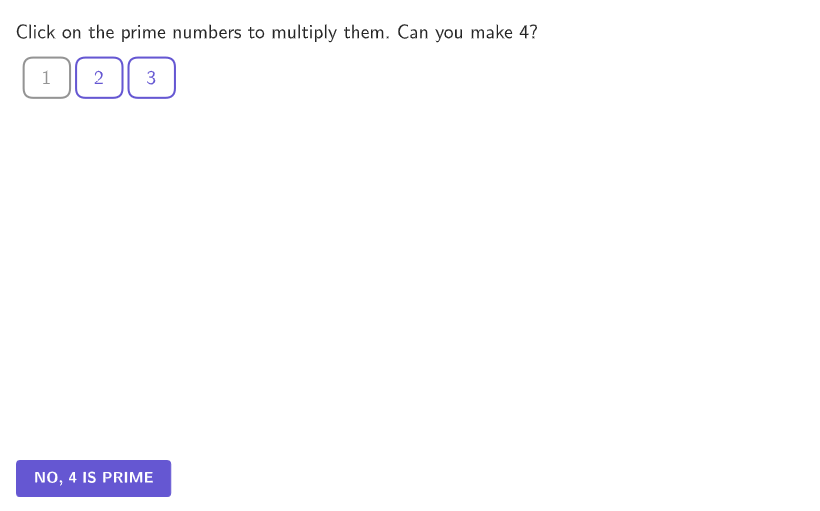
This example demonstrates how composite numbers can be expressed as products of prime numbers, highlighting the fundamental role of primes in multiplication. The key mathematical concepts involve prime factorization and number decomposition. Construction uses GeoGebra commands such as PrimeFactors, IsPrime, and Sequence to visualize the factorization process. Suitable for students in grades 4-5 to reinforce number sense and factorization skills.
GeoGebra Commands & Parameters
KeepIf(Mod[selectedNum, jj] ≟ 0, jj, Sequence[selectedNum]) → factorsAllIf(¬Defined[selectedNum], {}, If[active1, {"$\math{1 \times 1 }\;$"}, Zip[(((("$\math{" * Text[kk]) * " \times ") * Text[selectedNum / kk]) * "\; }$"), kk, factorsAll]]) → dropDownSelectedIndex(dropDown) → OptionsIf(Length[selectedNums] ≤ 1, {1}, Take[selectedNums, 1, Length[selectedNums] - 1]) → selectedNums'If(countQuestion ≤ 30, Product[Take[selectedNums, 1, Length[selectedNums] - 1]], Element[factorsAll, Options]) → firstFactSequence("×", kk, 1, Length[selectedNums] - 1) → timesFlatten({Sequence[{Element[selectedNums', kk], Element[times, kk]}, kk, 1, Length[times] - 1], Last[selectedNums']}) → product'If(countQuestion ≤ 30, TableText[Flatten[RemoveUndefined[{If[Length[selectedNums'] ≥ 2, product', Length[selectedNums'] ≟ 1, Last[selectedNums'], {}], If[Length[selectedNums'] ≥ 2, "="], If[Length[selectedNums'] ≥ 2, Text[Product[selectedNums']]]}]], "lh"], Text[Element[factorsAll, Options]]) → ProductText'Corner(5) → AppSizeFlatten(Sequence[Sequence[(kk * horizontalSeparation), kk, 1, 30 / rows], jj, 1, rows]) → xCoordinatesFlatten(Sequence[Sequence[8.4 - (anim * 0.5) - (kk * verticalSeparation), jj, 1, 30 / rows], kk, 0, rows]) → yCoordinatesZip((jj, kk), jj, xCoordinates, kk, yCoordinates) → textsPositionsText((("\ovalbox{" * A10) * "}"), Element[textsPositions, A10], true, true, 0, 0) → B10Text((("\ovalbox{" * A11) * "}"), Element[textsPositions, A11], true, true, 0, 0) → B11Text((("\ovalbox{" * A12) * "}"), Element[textsPositions, A12], true, true, 0, 0) → B12Text((("\ovalbox{" * A13) * "}"), Element[textsPositions, A13], true, true, 0, 0) → B13Text((("\ovalbox{" * A14) * "}"), Element[textsPositions, A14], true, true, 0, 0) → B14Text((("\ovalbox{" * A15) * "}"), Element[textsPositions, A15], true, true, 0, 0) → B15Text((("\ovalbox{" * A16) * "}"), Element[textsPositions, A16], true, true, 0, 0) → B16Text((("\ovalbox{" * A17) * "}"), Element[textsPositions, A17], true, true, 0, 0) → B17Text((("\ovalbox{" * A18) * "}"), Element[textsPositions, A18], true, true, 0, 0) → B18Text((("\ovalbox{" * A19) * "}"), Element[textsPositions, A19], true, true, 0, 0) → B19Text((("\ovalbox{" * A20) * "}"), Element[textsPositions, A20], true, true, 0, 0) → B20Text((("\ovalbox{" * A21) * "}"), Element[textsPositions, A21], true, true, 0, 0) → B21Text((("\ovalbox{" * A22) * "}"), Element[textsPositions, A22], true, true, 0, 0) → B22Text((("\ovalbox{" * A23) * "}"), Element[textsPositions, A23], true, true, 0, 0) → B23Text((("\ovalbox{" * A24) * "}"), Element[textsPositions, A24], true, true, 0, 0) → B24Text((("\ovalbox{" * A25) * "}"), Element[textsPositions, A25], true, true, 0, 0) → B25Text((("\ovalbox{" * A26) * "}"), Element[textsPositions, A26], true, true, 0, 0) → B26Text((("\ovalbox{" * A27) * "}"), Element[textsPositions, A27], true, true, 0, 0) → B27Text((("\ovalbox{" * A28) * "}"), Element[textsPositions, A28], true, true, 0, 0) → B28Text((("\ovalbox{" * A29) * "}"), Element[textsPositions, A29], true, true, 0, 0) → B29Text((("\ovalbox{" * A30) * "}"), Element[textsPositions, A30], true, true, 0, 0) → B30IsPrime(A1) → C1IsPrime(A2) → C2IsPrime(A3) → C3IsPrime(A4) → C4IsPrime(A5) → C5IsPrime(A6) → C6IsPrime(A7) → C7IsPrime(A8) → C8IsPrime(A9) → C9IsPrime(A10) → C10IsPrime(A11) → C11IsPrime(A12) → C12IsPrime(A13) → C13IsPrime(A14) → C14IsPrime(A15) → C15IsPrime(A16) → C16IsPrime(A17) → C17IsPrime(A18) → C18IsPrime(A19) → C19IsPrime(A20) → C20IsPrime(A21) → C21IsPrime(A22) → C22IsPrime(A23) → C23IsPrime(A24) → C24IsPrime(A25) → C25IsPrime(A26) → C26IsPrime(A27) → C27IsPrime(A28) → C28IsPrime(A29) → C29IsPrime(A30) → C30Zip((((("SetFixed(B" * jj) * ",true, ") * If[kk, "true", "false"]) * ")"), jj, Sequence[30], kk, primesOrNot) → FixNonPrimesFlatten({Sequence[{Element[selectedNums, kk], Element[times, kk]}, kk, 1, Length[times]], Last[selectedNums]}) → productText((("\ovalbox{\hspace{4}" * A1) * "\hspace{5}}"), Element[textsPositions, A1], true, true, 0, 0) → B1Text((("\ovalbox{\hspace{4}" * A2) * "\hspace{5}}"), Element[textsPositions, A2], true, true, 0, 0) → B2Text((("\ovalbox{\hspace{4}" * A3) * "\hspace{5}}"), Element[textsPositions, A3], true, true, 0, 0) → B3Text((("\ovalbox{\hspace{4}" * A4) * "\hspace{5}}"), Element[textsPositions, A4], true, true, 0, 0) → B4Text((("\ovalbox{\hspace{4}" * A5) * "\hspace{5}}"), Element[textsPositions, A5], true, true, 0, 0) → B5Text((("\ovalbox{\hspace{4}" * A6) * "\hspace{5}}"), Element[textsPositions, A6], true, true, 0, 0) → B6Text((("\ovalbox{\hspace{4}" * A7) * "\hspace{5}}"), Element[textsPositions, A7], true, true, 0, 0) → B7Text((("\ovalbox{\hspace{4}" * A8) * "\hspace{5}}"), Element[textsPositions, A8], true, true, 0, 0) → B8Text((("\ovalbox{\hspace{4}" * A9) * "\hspace{5}}"), Element[textsPositions, A9], true, true, 0, 0) → B9If(countQuestion ≤ 30, selectedNums(Length[selectedNums]), selectedNum / Element[factorsAll, Options]) → secondFactMin(RemoveUndefined[{1, 3.2 / secondFact, 14 / firstFact}]) → sqLengthIf(Length[selectedNums] ≥ 2, Sequence[Translate[B, ((0, (-sqLength)) * kk)], kk, 0, secondFact], {(-10, 0), (-10, -10)}) → PointsLeftIf(Length[selectedNums] ≥ 2, Sequence[Translate[B, ((sqLength, 0) * kk)], kk, 0, firstFact], {(-10, 0), (-10, -10)}) → PointsUpTranslate(PointsLeft, (If[Length[selectedNums] ≥ 2, (sqLength * firstFact), 1], 0)) → PointsRightTranslate(PointsUp, Vector[(0, ((-If[Length[selectedNums] ≥ 2, secondFact, 1]) * sqLength))]) → PointsDownPolygon({Element[PointsDown, 1], Element[PointsDown, Length[PointsDown]], Element[PointsRight, 1], B}) → q1Text(secondFact) → labelVSegmentIf(Length[selectedNums] ≥ 2, Text[labelVSegment, Midpoint[vSegment], true, true, 1, 0], "") → labelVPositioned_{1}If(Length[selectedNums] ≥ 2, Text[labelHSegment, Midpoint[hSegment], true, true, 0, -1], "") → labelHPositionedSequence((((("SetConditionToShowObject(B" * jj) * ", D") * jj) * ")"), jj, 4, 30) → conditionalVisibForTextsPrimeFactors(countQuestion) → l1If(prime ∧ IsPrime[countQuestion], "That's correct!", prime ∧ (¬IsPrime[countQuestion]), ((("Notice that " * l1(1)) * " is a factor of ") * countQuestion), (¬prime) ∧ Product[selectedNums] ≟ countQuestion, "Well done!", (("The product is not equal to " * countQuestion) * ". Keep trying.")) → feedbackTextTranslate(B, (0, -5)) → B'Zip(Segment[AA, BB], AA, PointsLeft, BB, PointsRight) → segmentsHZip(Segment[AA, BB], AA, PointsUp, BB, PointsDown) → segmentsVTranslate(PointsRight(1), (0.5, 0)) → ATranslate(PointsRight(Length[PointsRight]), (0.5, 0)) → CSegment(A, C) → fText(("\hspace{5}" * labelVSegment), Midpoint[f], true, true, 1, 0) → labelVPositionedTranslate(PointsLeft(Length[PointsLeft]), (0, -0.5)) → DTranslate(PointsRight(Length[PointsRight]), (0, -0.5)) → ESegment(D, E) → gText(ProductText', Midpoint[g], true, true, 0, -1) → labelHPositonedTableText(Flatten[{If[Length[selectedNums] ≥ 2, product, Length[selectedNums] ≟ 1, Last[selectedNums], {}], If[Length[selectedNums] ≥ 2, "=", ""], If[Length[selectedNums] ≥ 2, Text[Product[selectedNums]], ""]}], "lh") → ProductTextPolygon(Element[PointsRight, 1], Element[PointsLeft, 1], 4) → poly1Segment(Translate[PointsLeft(1), (0, -1.5)], Translate[PointsRight(1), (0, -1.5)]) → hSegment(Translate[PointsRight(1), (0.5, 0)], Translate[PointsRight(1), (0.5, -1)]) → iZip((("SetFixed(B" * jj) * ",true, true)"), jj, Sequence[30]) → UnFixAllCorner(ProductText, 3) → PosUnDoText(feedback, B', true, true, 1, 0) → feedbackTextPositionedTranslate(hGuideLine, Vector[(Vector[Corner[4], Corner[1]] / 500 * 16)]) → hGuideLine'Zip((((("SetColor(B" * jj) * ", ") * If[kk, "colorPrime", "colorInactive"]) * ")"), jj, Sequence[30], kk, primesOrNot) → ColorTheNumbersText(ProductText', (0, y(Midpoint[g])), true, true, 1, -1) → labelHPositioned2Corner(labelHPositoned, 1) → CorLabelHZip((((("SetColor(B" * jj) * ", ") * If[jj ≟ 1, "colorBlack", If[kk, "colorPrime", "colorNonPrime"]]) * ")"), jj, Sequence[30], kk, primesOrNot) → ColorTheNumbers2
AI Drawing Prompt Reference
Visualize how a composite number can be expressed as a product of prime numbers, emphasizing the fundamental role of primes in multiplication. Select a composite number, then decompose it into a sequence of prime factors and display them connected by multiplication signs to form an expression. Highlight each prime factor with circles and arrange them in order to clearly show the prime factorization process.
The prompt above was compiled from the original drawing commands and is for reference only.