
Exponential Functions: Charge/Discharge Model
Loading the math board and drawing, please wait…
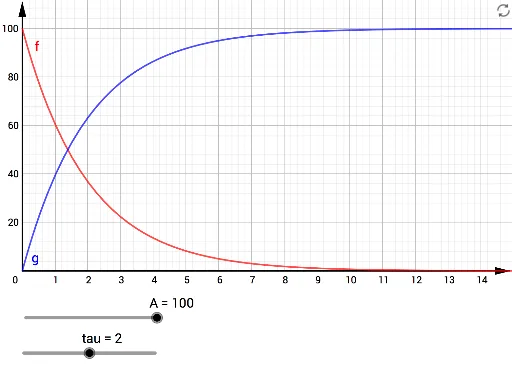
This example demonstrates the application of exponential functions in the charge/discharge process. Key mathematical concepts include the characteristics of exponential functions. By adjusting parameters, the voltage changes during the charge/discharge process can be observed. The construction summary mentions the use of GeoGebra commands including objects A, tau, function f, and g. Suitable for high school and above students to learn about exponential functions and their practical applications.
GeoGebra Commands & Parameters
Numeric A(100)Numeric tau(2)f(x) = If[x ≥ 0, (A * ℯ^(((-x)) / tau))]g(x) = If[x ≥ 0, A - (A * ℯ^(((-x)) / tau))]
AI Drawing Prompt Reference
Draw an exponential function graph for the charge/discharge process. First, create a numeric line for the initial voltage A, then create a numeric line for the time constant τ. Next, plot the voltage change curve for the charging process using the formula f(x) = A * ℯ^((-x) / τ), and finally plot the voltage change curve for the discharging process using the formula g(x) = A - (A * ℯ^((-x) / τ)).
The prompt above was compiled from the original drawing commands and is for reference only.