
Exploring Volume: Dynamic Construction of Rectangular Prisms and Cross-Sections
Loading the math board and drawing, please wait…
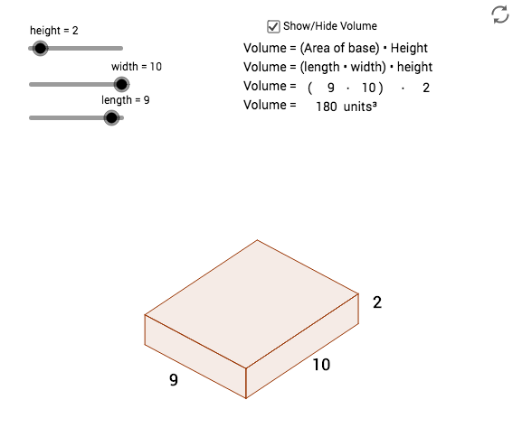
① This GeoGebra example dynamically demonstrates the composition of a rectangular prism's volume and uses planes to cut through the solid, visually revealing the relationship between volume, cross-sectional area, ratios, and differential equations. ② Core mathematical concepts include volume calculation, ratio relationships, definite integrals (for summing cross-sectional areas to obtain volume), differential equations (describing volume change rates), and intersections of spatial planes with polyhedra. ③ Construction highlights: From the construction summary, commands such as Vector, Line, Intersect, Segment, Polygon, and Midpoint are used, creating length, height, width objects, multiple points (A, O, B, C, etc.), segments (d, e, f, etc.), polygons (poly1, poly2, poly3), and auxiliary objects, allowing dynamic parameter adjustments to observe volume changes. ④ Suitable for high school to early college students, this example is ideal for teaching solid geometry, introductory calculus, or mathematical modeling, helping learners grasp the integral nature of volume and dynamic spatial relationships.
GeoGebra Commands & Parameters
Vector(((0.75 * width), (0.5 * width))) → wVector((0, height)) → zVector(((-0.75 * length), (0.4 * length))) → uLine(C, z) → dLine(B, w) → eLine(B, u) → fLine(A, z) → gIntersect(f, g) → DIntersect(d, e) → ESegment(A, D) → hSegment(D, B) → iSegment(B, E) → jSegment(E, C) → kLine(D, j) → lLine(E, i) → mIntersect(l, m) → FSegment(D, F) → nSegment(F, E) → pPolygon(D, A, O, B) → poly1, d_1, a_1, o, b_1Polygon(D, F, E, B) → poly2, d_2, f_1, e_1, b_2Polygon(O, C, E, B) → poly3, o_1, c_1, e_2, b_3Midpoint(o_1) → GMidpoint(c_1) → HMidpoint(a_1) → I