
Exploring Two Similar Triangles
Loading the math board and drawing, please wait…
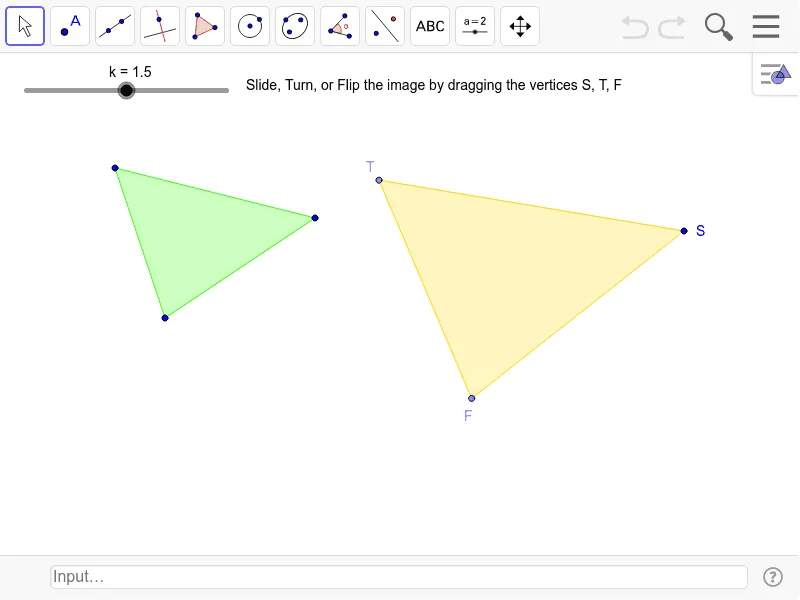
① This GeoGebra example dynamically demonstrates the construction and transformation of two similar triangles, visually showing the correspondence under translation, rotation, scaling, and reflection. ② The core mathematical concept is similar triangles, involving equal corresponding angles and proportional corresponding sides, as well as properties of similarity transformations (dilation, translation, rotation, reflection). ③ Construction highlights: from the summary, it uses Polygon to create the original triangle, Dilate to generate a scaled similar triangle, Vector and Translate for positional movement, Circle as auxiliary construction, Angle to mark corresponding angles, Rotate and Mirror to show different orientations of similarity, and Segment to connect corresponding points. Multiple points, sides, and auxiliary objects (e.g., A', B', C') are defined to track the transformation process. ④ Suitable for upper middle school or high school students, this is ideal for geometry lessons on understanding the criteria and properties of similar triangles, and can serve as an interactive demonstration for teachers.
GeoGebra Commands & Parameters
Polygon(A, B, C) → poly1, c, a, bDilate(A, k, D) → A'Dilate(B, k, D) → B'Dilate(C, k, D) → C'Polygon(A', B', C') → poly1', c', a', b'Vector(C', S) → uTranslate(A', u) → A''Translate(B', u) → B''Translate(C', u) → C''Polygon(A'', B'', C'') → poly1'', c'', a'', b''Circle(S, B'') → dPoint(d) → TAngle(B'', S, T) → αRotate(A'', α, S) → A'''Rotate(B'', α, S) → B'''Rotate(C'', α, S) → C'''Polygon(A''', B''', C''') → poly1''', c''', a''', b'''Mirror(A''', a''') → ESegment(A''', E) → ePoint(e) → FPolygon(S, F, T) → poly2, r, s, f
AI Drawing Prompt Reference
Draw a triangle, then create a smaller similar triangle by scaling it about a point inside the original. Translate this smaller triangle by a vector to get a congruent copy. Next, draw a circle centered at one vertex of the translated triangle, pick a point on the circle, and rotate the translated triangle about that center by the angle to that point, producing a rotated similar triangle. Finally, reflect this rotated triangle across one of its sides to get a mirror image, connect the mirror point to the corresponding vertex, and form a small triangle using the center, the circle point, and the mirror point, illustrating combined similarity transformations.
The prompt above was compiled from the original drawing commands and is for reference only.