
Exploring Triangle Properties Based on Interior Angles
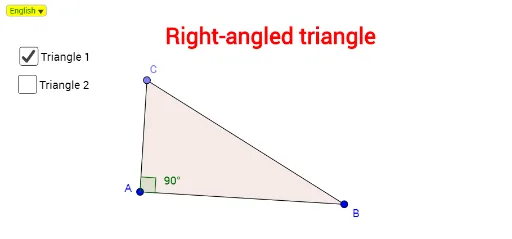
Loading the math board and drawing, please wait…
In collections
Mathematics Form 1
This interactive GeoGebra example dynamically demonstrates how the interior angles of a triangle relate to its sides, area, and circumcircle. It covers core concepts such as the triangle angle sum theorem, angle-side relationships, similarity transformations, and polygon angle properties. The construction uses commands like Segment, Polygon, Angle, Slider, SelectedIndex, Rotate, CircleSector, Midpoint, OrthogonalLine, and If to create adjustable angles and live visual feedback. Text objects display real-time conclusions. Suitable for middle and high school students learning triangle geometry, transformations, and dynamic mathematics exploration, as well as for classroom demonstrations by teachers.
GeoGebra Commands & Parameters
Segment(D, E) → eSlope(e) → KcIf((Kc * (x(E) - x(D))) < 0, y - y(D) < (-1 / Kc * (x - x(D))) ∧ y - y(E) > (-1 / Kc * (x - x(E))), y - y(D) > (-1 / Kc * (x - x(D))) ∧ y - y(E) < (-1 / Kc * (x - x(E)))) → oSegment(A, B) → aOrthogonalLine(A, a) → bPoint(b) → CSegment(C, B) → cSegment(C, A) → dPolygon(A, B, C) → poly1, c_1, a_1, b_1Midpoint(D, E) → GSegment(F, D) → gSegment(F, E) → hOrthogonalLine(D, e) → iOrthogonalLine(E, e) → jAngle(B, A, C) → αAngle(D, F, E) → βAngle(E, D, F) → γAngle(F, E, D) → δRotate(E, 359.99°, G) → E_1CircleSector(G, E, E_1) → qAngle(F, D, E) → εAngle(E, F, D) → ζAngle(D, E, F) → ηSelectedIndex(Bahasa) → nnIf(nn ≟ 1, "Acute-angled triangle", "Segi tiga bersudut tirus") → text1If(nn ≟ 1, "Obtuse-angled triangle", "Segi tiga bersudut cakah") → text2If(nn ≟ 1, "Right-angled triangle", "Segi tiga bersudut tegak") → text3
AI Drawing Prompt Reference
Create an interactive triangle with adjustable interior angles using sliders. The triangle has a fixed base and a movable vertex on a perpendicular line, allowing shape changes. Display the three angle measures and automatically label the triangle as acute, obtuse, or right based on its largest angle. Include a circumcircle and angle relationships to demonstrate the angle sum theorem and side-angle relations.
The prompt above was compiled from the original drawing commands and is for reference only.