
Exploring the Three Parallels Theorem
Loading the math board and drawing, please wait…
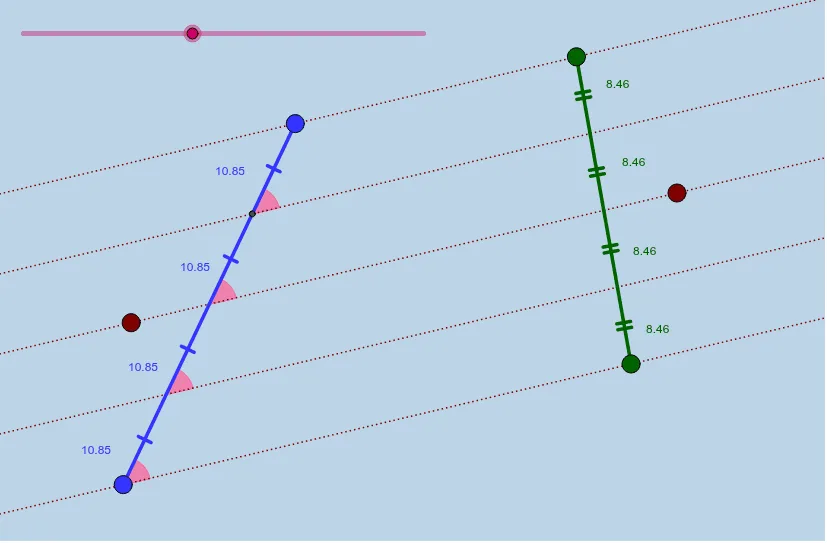
This example uses GeoGebra to explore the three parallels theorem. Key concepts include parallel lines, distance, and triangles. Commands used include Line, Distance, Point, etc. Suitable for middle school and above students to learn geometric proofs and explore properties.
GeoGebra Commands & Parameters
Line(A, B) → a_1Circle(A, a) → cOrthogonalLine(A, a_1) → bIntersect(c, b, 1) → COrthogonalLine(C, b) → dIntersect(c, b) → D, EOrthogonalLine(E, b) → eCircle(E, a) → fIntersect(f, b, 2) → FOrthogonalLine(F, b) → gCircle(C, a) → hIntersect(h, b) → G, HOrthogonalLine(G, b) → iDistance(F, E) → distanceFEDistance(E, A) → distanceEADistance(A, C) → distanceACDistance(C, G) → distanceCGPoint(b) → IPoint(b) → JPoint(g) → KPoint(i) → LLine(K, L) → jIntersect(e, j) → OIntersect(a_1, j) → PIntersect(d, j) → QSegment(K, O) → kSegment(O, P) → lSegment(P, Q) → mSegment(Q, L) → nPoint(g) → MPoint(i) → NSegment(M, N) → pIntersect(e, p) → RIntersect(a_1, p) → SIntersect(d, p) → TSegment(M, R) → qSegment(R, S) → rSegment(S, T) → sSegment(T, N) → tCircle(N, 3) → c_1Circle(T, 3) → d_1Circle(S, 3) → e_1Circle(R, 3) → f_1Intersect(f_1, e, 1) → UIntersect(f_1, q, 1) → VIntersect(e_1, a_1, 2) → WIntersect(e_1, r, 1) → ZIntersect(d_1, d, 1) → A_1Intersect(d_1, s, 1) → B_1Intersect(c_1, i, 1) → C_1Intersect(c_1, t, 1) → D_1CircleSector(R, U, V) → g_1CircleSector(S, W, Z) → h_1CircleSector(T, A_1, B_1) → k_1CircleSector(N, C_1, D_1) → p_1