
Exploring the Sum of Exterior Angles of Polygons
Loading the math board and drawing, please wait…
In collections
Polygon: Interior and Exterior Angles
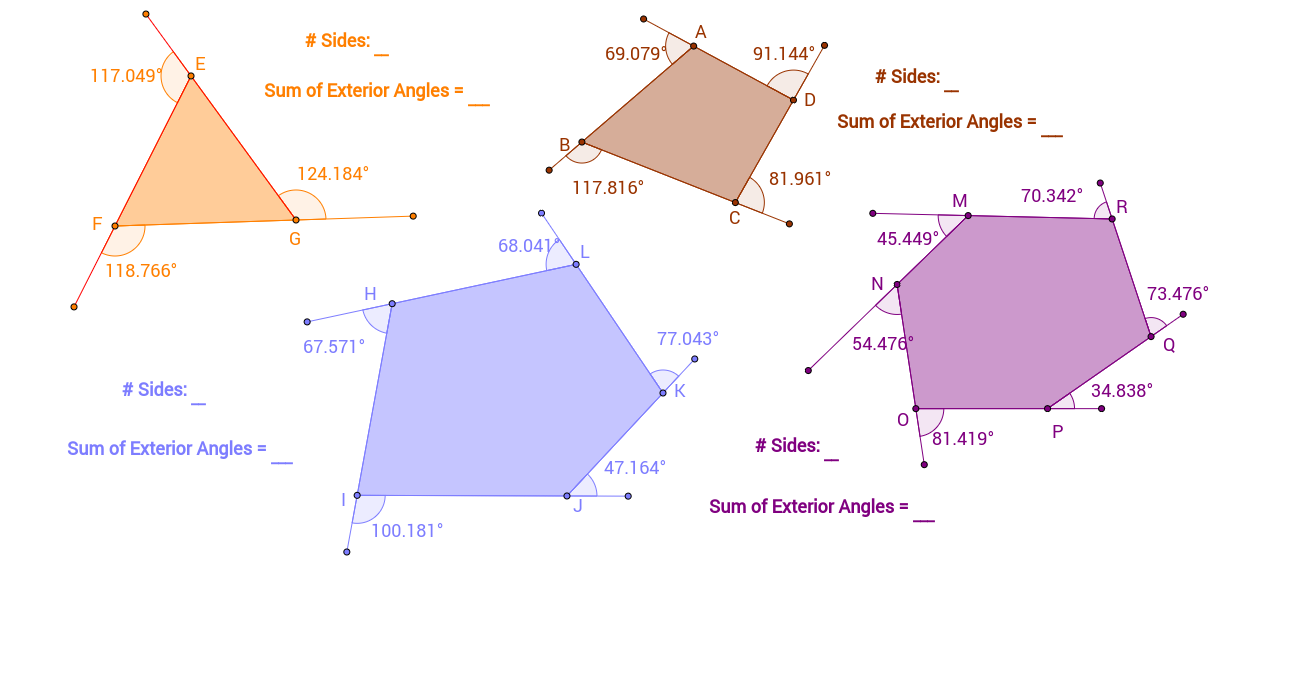
This GeoGebra applet demonstrates that the sum of the exterior angles of any convex polygon remains constant at 360 degrees, regardless of the number of sides or the polygon's shape. Students can drag vertices to observe how individual exterior angles vary while their total stays invariant. The core mathematical concepts include exterior angles of polygons, the exterior angle sum theorem, convex polygon properties, and angle measurement. Construction highlights: the example uses GeoGebra commands Polygon to build polygon objects poly1 through poly4, Ray and Segment to draw sides and their extensions, Point to mark vertices and exterior angle points, and Angle to measure each exterior angle; points A, B, C, D and segments a–r enable dynamic adjustment of the polygon shape. It is suitable for middle school geometry instruction and high school review, supporting inquiry-based learning and derivation of the exterior angle sum formula.
GeoGebra Commands & Parameters
Polygon(A, B, C, D) → poly1, a, b, c, dPolygon(E, F, G) → poly2, g, e, fPolygon(H, I, J, K, L) → poly3, h, i, j, k, lPolygon(M, N, O, P, Q, R) → poly4, m, n, o, p, q, rRay(F, G) → sRay(G, E) → tRay(E, F) → a_1Ray(B, C) → b_1Ray(C, D) → c_1Ray(D, A) → d_1Ray(A, B) → e_1Ray(K, L) → f_1Ray(L, H) → g_1Ray(H, I) → h_1Ray(I, J) → i_1Ray(J, K) → j_1Ray(N, O) → k_1Ray(O, P) → l_1Ray(P, Q) → m_1Ray(Q, R) → n_1Ray(R, M) → p_1Ray(M, N) → q_1Point(f_1) → SPoint(g_1) → TPoint(h_1) → UPoint(i_1) → VPoint(j_1) → WPoint(q_1) → ZPoint(k_1) → A_1Point(m_1) → B_1Point(n_1) → C_1Point(p_1) → D_1Point(l_1) → E_1Point(b_1) → F_1Point(c_1) → G_1Point(d_1) → H_1Point(e_1) → I_1Point(s) → J_1Point(t) → K_1Point(a_1) → L_1Segment(G, K_1) → r_1Segment(E, L_1) → s_1Segment(F, J_1) → t_1Segment(C, G_1) → a_2Segment(D, H_1) → b_2Segment(A, I_1) → c_2Segment(B, F_1) → d_2Segment(H, U) → e_2Segment(I, V) → f_2Angle(K_1, E, F) → αAngle(L_1, F, G) → βAngle(J_1, G, E) → γAngle(H_1, A, I_1) → δAngle(I_1, B, C) → εAngle(F_1, C, D) → ζAngle(G_1, D, A) → ηSegment(S, K) → g_2Segment(L, T) → h_2Segment(J, W) → i_2Angle(S, L, T) → θAngle(T, H, I) → ιAngle(V, J, K) → λAngle(W, K, L) → μSegment(Q, C_1) → j_2Segment(R, D_1) → k_2Segment(M, Z) → l_2Segment(N, A_1) → m_2Segment(O, E_1) → n_2Segment(P, B_1) → p_2Angle(C_1, R, M) → νAngle(D_1, M, N) → ξAngle(Z, N, O) → οAngle(A_1, O, P) → ρAngle(E_1, P, Q) → σAngle(B_1, Q, R) → τAngle(U, I, J) → κ