
Exploring the Area of a Circle by Daniela Leone
Loading the math board and drawing, please wait…
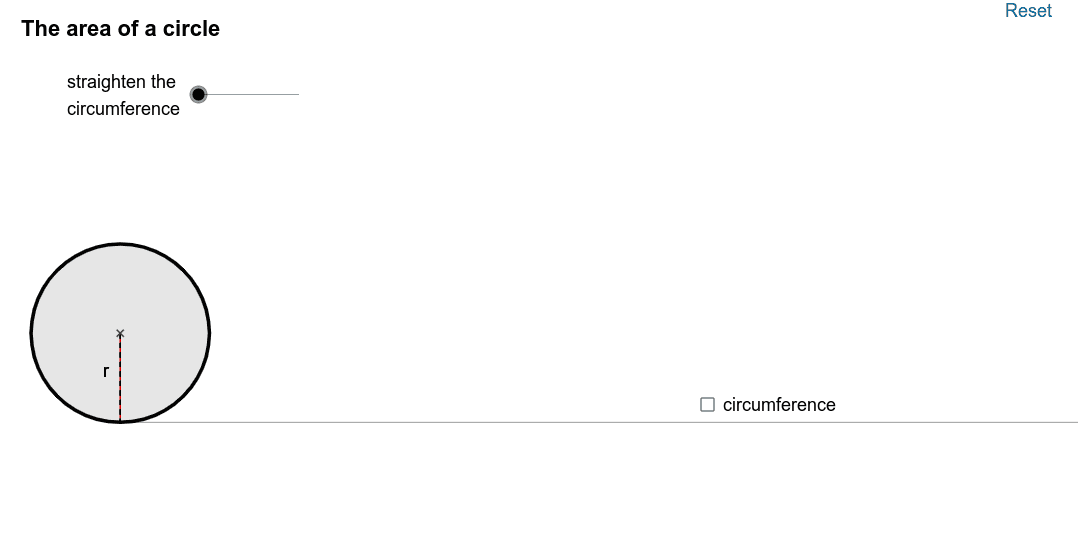
This example guides students to derive the area formula of a circle by dissecting it into multiple sectors. Key mathematical concepts include the area formula of a circle and sector area calculation. GeoGebra commands used include Segment, Point, Min, Sequence, Max, Rotate, Sector, Arc, CurveCartesian, Circle, Ray, Midpoint, Intersect, CircleArc. Suitable for middle school and above students for geometric construction and area calculation.
GeoGebra Commands & Parameters
Segment(E, (x(E) + 2, y(E))) → aPoint(a) → FMin(x(F) - x(E), 1) → kPoint(yAxis) → OSequence(If[k < 1, (x(O) + l * sin(i * φ) * cos(i * φ) / sin(φ), y(O) + l * sin(i * φ) * sin(i * φ) / sin(φ)), (x(O) + l * i, y(O))], i, 0, 2 * n) → list2Sequence((x(O) + sin(i * θ), y(O) + 1 - cos(i * θ)), i, 0, 2 * n) → list1Max(x(F) - x(E) - 1, 0) → k'Rotate((x(O) + 0, y(O) + 1), -k * θ / 2, O) → ARotate(O, -k * θ / 2, O) → O'Rotate(Element[list1, 1], -k * θ / 2, O) → BSector(Rotate[Circle[(x(O) + 0, y(O) + 1), O], -k * θ / 2, O], Rotate[O, -k * θ / 2, O], Rotate[Element[list1, 1], -k * θ / 2, O]) → cRotate((x(O) + 0, y(O) + 1), -k * θ / 2, O) → CRotate(O, -k * θ / 2, O) → O'_1Rotate(Element[list1, 1], -k * θ / 2, O) → DArc(Rotate[Circle[(x(O) + 0, y(O) + 1), O], -k * θ / 2, O], O'_1, D) → dCurveCartesian(t - sin(t), 1 - cos(t), t, 0, 6.28319) → bCircle((0, 1), 1) → hRay((0, 0), (1, 0)) → iPoint(Segment[(0, 1), (6.28319, 1)]) → HSegment(H, (x(H), 0)) → jMidpoint(j) → IMidpoint(a) → JCircle(L, 1 / (1 - m)) → pCircle((0, 0), 1 / (1 - m)) → qIntersect(p, q, 1) → MIntersect(p, q, 2) → NCircle((0, 1), 1) → c_1Segment((0, 0), (6.283185307179586, 0)) → eSegment(G, (x(G), y(G) - 1)) → rSequence(Sector[Rotate[Translate[Circle[(x(O) + 0, y(O) + 1), Element[list1, i]], Vector[Element[list1, i], Element[list2, i]]], -(2 * i - 1) * k * θ / 2, Element[list2, i]], Rotate[Translate[Element[list1, i], Vector[Element[list1, i], Element[list2, i]]], -(2 * i - 1) * k * θ / 2, Element[list2, i]], Rotate[Translate[Element[list1, i + 1], Vector[Element[list1, i], Element[list2, i]]], -(2 * i - 1) * k * θ / 2, Element[list2, i]]], i, 1, n) → list3Sequence(Sector[Rotate[Rotate[Translate[Circle[(x(O) + 0, y(O) + 1), Element[list1, i]], Vector[Element[list1, i], Element[list2, i]]], -(2 * i - 1) * k * θ / 2, Element[list2, i]], 180° * k', (x(O) + n * l - sin(θ / 2) / 2, y(O) + cos(θ / 2) / 2)], Rotate[Rotate[Translate[Element[list1, i], Vector[Element[list1, i], Element[list2, i]]], -(2 * i - 1) * k * θ / 2, Element[list2, i]], 180° * k', (x(O) + n * l - sin(θ / 2) / 2, y(O) + cos(θ / 2) / 2)], Rotate[Rotate[Translate[Element[list1, i + 1], Vector[Element[list1, i], Element[list2, i]]], -(2 * i - 1) * k * θ / 2, Element[list2, i]], 180° * k', (x(O) + n * l - sin(θ / 2) / 2, y(O) + cos(θ / 2) / 2)]], i, n + 1, 2 * n) → list4CircleArc((0, 1 / (1 - m)), O, L) → sSegment(Q, R) → g
AI Drawing Prompt Reference
Draw a circle and divide it into multiple sectors to illustrate how the area formula of a circle is derived. Start by drawing a ray and a circle, then segment the circle into several sectors with different colors or fills based on angles. Rearrange these sectors to form a shape resembling a rectangle, where the area is equal to that of the circle. Label key points and lines, such as the center, radius, and sector edges, to clearly demonstrate the derivation process.
The prompt above was compiled from the original drawing commands and is for reference only.