
Exploring Sum of Interior Angles of Polygons
Loading the math board and drawing, please wait…
In collections
Angles in polygons
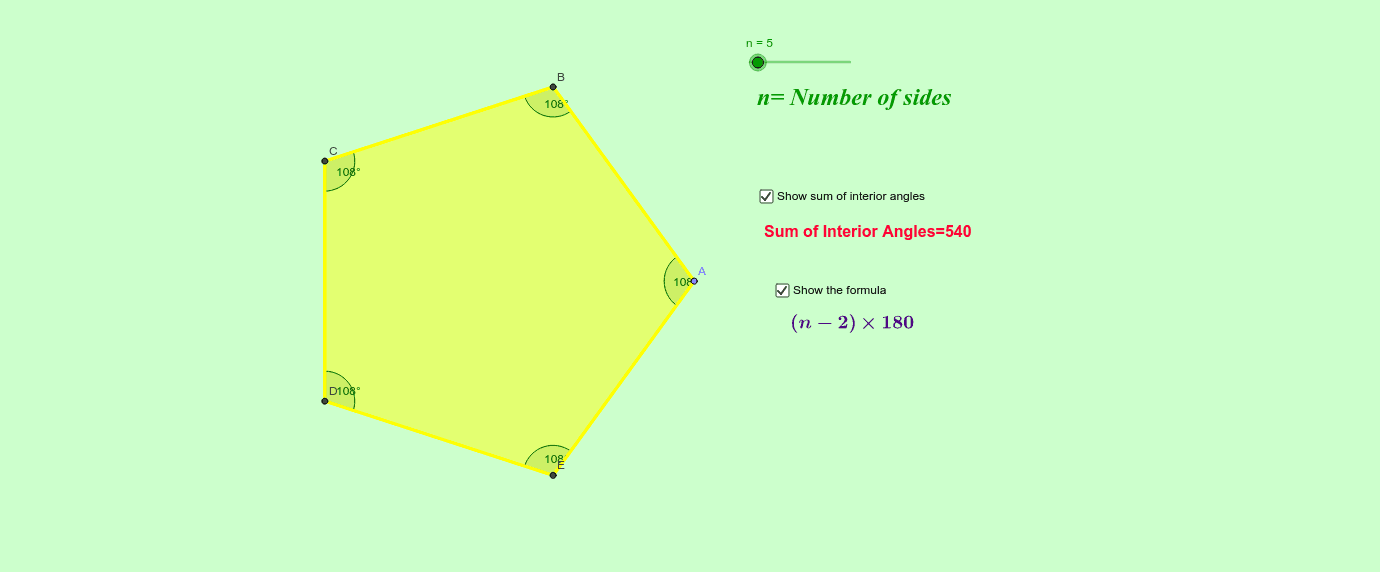
This example demonstrates the relationship between the number of sides and the sum of interior angles in polygons. Key math concepts include polygons, interior angles, and mathematical induction. It is constructed using GeoGebra commands like Point, Polygon, and Angle, with a slider to adjust the number of sides dynamically. Suitable for middle school and above students to understand the sum of interior angles theorem and explore geometric relationships.
GeoGebra Commands & Parameters
Point(xAxis) → APolygon(A, B, n) → çokgen1, a, j, k, l, m, p, q, r, s, t, a_1, b, b_1, c_1, d_1, e_1, f_1, g_1, h_1, i_1, j_1, k_1, c, l_1, C, D, E, F, G, H, I, J, K, d, L, M, N, O, P, Q, R, S, T, U, e, V, W, Z, A_1, B_1, C_1, D_1, E_1, F_1, f, g, h, iAngle(çokgen1) → α, β, α_5, α_6, α_7, α_8, α_9, α_{10}, α_{11}, α_{12}, α_{13}, α_{14}, γ, α_{15}, α_{16}, α_{17}, α_{18}, α_{19}, α_{20}, α_{21}, α_{22}, α_{23}, α_{24}, δ, ε, ζ, α_1, α_2, α_3, α_4
AI Drawing Prompt Reference
Draw a polygon with a slider to dynamically adjust the number of sides, demonstrating the relationship between the number of sides and the sum of interior angles. Label the interior angles of the polygon in different colors and calculate their sum to verify the sum of interior angles theorem.
The prompt above was compiled from the original drawing commands and is for reference only.