
Exploring Similarity in Rectangles
Loading the math board and drawing, please wait…
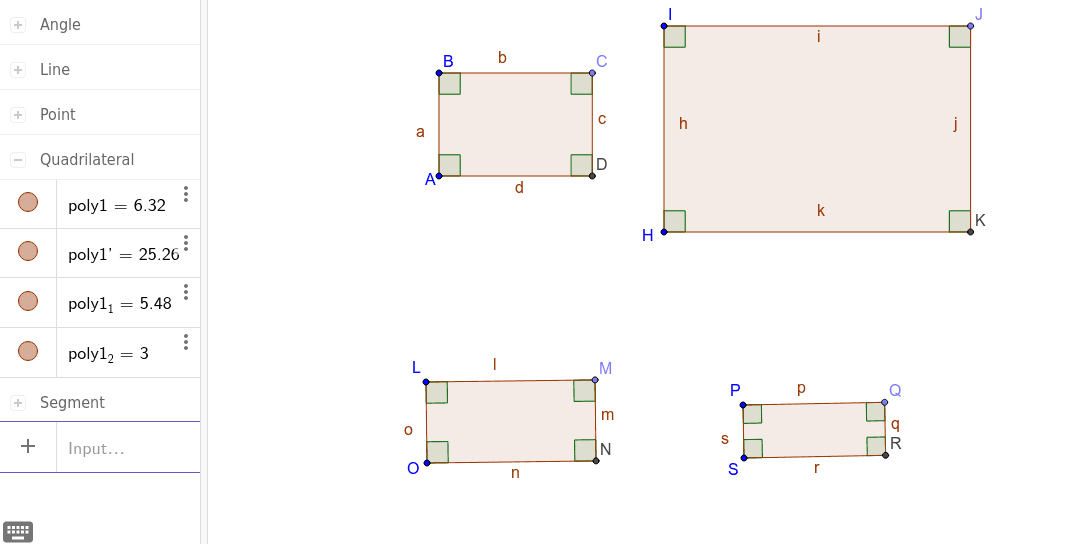
This example uses GeoGebra to demonstrate the properties of similar rectangles, focusing on the core mathematical concepts of similar figures. By constructing rectangles, drawing symmetry axes, and using transformation commands, students can visually understand that corresponding sides of similar rectangles are proportional and corresponding angles are equal. This example is suitable for junior high school geometry lessons, helping students grasp the basic concepts of similar figures.
GeoGebra Commands & Parameters
Line(A, B) → a_2OrthogonalLine(B, a_2) → b_2OrthogonalLine(A, a_2) → c_2Point(b_2) → COrthogonalLine(C, b_2) → d_2Intersect(c_2, d_2) → DPolygon(B, C, D, A) → poly1, b, c, d, aDilate(B, 2, E) → IDilate(C, 2, E) → JDilate(D, 2, E) → KDilate(A, 2, E) → HPolygon(I, J, K, H) → poly1', i, j, k, hLine(O, L) → a_3OrthogonalLine(L, a_3) → b_3OrthogonalLine(O, a_3) → c_3Point(b_3) → MOrthogonalLine(M, b_3) → d_3Intersect(c_3, d_3) → NPolygon(L, M, N, O) → poly1_1, l, m, n, oLine(S, P) → a_4OrthogonalLine(P, a_4) → b_4OrthogonalLine(S, a_4) → c_4Point(b_4) → QOrthogonalLine(Q, b_4) → d_4Intersect(c_4, d_4) → RPolygon(P, Q, R, S) → poly1_2, p, q, r, sAngle(D, A, B) → αAngle(A, B, C) → βAngle(B, C, D) → γAngle(C, D, A) → δAngle(H, I, J) → εAngle(I, J, K) → ζAngle(J, K, H) → ηAngle(K, H, I) → θAngle(L, M, N) → ιAngle(M, N, O) → κAngle(N, O, L) → λAngle(O, L, M) → μAngle(S, P, Q) → νAngle(P, Q, R) → ξAngle(Q, R, S) → οAngle(R, S, P) → ρ
AI Drawing Prompt Reference
Draw two similar rectangles, the first one with vertices A, B, C, D, and the second one with vertices I, J, K, H, which are dilated from the first one with a scale factor of 2 around point E. Then draw the diagonals of each rectangle and label the interior angles at each vertex.
The prompt above was compiled from the original drawing commands and is for reference only.