
Exploring Rotations: Dynamic Transformation of Polygons and Circles
Loading the math board and drawing, please wait…
In collections
Rotations
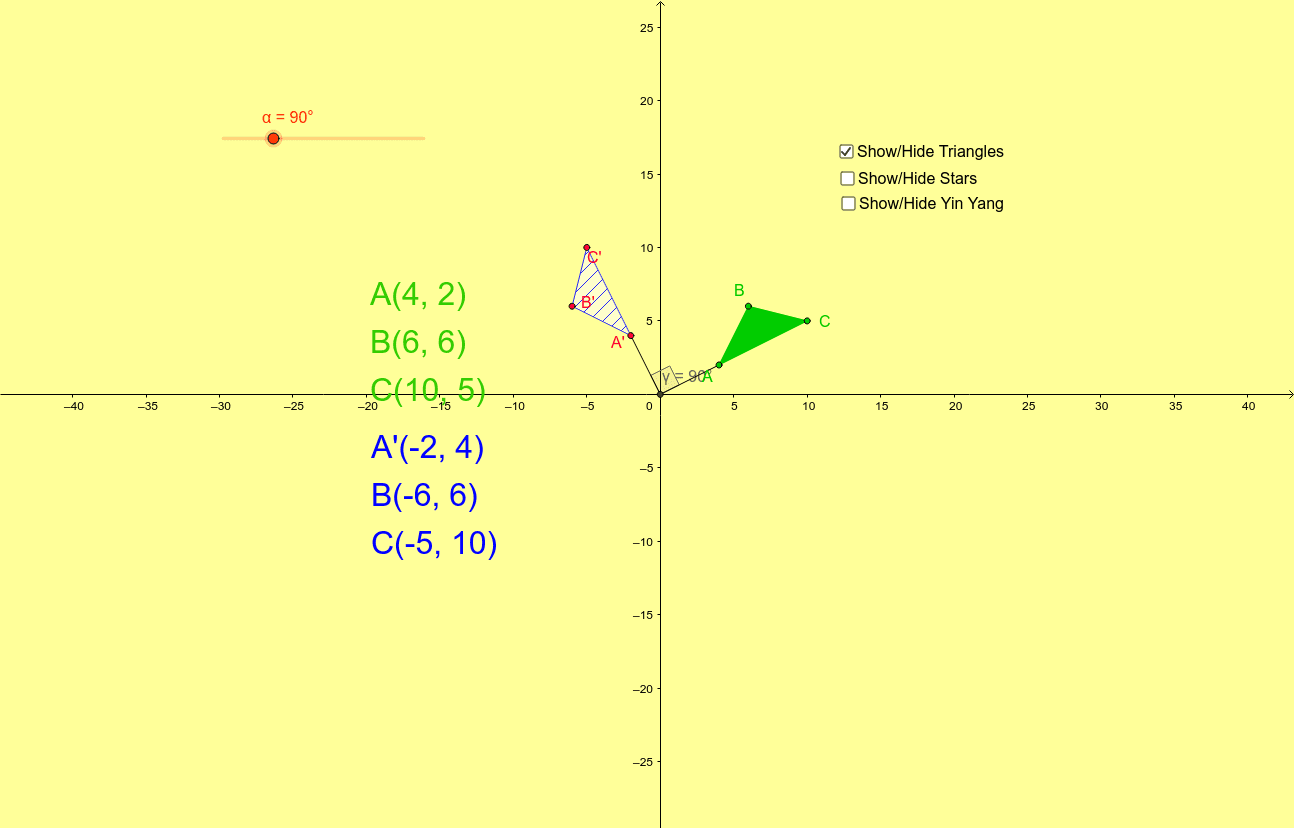
①This example demonstrates how to use GeoGebra to rotate a quadrilateral along with associated circles, segments, and other geometric objects, visually showing the changes in position and shape before and after rotation. ②Core mathematical concepts include planar geometric rotation transformations, center and angle of rotation, properties of polygons and circles, and relationships between corresponding points, sides, and angles after rotation. ③Construction highlights: From the construction summary, commands such as Polygon, Circle, Segment, Rotate, Point, CircumcircleArc, and Angle are used, creating objects like A, B, C, poly1, c, a, b, β, and rotated counterparts like A', B', C', poly1', etc., with rotation controlled by sliders or angle parameters. ④Suitable for middle school geometry teaching to help students understand the definition, properties, and intuitive process of rotation, as well as exploring rotational symmetry.
GeoGebra Commands & Parameters
Polygon(A, B, C) → poly1, c, a, bIntersect(xAxis, yAxis) → DCircle(D, E) → dSegment(D, E) → eRotate(E, 72°, D) → IRotate(I, 72°, D) → HRotate(H, 72°, D) → GRotate(G, 72°, D) → FPolygon(E, H, F, I, G) → poly2, e_1, e'', f, e', e'''Rotate(E, β, D) → E'Rotate(H, β, D) → H'Rotate(F, β, D) → F'Rotate(I, β, D) → I'Rotate(G, β, D) → G'Polygon(E', H', F', I', G') → poly2', e'_1, h', f', i', g'Rotate(A, α, D) → A'Rotate(B, α, D) → B'Rotate(C, α, D) → C'Polygon(A', B', C') → poly1', c', a', b'Circle(D, J) → kPoint(yAxis) → KCircle(K, J) → pPoint(yAxis) → LCircle(L, D) → qPoint(yAxis) → MCircle(K, M) → rPoint(yAxis) → NCircle(L, N) → sPoint(p) → OPoint(q) → PCircumcircleArc(J, O, D) → tIntersect(k, q, 1) → QCircumcircleArc(D, P, Q) → c_1Rotate(k, θ, D) → k'Rotate(r, θ, D) → r'Rotate(s, θ, D) → s'Rotate(J, θ, D) → J'Rotate(O, θ, D) → O'Rotate(D, θ, D) → D'CircumcircleArc(J', O', D') → t'Rotate(D, θ, D) → D'_1Rotate(P, θ, D) → P'Rotate(Q, θ, D) → Q'CircumcircleArc(D'_1, P', Q') → d_1Segment(D, A) → jSegment(D, A') → lAngle(A, D, A') → γ