
Exploring Rotations by brotheas
Loading the math board and drawing, please wait…
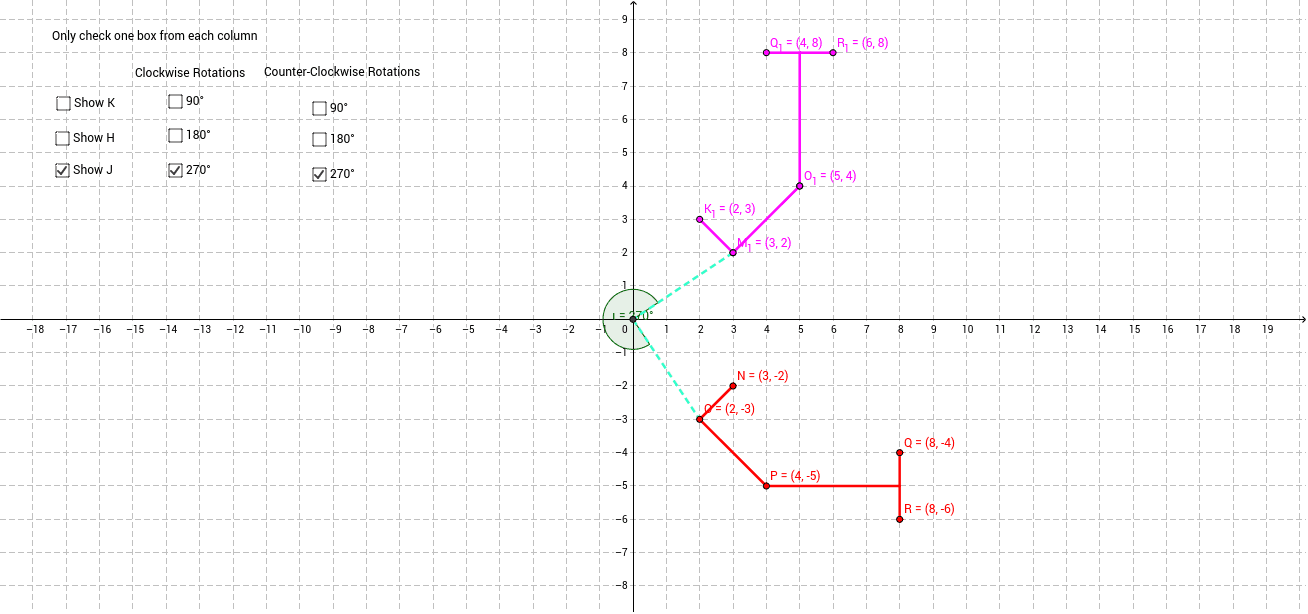
This example demonstrates the effects of rotations around the origin on geometric figures. Core math concepts include rotation transformation, angle measurement, and coordinate geometry. It utilizes commands and objects such as Segment, Point, Mirror, Line, Intersect, Rotate, and Angle in GeoGebra. Suitable for high school students learning geometric transformations or for educational demonstrations.
GeoGebra Commands & Parameters
Segment(C, A) → aSegment(D, B) → bSegment(B, E) → cPoint(xAxis) → FPoint(xAxis) → GSegment(F, G) → gMirror(C, g) → C'Mirror(A, g) → A'Segment(C', A') → a'Mirror(D, g) → D'Mirror(B, g) → B'Segment(D', B') → b'Mirror(B, g) → B'_1Mirror(E, g) → E'Segment(B'_1, E') → c'Segment(I, H) → lSegment(J, K) → mPoint(l) → LPoint(m) → MSegment(L, M) → nMirror(I, g) → I'Mirror(H, g) → H'Segment(I', H') → l'Mirror(J, g) → J'Mirror(K, g) → K'Segment(J', K') → m'Mirror(L, g) → L'Mirror(M, g) → M'Segment(L', M') → n'Segment(N, O) → pSegment(O, P) → qSegment(P, S) → rSegment(Q, R) → sMirror(N, g) → N'Mirror(O, g) → O'Segment(N', O') → p'Mirror(O, g) → O'_1Mirror(P, g) → P'Segment(O'_1, P') → q'Mirror(P, g) → P'_1Mirror(S, g) → S'Segment(P'_1, S') → r'Mirror(Q, g) → Q'Mirror(R, g) → R'Segment(Q', R') → s'Point(yAxis) → TPoint(yAxis) → USegment(T, U) → tMirror(C, yAxis) → C'_1Mirror(A, yAxis) → A'_1Segment(C'_1, A'_1) → a'_1Mirror(D, yAxis) → D'_1Mirror(B, yAxis) → B'_2Segment(D'_1, B'_2) → b'_1Mirror(B, yAxis) → B'_3Mirror(E, yAxis) → E'_1Segment(B'_3, E'_1) → c'_1Mirror(I, t) → I'_1Mirror(H, t) → H'_1Segment(I'_1, H'_1) → l'_1Mirror(J, t) → J'_1Mirror(K, t) → K'_1Segment(J'_1, K'_1) → m'_1Mirror(L, t) → L'_1Mirror(M, t) → M'_1Segment(L'_1, M'_1) → n'_1Mirror(N, yAxis) → N'_1Mirror(O, yAxis) → O'_2Segment(N'_1, O'_2) → p'_1Mirror(O, yAxis) → O'_3Mirror(P, yAxis) → P'_2Segment(O'_3, P'_2) → q'_1Mirror(P, yAxis) → P'_3Mirror(S, yAxis) → S'_1Segment(P'_3, S'_1) → r'_1Mirror(Q, yAxis) → Q'_1Mirror(R, yAxis) → R'_1Segment(Q'_1, R'_1) → s'_1Line(V, W) → a_1Mirror(C, a_1) → C'_2Mirror(A, a_1) → A'_2Segment(C'_2, A'_2) → a'_2Mirror(D, a_1) → D'_2Mirror(B, a_1) → B'_4Segment(D'_2, B'_4) → b'_2Mirror(B, a_1) → B'_5Mirror(E, a_1) → E'_2Segment(B'_5, E'_2) → c'_2Mirror(I, a_1) → I'_2Mirror(H, a_1) → H'_2Segment(I'_2, H'_2) → l'_2Mirror(J, a_1) → J'_2Mirror(K, a_1) → K'_2Segment(J'_2, K'_2) → m'_2Mirror(L, a_1) → L'_2Mirror(M, a_1) → M'_2Segment(L'_2, M'_2) → n'_2Mirror(N, a_1) → N'_2Mirror(O, a_1) → O'_4Segment(N'_2, O'_4) → p'_2Mirror(O, a_1) → O'_5Mirror(P, a_1) → P'_4Segment(O'_5, P'_4) → q'_2Mirror(P, a_1) → P'_5Mirror(S, a_1) → S'_2Segment(P'_5, S'_2) → r'_2Mirror(Q, a_1) → Q'_2Mirror(R, a_1) → R'_2Segment(Q'_2, R'_2) → s'_2Line(Z, A_1) → b_1Mirror(N, b_1) → N'_3Mirror(O, b_1) → O'_6Segment(N'_3, O'_6) → p'_3Mirror(O, b_1) → O'_7Mirror(P, b_1) → P'_6Segment(O'_7, P'_6) → q'_3Mirror(P, b_1) → P'_7Mirror(S, b_1) → S'_3Segment(P'_7, S'_3) → r'_3Mirror(Q, b_1) → Q'_3Mirror(R, b_1) → R'_3Segment(Q'_3, R'_3) → s'_3Mirror(I, b_1) → I'_3Mirror(H, b_1) → H'_3Segment(I'_3, H'_3) → l'_3Mirror(J, b_1) → J'_3Mirror(K, b_1) → K'_3Segment(J'_3, K'_3) → m'_3Mirror(L, b_1) → L'_3Mirror(M, b_1) → M'_3Segment(L'_3, M'_3) → n'_3Mirror(C, b_1) → C'_3Mirror(A, b_1) → A'_3Segment(C'_3, A'_3) → a'_3Mirror(D, b_1) → D'_3Mirror(B, b_1) → B'_6Segment(D'_3, B'_6) → b'_3Mirror(B, b_1) → B'_7Mirror(E, b_1) → E'_3Segment(B'_7, E'_3) → c'_3Intersect(xAxis, yAxis) → B_1Rotate(C, 270*°, B_1) → C'_4Rotate(A, 270*°, B_1) → A'_4Segment(C'_4, A'_4) → a'_4Rotate(D, 270*°, B_1) → D'_4Rotate(B, 270*°, B_1) → B'_8Segment(D'_4, B'_8) → b'_4Rotate(B, 270*°, B_1) → B'_9Rotate(E, 270*°, B_1) → E'_4Segment(B'_9, E'_4) → c'_4Rotate(C, 180*°, B_1) → C'_5Rotate(A, 180*°, B_1) → A'_5Segment(C'_5, A'_5) → a'_5Rotate(D, 180*°, B_1) → D'_5Rotate(B, 180*°, B_1) → B'_{10}Segment(D'_5, B'_{10}) → b'_5Rotate(B, 180*°, B_1) → B'_{11}Rotate(E, 180*°, B_1) → E'_5Segment(B'_{11}, E'_5) → c'_5Rotate(C, 90*°, B_1) → C'_6Rotate(A, 90*°, B_1) → A'_6Segment(C'_6, A'_6) → a'_6Rotate(D, 90*°, B_1) → D'_6Rotate(B, 90*°, B_1) → B'_{12}Segment(D'_6, B'_{12}) → b'_6Rotate(B, 90*°, B_1) → B'_{13}Rotate(E, 90*°, B_1) → E'_6Segment(B'_{13}, E'_6) → c'_6Rotate(I, 90*°, B_1) → I'_4Rotate(H, 90*°, B_1) → H'_4Segment(I'_4, H'_4) → l'_4Rotate(J, 90*°, B_1) → J'_4Rotate(K, 90*°, B_1) → K'_4Segment(J'_4, K'_4) → m'_4Rotate(L, 90*°, B_1) → L'_4Rotate(M, 90*°, B_1) → M'_4Segment(L'_4, M'_4) → n'_4Rotate(I, 180*°, B_1) → I'_5Rotate(H, 180*°, B_1) → H'_5Segment(I'_5, H'_5) → l'_5Rotate(J, 180*°, B_1) → J'_5Rotate(K, 180*°, B_1) → K'_5Segment(J'_5, K'_5) → m'_5Rotate(L, 180*°, B_1) → L'_5Rotate(M, 180*°, B_1) → M'_5Segment(L'_5, M'_5) → n'_5Rotate(I, 270*°, B_1) → I'_6Rotate(H, 270*°, B_1) → H'_6Segment(I'_6, H'_6) → l'_6Rotate(J, 270*°, B_1) → J'_6Rotate(K, 270*°, B_1) → K'_6Segment(J'_6, K'_6) → m'_6Rotate(L, 270*°, B_1) → L'_6Rotate(M, 270*°, B_1) → M'_6Segment(L'_6, M'_6) → n'_6Rotate(N, 270*°, B_1) → N'_4Rotate(O, 270*°, B_1) → O'_8Segment(N'_4, O'_8) → p'_4Rotate(O, 270*°, B_1) → O'_9Rotate(P, 270*°, B_1) → P'_8Segment(O'_9, P'_8) → q'_4Rotate(P, 270*°, B_1) → P'_9Rotate(S, 270*°, B_1) → S'_4Segment(P'_9, S'_4) → r'_4Rotate(Q, 270*°, B_1) → Q'_4Rotate(R, 270*°, B_1) → R'_4Segment(Q'_4, R'_4) → s'_4Rotate(N'_4, 270*°, B_1) → C_1Rotate(O'_8, 270*°, B_1) → D_1Segment(C_1, D_1) → d_1Rotate(O'_9, 270*°, B_1) → E_1Rotate(P'_8, 270*°, B_1) → F_1Segment(E_1, F_1) → e_1Rotate(P'_9, 270*°, B_1) → G_1Rotate(S'_4, 270*°, B_1) → H_1Segment(G_1, H_1) → f_1Rotate(Q'_4, 270*°, B_1) → I_1Rotate(R'_4, 270*°, B_1) → J_1Segment(I_1, J_1) → g_1Rotate(C_1, 270*°, B_1) → K_1Rotate(D_1, 270*°, B_1) → L_1Segment(K_1, L_1) → h_1Rotate(E_1, 270*°, B_1) → M_1Rotate(F_1, 270*°, B_1) → N_1Segment(M_1, N_1) → i_1Rotate(G_1, 270*°, B_1) → O_1Rotate(H_1, 270*°, B_1) → P_1Segment(O_1, P_1) → j_1Rotate(I_1, 270*°, B_1) → Q_1Rotate(J_1, 270*°, B_1) → R_1Segment(Q_1, R_1) → k_1Segment(C, B_1) → l_1Segment(B_1, C'_4) → m_1Angle(C'_4, B_1, C) → αSegment(C'_5, B_1) → n_1Segment(B_1, C) → p_1Angle(C'_5, B_1, C) → βSegment(C'_6, B_1) → q_1Segment(B_1, C) → r_1Angle(C'_6, B_1, C) → γSegment(J, B_1) → s_1Segment(B_1, J'_6) → t_1Angle(J'_6, B_1, J) → δSegment(J, B_1) → a_2Segment(B_1, J'_5) → b_2Angle(J'_5, B_1, J) → εSegment(J, B_1) → c_2Segment(B_1, J'_4) → d_2Angle(J'_4, B_1, J) → ζSegment(O'_8, B_1) → e_2Segment(O, B_1) → f_2Angle(O'_8, B_1, O) → ηSegment(D_1, B_1) → g_2Segment(O, B_1) → h_2Angle(D_1, B_1, O) → θSegment(L_1, B_1) → i_2Segment(B_1, O) → j_2Angle(L_1, B_1, O) → ι
AI Drawing Prompt Reference
Draw a geometric figure to demonstrate the effects of rotations around the origin. Start by drawing two line segments and their reflections, then draw the reflected line segments. Next, draw the coordinate axes and use them to perform mirror operations, obtaining new line segments. Finally, draw the coordinate axes and connect two points to form a line segment, fully showcasing the geometric transformation process of rotation and reflection.
The prompt above was compiled from the original drawing commands and is for reference only.