
Exploring Properties of Trapezoids
Loading the math board and drawing, please wait…
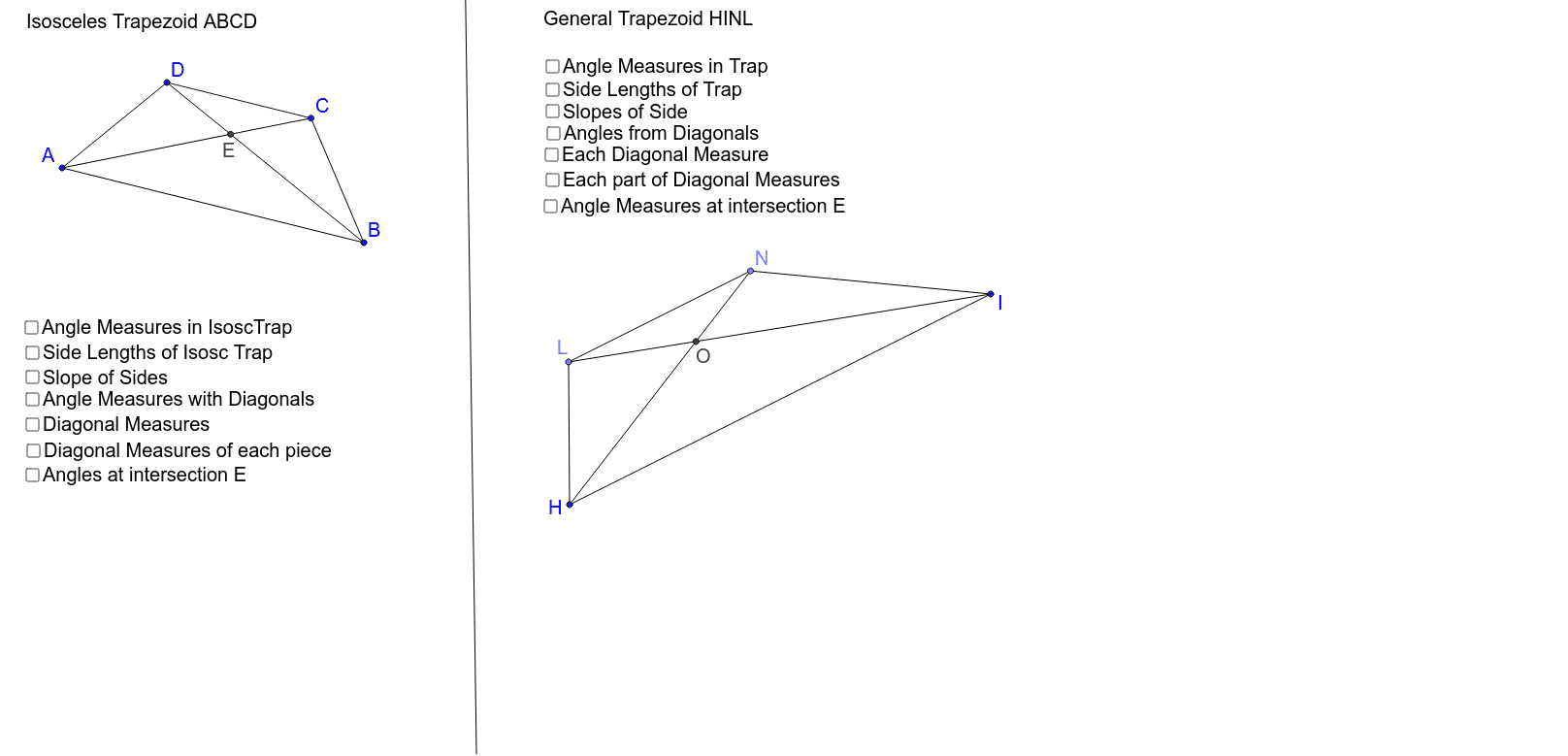
This example demonstrates the properties of both general and isosceles trapezoids. By constructing various elements of the trapezoid, such as segments, angles, and distances, it helps students understand the basic properties of trapezoids. GeoGebra commands used include Segment, LineBisector, Intersect, Mirror, Angle, Distance, Slope, Line, OrthogonalLine, Point, Circle, CircleArc, etc. Suitable for middle school and above students to learn geometric construction and related properties.
GeoGebra Commands & Parameters
Segment(A, B) → aLineBisector(a) → bIntersect(b, a) → C_1Segment(A, D) → cMirror(D, b) → CSegment(C, B) → dSegment(C, D) → eAngle(B, A, D) → αAngle(A, D, C) → βAngle(D, C, B) → γAngle(C, B, A) → δDistance(A, D) → distanceADDistance(D, C) → distanceDD'Distance(C, B) → distanceD'BDistance(B, A) → distanceBASlope(e) → mSlope(a) → m_1Segment(A, C) → iSegment(B, D) → jIntersect(i, j) → EAngle(E, A, D) → εAngle(A, D, E) → ζAngle(E, D, C) → ηAngle(D, C, E) → θAngle(E, C, B) → ιAngle(C, B, E) → κAngle(E, B, A) → λAngle(B, A, E) → μDistance(A, E) → distanceAEDistance(E, C) → distanceED'Distance(B, E) → distanceBEDistance(E, D) → distanceEDDistance(A, C) → distanceAD'Distance(D, B) → distanceDBLine(F, G) → pLine(H, I) → qOrthogonalLine(H, q) → rOrthogonalLine(I, q) → sPoint(q) → JCircle(H, J) → tIntersect(t, r, 2) → KCircleArc(H, J, K) → c_1Point(c_1) → LLine(L, q) → a_1Intersect(a_1, s) → MSegment(L, M) → b_1Point(b_1) → NSegment(H, L) → d_1Segment(L, N) → e_1Segment(N, I) → f_1Segment(H, I) → g_1Angle(N, I, H) → νAngle(I, H, L) → ξAngle(H, L, N) → οAngle(L, N, I) → ρDistance(H, L) → distanceHLDistance(L, N) → distanceLNDistance(N, I) → distanceNIDistance(I, H) → distanceIHSlope(e_1) → m_2Slope(g_1) → m_3Segment(L, I) → h_1Segment(N, H) → i_1Intersect(h_1, i_1) → OAngle(C, E, D) → σAngle(B, E, C) → τAngle(H, L, O) → υAngle(O, L, N) → ϕAngle(L, N, O) → χAngle(N, I, O) → ψAngle(O, N, I) → ωAngle(O, I, H) → α_1Angle(I, H, O) → β_1Angle(O, H, L) → γ_1Distance(L, O) → distanceLODistance(O, N) → distanceONDistance(O, I) → distanceOIDistance(O, H) → distanceOHDistance(L, I) → distanceLIDistance(N, H) → distanceNHAngle(L, O, H) → δ_1Angle(N, O, L) → ε_1
AI Drawing Prompt Reference
Draw a trapezoid. First, draw two parallel line segments as the bases. Then, draw points at the ends of the bases and connect them to the top points to form the legs. Next, draw the diagonals of the trapezoid and mark their intersection point. Finally, label the base lengths, leg lengths, and diagonal lengths, and draw the interior angles. Ensure the trapezoid is an isosceles trapezoid, meaning the two legs are equal in length.
The prompt above was compiled from the original drawing commands and is for reference only.