
Exploring Properties of Parallelograms by Roxana Kim
Loading the math board and drawing, please wait…
In collections
Exploring the Properties of Quadrilaterals
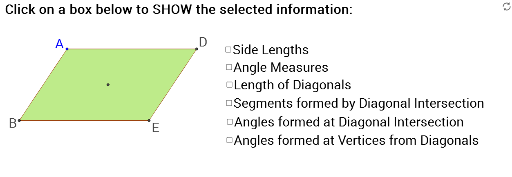
This interactive GeoGebra applet demonstrates the fundamental properties of a parallelogram, including opposite sides being parallel and equal, opposite angles being equal, consecutive angles being supplementary, and diagonals bisecting each other. Users can drag vertices to resize the shape and verify each property step by step. The construction uses core GeoGebra commands such as Intersect, Line, Segment, Polygon, and Angle, with objects like points A, B, C, D, auxiliary points E and F, and various segments and angles. It is ideal for middle school geometry lessons, enabling students to visually discover and confirm parallelogram properties through dynamic manipulation, and also serves as a valuable tool for teachers in classroom demonstrations or for self-paced student exploration.
GeoGebra Commands & Parameters
Intersect(xAxis, yAxis) → BLine(B, A) → aLine(A, xAxis) → bLine(B, b) → cPoint(c) → CLine(C, a) → dIntersect(b, d) → DIntersect(c, d) → EPolygon(B, A, D, E) → poly1, b_1, a_1, d_1, eSegment(B, D) → fSegment(A, E) → gIntersect(f, g) → FSegment(B, F) → hSegment(F, D) → iSegment(E, F) → jSegment(F, A) → kAngle(E, F, D) → αAngle(D, F, A) → βAngle(A, F, B) → γAngle(B, F, E) → δAngle(D, E, B) → εAngle(B, A, D) → ζAngle(A, D, E) → ηAngle(E, B, A) → θAngle(E, B, F) → ιAngle(F, B, A) → κAngle(B, A, F) → λAngle(F, A, D) → μAngle(F, E, B) → νAngle(D, E, F) → ξAngle(F, D, E) → οAngle(A, D, F) → ρPolygon(A, D, E, B) → poly2, a_2, d_2, e_1, b_2Segment(A, E) → pSegment(B, D) → sSegment(A, E) → rSegment(B, D) → c_1
AI Drawing Prompt Reference
Draw a parallelogram ABCD by making lines parallel to the x-axis through point A and the y-axis through point B, intersecting at points C and D. Connect the points to form the parallelogram, then draw the diagonals AC and BD which intersect at point F. Draw all four sides and the two diagonals, measure and display the angles to verify the properties of opposite sides being parallel and equal, opposite angles being equal, consecutive angles being supplementary, and diagonals bisecting each other.
The prompt above was compiled from the original drawing commands and is for reference only.