
Exploring Properties of Kites
Loading the math board and drawing, please wait…
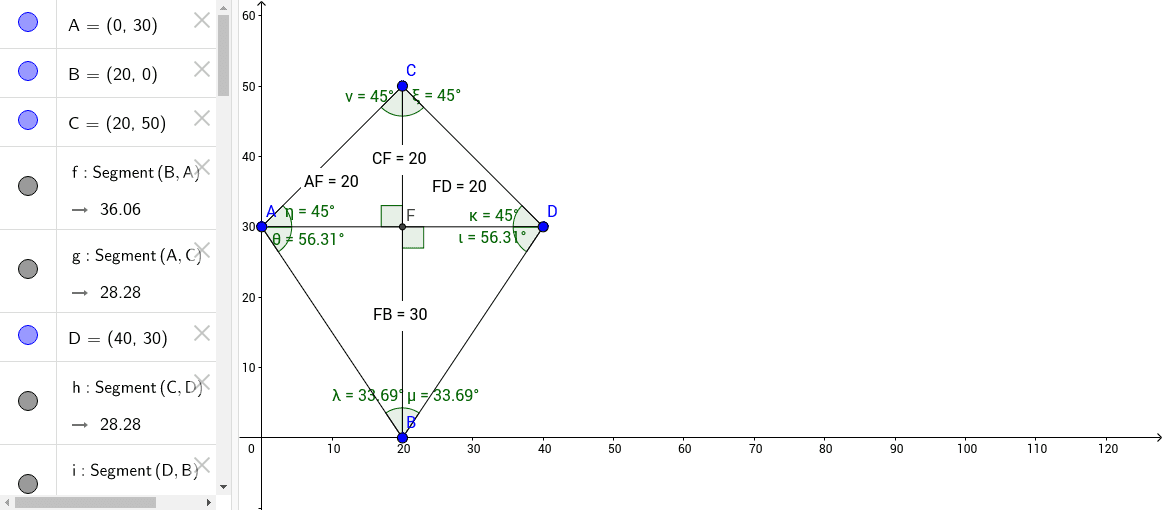
① This GeoGebra example dynamically demonstrates the key properties of a kite quadrilateral, such as perpendicular diagonals, one pair of equal opposite angles, and an axis of symmetry. ② Core mathematical concepts include quadrilateral classification, axial symmetry, perpendicular bisectors, angle relationships, and distance measurement, all within plane geometry. ③ Construction details: using GeoGebra commands Segment, Angle, Intersect, and Distance, the construction defines points A, B, C, D, E, F, G and measures segment lengths (distanceCF, distanceAF, distanceFD, distanceFB) with corresponding text labels, allowing interactive dragging to verify invariant properties. ④ Suitable for middle school to high school students, this example serves as a visual aid for classroom instruction or independent exploration of kite geometry, and as a practice exercise in geometric construction and measurement.
GeoGebra Commands & Parameters
Segment(B, A) → fSegment(A, C) → gSegment(C, D) → hSegment(D, B) → iAngle(B, A, C) → αAngle(C, D, B) → βAngle(A, C, D) → γAngle(D, B, A) → δSegment(C, B) → jSegment(A, D) → kIntersect(j, k) → FAngle(C, F, A) → εAngle(B, F, D) → ζAngle(F, A, C) → ηAngle(B, A, F) → θAngle(F, D, B) → ιAngle(C, D, F) → κAngle(F, B, A) → λAngle(D, B, F) → μAngle(A, C, F) → νAngle(F, C, D) → ξDistance(C, F) → distanceCFDistance(A, F) → distanceAFDistance(F, D) → distanceFDDistance(F, B) → distanceFB