
Exploring Lines of Symmetry in Quadrilaterals
Loading the math board and drawing, please wait…
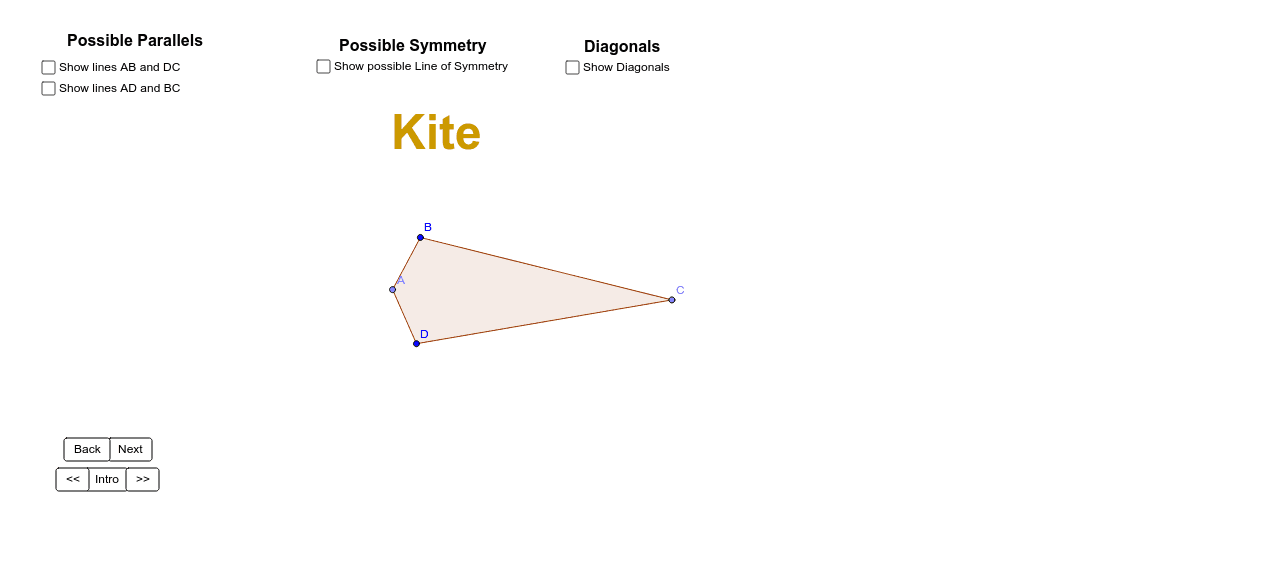
① This example demonstrates how to find the lines of symmetry of a quadrilateral using geometric construction, and visually shows the reflected image after symmetry transformation. ② Core mathematical concepts include axial symmetry, symmetry lines, properties of polygons, and reflection transformations. ③ Construction highlights: using GeoGebra commands such as Polygon to create the quadrilateral, Line, Segment, Angle, Distance for measurements, Mirror for reflection, and Intersect, Circle, OrthogonalLine to assist in determining symmetry axes, with buttons and text objects for interactivity. ④ Suitable for middle and high school students learning geometric symmetry, and for teachers to demonstrate in class, helping students understand the conditions for existence of symmetry lines and the symmetry features of different quadrilateral types (e.g., rectangle, rhombus, isosceles trapezoid).
GeoGebra Commands & Parameters
Line(D, C) → fLine(B, C) → gSegment(B, C) → jSegment(C, D) → kLine(B, D) → mSegment(E, F) → pSegment(B, D) → tAngle(B, C, D) → γDistance(B, C) → distanceBCDistance(C, D) → distanceCDDistance(D, B) → distanceDBLine(J, K) → b_1Point(b_1) → LPoint(b_1) → NPoint(b_1) → OPoint(b_1) → QMirror(M, b_1) → M'Point(b_1) → PPoint(b_1) → RSegment(P, M) → c_1Segment(M, R) → f_1Segment(R, M') → g_1Segment(M', P) → h_1Segment(P, R) → i_1Segment(M, M') → j_1Intersect(i_1, j_1) → SLine(P, M') → k_1Line(M, R) → l_1Line(R, M') → m_1Line(M, P) → n_1Polygon(P, M, R, M') → poly3, p_1, m_2, r_1, m'Distance(P, M) → distancePMDistance(M, R) → distanceMRDistance(R, M') → distanceRM'Distance(M', P) → distanceM'PAngle(M', P, M) → ζAngle(P, M, R) → ηAngle(M, R, M') → θAngle(R, M', P) → ιAngle(P, S, M') → κDistance(M', M) → distanceM'MDistance(P, R) → distancePRSegment(T, U) → d_1Circle(S, Segment[U, T]) → e_1Point(e_1) → VLine(V, S) → q_1Mirror(P, q_1) → P'Mirror(M, q_1) → M'_1Mirror(R, q_1) → R'Mirror(M', q_1) → M''Polygon(P', M'_1, R', M'') → poly3', p', m'_1, r', m''Line(W, Z) → s_1Point(s_1) → B_1Point(s_1) → C_1Segment(B_1, C_1) → a_2Point(s_1) → D_1Point(s_1) → E_1Segment(D_1, E_1) → b_2Point(a_2) → H_1Line(A_1, F_1) → t_1Line(G_1, t_1) → c_2Point(c_2) → I_1Line(A_1, G_1) → h_2Line(F_1, I_1) → i_2Line(A_1, F_1) → j_2Line(I_1, G_1) → k_2Distance(G_1, A_1) → distanceG1A1Distance(A_1, F_1) → distanceA1F1Distance(F_1, I_1) → distanceF1I1Distance(I_1, G_1) → distanceI1G1Angle(I_1, G_1, A_1) → λAngle(G_1, A_1, F_1) → μAngle(A_1, F_1, I_1) → νAngle(F_1, I_1, G_1) → ξSegment(A_1, I_1) → l_2Segment(G_1, F_1) → n_2Intersect(l_2, n_2) → K_1Distance(G_1, F_1) → distanceG1F1Distance(A_1, I_1) → distanceA1I1Angle(G_1, K_1, I_1) → οPolygon(G_1, A_1, F_1, I_1) → poly4, g_2, a_3, f_2, i_3Segment(J_1, L_1) → d_2Circle(K_1, Segment[J_1, L_1]) → e_2Point(e_2) → M_1Line(K_1, M_1) → p_2Mirror(G_1, p_2) → N_1Mirror(A_1, p_2) → O_1Mirror(F_1, p_2) → P_1Mirror(I_1, p_2) → Q_1Polygon(N_1, O_1, P_1, Q_1) → poly4', n_3, o_1, p_3, q_2Line(R_1, S_1) → r_2Line(T_1, r_2) → s_2Segment(R_1, T_1) → t_2Circle(S_1, Segment[R_1, S_1]) → c_3Circle(S_1, Segment[R_1, T_1]) → d_3Circle(R_1, Segment[T_1, S_1]) → e_3Intersect(d_3, e_3, 2) → U_1Segment(T_1, U_1) → b_3Segment(U_1, S_1) → f_3Segment(S_1, R_1) → g_3Intersect(t_2, f_3) → V_1Intersect(b_3, g_3) → W_1Distance(U_1, V_1) → distanceU1V1Distance(U_1, W_1) → distanceU1W1Intersect(f_2, g_2) → Z_1Polygon(R_1, T_1, U_1, S_1) → poly5, r_3, t_3, u_1, s_3Line(R_1, T_1) → h_3Line(S_1, U_1) → j_3Line(T_1, U_1) → k_3Line(R_1, S_1) → l_3Segment(T_1, S_1) → m_3Segment(R_1, U_1) → q_3Intersect(m_3, q_3) → A_2Segment(B_2, C_2) → a_4Circle(A_2, Segment[B_2, C_2]) → c_4Point(c_4) → D_2Line(A_2, D_2) → b_4Mirror(R_1, b_4) → E_2Mirror(T_1, b_4) → F_2Mirror(U_1, b_4) → G_2Mirror(S_1, b_4) → H_2Polygon(E_2, F_2, G_2, H_2) → poly5', e_4, f_4, g_4, h_4Distance(R_1, T_1) → distanceR1T1Distance(T_1, U_1) → distanceT1U1Distance(U_1, S_1) → distanceU1S1Distance(S_1, R_1) → distanceS1R1Distance(R_1, U_1) → distanceR1U1Distance(T_1, S_1) → distanceT1S1Angle(R_1, A_2, S_1) → ρAngle(S_1, R_1, T_1) → σAngle(R_1, T_1, U_1) → τAngle(T_1, U_1, S_1) → υAngle(U_1, S_1, R_1) → ϕLine(I_2, J_2) → d_4Line(K_2, d_4) → i_4Line(K_2, I_2) → j_4Line(J_2, j_4) → k_4Intersect(i_4, k_4) → L_2Polygon(K_2, I_2, J_2, L_2) → poly6, k_5, i_5, j_5, l_4Line(I_2, K_2) → m_4Line(J_2, L_2) → n_4Line(I_2, J_2) → p_4Line(K_2, L_2) → q_4Segment(K_2, J_2) → r_4Segment(I_2, L_2) → s_4Intersect(r_4, s_4) → M_2Segment(N_2, O_2) → t_4Circle(M_2, Segment[N_2, O_2]) → c_5Point(c_5) → P_2Line(M_2, P_2) → a_5Mirror(K_2, a_5) → Q_2Mirror(I_2, a_5) → R_2Mirror(J_2, a_5) → S_2Mirror(L_2, a_5) → T_2Polygon(Q_2, R_2, S_2, T_2) → poly6', q_5, r_5, s_5, t_5Distance(I_2, K_2) → distanceI2K2Distance(K_2, L_2) → distanceK2L2Distance(L_2, J_2) → distanceL2J2Distance(J_2, I_2) → distanceJ2I2Distance(I_2, L_2) → distanceI2L2Distance(K_2, J_2) → distanceK2J2Angle(J_2, I_2, K_2) → χAngle(I_2, K_2, L_2) → ψAngle(K_2, L_2, J_2) → ωAngle(L_2, J_2, I_2) → α_1Angle(I_2, M_2, J_2) → β_1Distance(I_2, J_2) → distanceI2J2Distance(I_2, L_2) → v_1Distance(K_2, J_2) → w_1Circle(U_2, V_2) → d_5Point(d_5) → W_2Segment(V_2, W_2) → b_5Mirror(U_2, b_5) → Z_2Polygon(W_2, U_2, V_2, Z_2) → poly7, w_2, u_2, v_2, z_2Segment(U_2, Z_2) → e_5Intersect(b_5, e_5) → A_3Distance(W_2, V_2) → distanceW2V2Distance(U_2, Z_2) → distanceU2Z2Angle(W_2, A_3, Z_2) → γ_1Angle(Z_2, W_2, U_2) → δ_1Angle(W_2, U_2, V_2) → ε_1Angle(U_2, V_2, Z_2) → ζ_1Angle(V_2, Z_2, W_2) → η_1Distance(W_2, U_2) → distanceW2U2Distance(U_2, V_2) → distanceU2V2Distance(V_2, Z_2) → distanceV2Z2Distance(Z_2, W_2) → distanceZ2W2Segment(B_3, C_3) → f_5Circle(A_3, Segment[B_3, C_3]) → g_5Point(g_5) → D_3Line(D_3, A_3) → h_5Mirror(W_2, h_5) → E_3Mirror(U_2, h_5) → F_3Mirror(V_2, h_5) → G_3Mirror(Z_2, h_5) → H_3Polygon(E_3, F_3, G_3, H_3) → poly7', e_6, f_6, g_6, h_6Line(W_2, U_2) → l_5Line(U_2, V_2) → m_5Line(V_2, Z_2) → n_5Line(Z_2, W_2) → p_5Segment(I_3, J_3) → a_6OrthogonalLine(I_3, a_6) → b_6OrthogonalLine(J_3, a_6) → c_6Point(b_6) → K_3Line(K_3, b_6) → d_6Line(K_3, d_6) → i_6Line(K_3, a_6) → j_6Intersect(c_6, j_6) → L_3Polygon(I_3, K_3, L_3, J_3) → poly8, i_7, k_6, l_6, j_7Distance(I_3, K_3) → distanceI3K3Distance(K_3, L_3) → distanceK3L3Distance(L_3, J_3) → distanceL3J3Distance(J_3, I_3) → distanceJ3I3Angle(J_3, I_3, K_3) → θ_1Angle(I_3, K_3, L_3) → ι_1Angle(K_3, L_3, J_3) → κ_1Angle(L_3, J_3, I_3) → λ_1Segment(K_3, J_3) → m_6Segment(I_3, L_3) → n_6Intersect(m_6, n_6) → M_3Line(I_3, K_3) → p_6Line(K_3, L_3) → q_6Line(L_3, J_3) → r_6Line(J_3, I_3) → s_6Angle(I_3, M_3, J_3) → μ_1Distance(I_3, L_3) → distanceI3L3Distance(K_3, J_3) → distanceK3J3Segment(N_3, O_3) → t_6Circle(M_3, Segment[N_3, O_3]) → c_7Point(c_7) → P_3Line(M_3, P_3) → a_7Mirror(I_3, a_7) → Q_3Mirror(K_3, a_7) → R_3Mirror(L_3, a_7) → S_3Mirror(J_3, a_7) → T_3Polygon(Q_3, R_3, S_3, T_3) → poly8', q_7, r_7, s_7, t_7Segment(A, G) → aOrthogonalLine(A, a) → bOrthogonalLine(G, a) → cCircle(A, Segment[A, G]) → dCircle(G, Segment[A, G]) → eIntersect(d, b, 2) → HIntersect(e, c, 2) → IPolygon(A, H, I, G) → poly1, a_1, h, i, g_7Segment(H, G) → lSegment(I, A) → nIntersect(l, n) → U_3Line(H, I) → qLine(G, A) → rLine(A, H) → b_7Line(I, G) → d_7Angle(G, U_3, I) → αAngle(G, A, H) → βAngle(A, H, I) → δAngle(H, I, G) → εAngle(I, G, A) → ν_1Distance(A, H) → distanceAHDistance(H, I) → distanceHIDistance(I, G) → distanceIGDistance(G, A) → distanceGADistance(A, I) → distanceAIDistance(H, G) → distanceHGSegment(B, V_3) → e_7Segment(V_3, D) → f_7Polygon(V_3, B, C, D) → poly2, v_3, b_8, c_8, d_8Line(B, V_3) → h_7Line(V_3, D) → k_7Segment(C, V_3) → l_7Intersect(t, l_7) → W_3Intersect(c_8, v_3) → Z_3Intersect(d_8, b_8) → A_4Segment(B_4, C_4) → m_7Circle(W_3, Segment[B_4, C_4]) → p_7Point(p_7) → D_4Line(W_3, D_4) → n_7Mirror(V_3, n_7) → E_4Mirror(B, n_7) → B'Mirror(C, n_7) → C'Mirror(D, n_7) → D'Polygon(E_4, B', C', D') → poly2', e_8, b', c', d'Mirror(B', b') → B''Mirror(C', b') → C''Distance(V_3, B) → distanceV3BDistance(B, C) → z_1Distance(C, D) → o_2Distance(D, V_3) → distanceDV3Distance(V_3, C) → distanceV3CDistance(B, D) → distanceBDAngle(D, V_3, B) → ξ_1Angle(V_3, B, C) → ο_1Angle(B, C, D) → ρ_1Angle(C, D, V_3) → σ_1Angle(V_3, W_3, D) → τ_1Segment(F_4, G_4) → a_8Circle(U_3, Segment[F_4, G_4]) → f_8Point(f_8) → H_4Line(U_3, H_4) → g_8Mirror(A, g_8) → A'Mirror(H, g_8) → H'Mirror(I, g_8) → I'Mirror(G, g_8) → G'Polygon(A', H', I', G') → poly1', a', h', i', g'
AI Drawing Prompt Reference
Draw a quadrilateral and determine its lines of symmetry. Start by constructing the quadrilateral with its four sides, then measure the side lengths and one interior angle. Next, construct a potential axis of symmetry and reflect the quadrilateral across this axis to create a mirrored copy. Connect corresponding vertices between the original and reflected quadrilaterals and mark their intersection point. Using this intersection as the center, draw a circle with a radius equal to the distance between two points on the figure. Pick a point on the circle, draw a line through it and the intersection, and reflect the original quadrilateral across this new line to obtain a second reflected image. Finally, measure the side lengths and angles of the reflected figures to verify symmetry properties.
The prompt above was compiled from the original drawing commands and is for reference only.