
Exploring Interior Angles of Polygons by sandersd
Loading the math board and drawing, please wait…
In collections
Angles in polygons
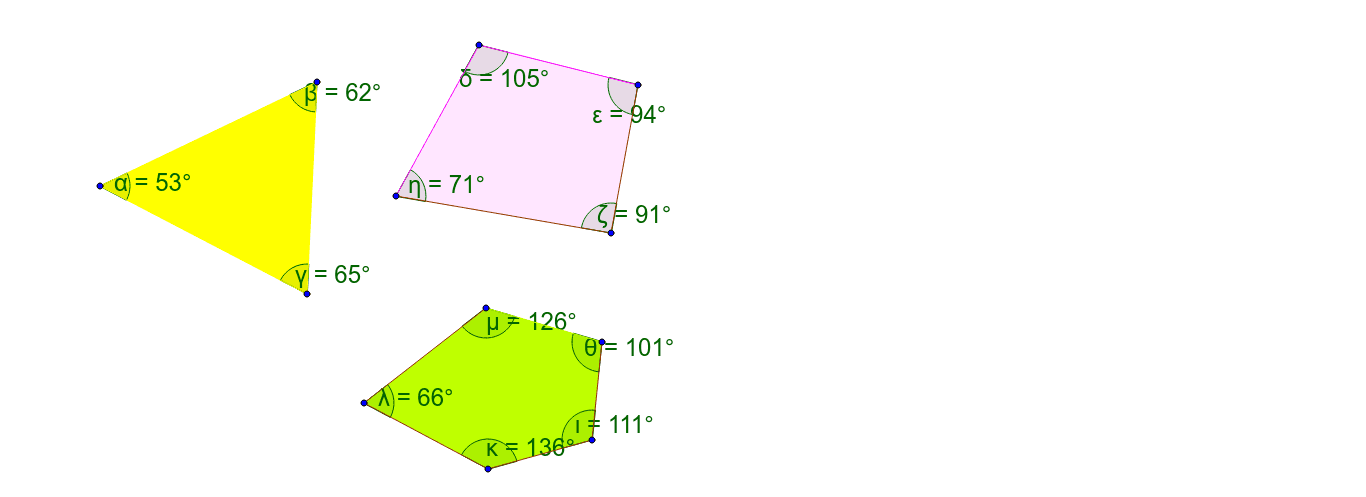
This example demonstrates how to calculate the sums of interior angles for polygons of varying number of sides using GeoGebra. Core math concepts include the polygon interior angle sum theorem and angle measurement. Key GeoGebra commands used are Polygon for creating polygons, Angle for measuring interior angles, and sliders for adjusting side counts and calculating totals. Suitable for middle school and above students learning polygon properties or as a basis for mathematical exploration activities.
GeoGebra Commands & Parameters
Polygon(A, B, C) → poly1, c, a, bPolygon(D, E, F, G) → poly2, d, e, f, gPolygon(H, I, J, K, L) → poly3, h, i, j, k, lAngle(C, A, B) → αAngle(A, B, C) → βAngle(B, C, A) → γAngle(G, D, E) → δAngle(D, E, F) → εAngle(E, F, G) → ζAngle(F, G, D) → ηAngle(H, I, J) → θAngle(I, J, K) → ιAngle(J, K, L) → κAngle(K, L, H) → λAngle(L, H, I) → μ
AI Drawing Prompt Reference
Draw multiple polygons with sides ranging from three to five, displaying the interior angles of each. Measure and label the three adjacent interior angles of each polygon in different colors. Calculate and display the sum of interior angles for each polygon, verifying the polygon interior angle sum theorem. Use sliders to adjust the number of sides of the polygons, dynamically showing the change in the sum of interior angles.
The prompt above was compiled from the original drawing commands and is for reference only.