
Exploring Alternate Exterior Angles
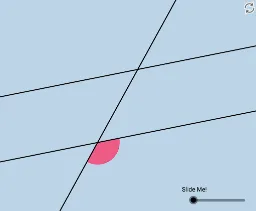
Loading the math board and drawing, please wait…
This example demonstrates the geometric concept that alternate exterior angles are congruent when a transversal intersects parallel lines. It involves core math concepts like parallel lines, transversal, alternate exterior angles, and geometric proofs. The construction uses GeoGebra commands such as Point, Rotate, Angle, Line, Circle, Intersect, CircleSector, Dilate, Vector, Midpoint, Segment, Ray, and CircleArc. Suitable for high school students learning geometric proofs.
GeoGebra Commands & Parameters
Point(a) → BRotate(B, α, A) → B'Angle(B, A, B') → βLine(A, B') → bCircle(A, 1) → eIntersect(b, d) → CCircle(C, 1) → fIntersect(e, a) → D, EIntersect(e, b) → F, GIntersect(f, b) → H, IIntersect(f, d) → J, KCircleSector(C, J, H) → kCircleSector(C, H, K) → pCircleSector(A, F, E) → tDilate(A, If[0 < i < 1, 1 - i], C) → A'Vector(A, A') → uVector(A, C) → vMidpoint(C, A) → LRotate(A, (((-i) * 180))°, L) → A'_1Segment(L, A'_1) → gSegment(C, L) → nSegment(L, A) → sPoint(b) → MPoint(b) → NRay(C, M) → a_1Ray(A, N) → b_1Rotate(E, (((-i) * 180))°, L) → E'Ray(A'_1, E') → d_1Circle(A'_1, Distance[L, A'_1]) → e_1Intersect(e_1, d_1, 1) → ORotate(A, ((i * 180))°, L) → A'_2Rotate(D, ((i * 180))°, L) → D'Circle(A'_2, L) → k_1Ray(A'_2, D') → i_1Intersect(k_1, i_1) → P,Segment(A'_2, P) → j_1Intersect(e, b, 1) → QIntersect(f, n, 1) → RCircleSector(A, Q, E) → c_1Rotate(c_1, (((-i) * 180))°, L) → qRotate(Q, (((-i) * 180))°, L) → Q'Circle(A, g) → g_1Intersect(g_1, b_1, 1) → SIntersect(g_1, a, 2) → TSegment(A, S) → h_1Rotate(A, (((-i) * 180))°, L) → A'_3Rotate(S, (((-i) * 180))°, L) → S'Segment(A'_3, S') → l_1Segment(A, T) → m_1Rotate(A, (((-i) * 180))°, L) → A'_4Rotate(T, (((-i) * 180))°, L) → T'Segment(A'_4, T') → n_1CircleArc(A, Q, E) → p_1Intersect(e_1, a, 1) → USegment(A, U) → q_1Intersect(a, q_1) → VIntersect(a, q_1) → WIntersect(e, a, 1) → ZCircleSector(A, Z, Q) → rRotate(A, ((i * 180))°, L) → A'_5Rotate(r, ((i * 180))°, L) → r'Rotate(A, ((i * 180))°, L) → A'_6Rotate(S, ((i * 180))°, L) → S'_1Segment(A'_6, S'_1) → hSegment(L, A'_5) → r_1CircleArc(A, Z, Q) → f_1