
Exploring AAA Congruent Triangles
Loading the math board and drawing, please wait…
In collections
Congruent Triangles
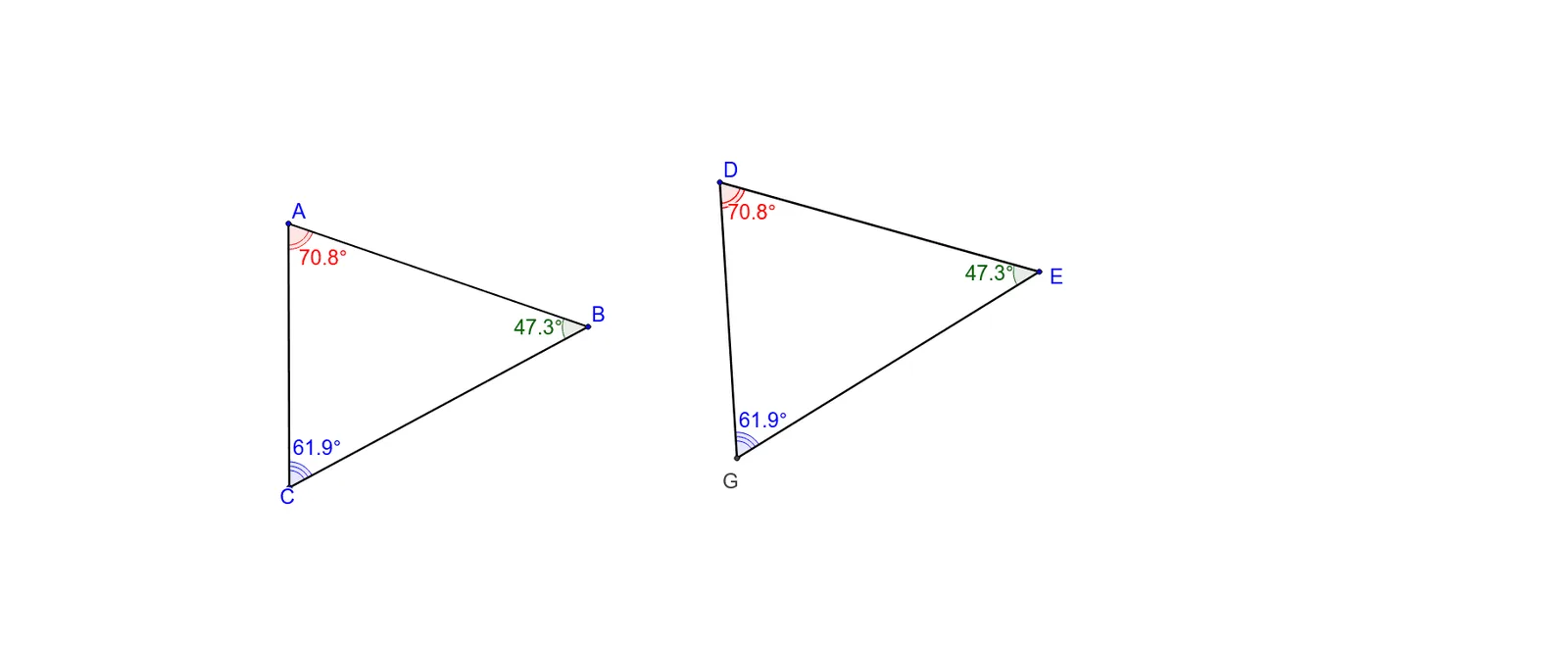
This example demonstrates whether triangles with three equal angles are congruent, involving core math concepts like triangle congruence criteria, angle relationships, and geometric transformations. It uses commands such as Segment, Angle, Rotate, Line, Intersect, and Distance to construct the geometric figures, making it suitable for high school students or teachers to understand triangle congruence and dynamic geometric transformations.
GeoGebra Commands & Parameters
Segment(A, B) → aSegment(A, C) → bSegment(C, B) → cSegment(D, E) → a_1Angle(C, A, B) → αAngle(A, B, C) → βRotate(E, (-α), D) → D_1Angle(D_1, D, E) → γLine(D_1, D) → dRotate(D, (-β), E) → E_1Rotate(D, β, E) → FAngle(D, E, F) → δLine(E, F) → eIntersect(d, e) → GSegment(D, G) → fSegment(G, E) → gAngle(B, C, A) → εAngle(E, G, D) → ζDistance(a, a_1) → h
AI Drawing Prompt Reference
Draw two triangles. Start with the first triangle defined by three points, and mark one of its angles. Then, using one side of the second triangle as a base, rotate one endpoint by the negative of the first angle to create a new point, and rotate the other endpoint by the negative of the second angle to create another point. Draw lines from these rotated points through the base endpoints, and let them intersect to form the third vertex of the second triangle. Connect this vertex to the base endpoints to complete the second triangle. Finally, measure the corresponding side lengths of both triangles and mark the third angles in each, showing that triangles with equal angles are not necessarily congruent.
The prompt above was compiled from the original drawing commands and is for reference only.