
Explore Angles of Elevation and Depression
Loading the math board and drawing, please wait…
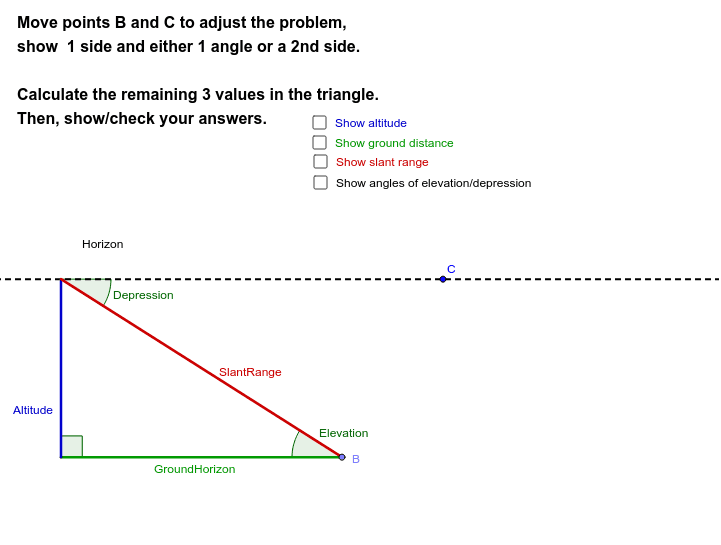
This example demonstrates the geometric relationship between angles of elevation and depression by varying inputs. It involves core math concepts like trigonometry and geometric construction using commands such as Point, Line, OrthogonalLine, Intersect, Segment, and Angle. Suitable for middle school students and educational purposes.
GeoGebra Commands & Parameters
Point(xAxis) → APoint(xAxis) → BLine(A, B) → aLine(C, a) → HorizonOrthogonalLine(A, a) → cOrthogonalLine(B, a) → dIntersect(Horizon, c) → DIntersect(Horizon, d) → ESegment(A, B) → GroundHorizonSegment(D, A) → AltitudeSegment(D, B) → SlantRangeAngle(D, B, A) → ElevationAngle(B, D, E) → DepressionAngle(B, A, D) → αSegment(A, B) → bSegment(D, A) → eSegment(D, B) → fAngle(B, D, C) → βAngle(D, B, A) → γ
AI Drawing Prompt Reference
Draw a triangle with horizontal, vertical, and slanted lines to illustrate angles of elevation and depression. Start by taking two points A and B on a horizontal line and connecting them to form the ground level. From point A, draw a perpendicular line to the horizontal line, and from point B, draw another perpendicular line to the horizontal line, which intersect at points D and E respectively. Connect A and B to form the ground slant, connect D and A to form a vertical line, and connect D and B to form a slanted line. Measure the angle DAB as the angle of elevation, the angle DBE as the angle of depression, and the angle DBA as angle α.
The prompt above was compiled from the original drawing commands and is for reference only.