
Explore 1: Angles in Shapes
Loading the math board and drawing, please wait…
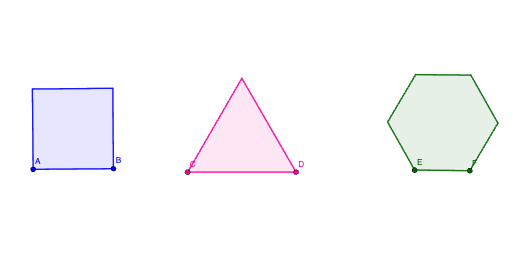
① This example demonstrates how angles appear and relate within various polygons, such as triangles and quadrilaterals, by constructing shapes and measuring their interior angles. ② Core mathematical concepts include the polygon interior angle sum theorem, angle measurement, and fundamental properties of geometric figures. ③ Construction highlights: Based on the summary, the GeoGebra Polygon command is used to create multiple polygons (poly1, poly2, poly3) with vertices A, B, C, D, E, F, etc., along with edges f, g, h, i, j, k, l, m, n, p, q, r, s and auxiliary points C₁, D₁, E₁ for labeling and angle measurement. ④ Suitable for middle school geometry lessons to explore angle sums in polygons, for upper elementary students to grasp angle basics, or as an interactive review tool in high school geometry.
GeoGebra Commands & Parameters
Polygon(A, B, 4) → poly1, f, g, h, i, C_{1}, D_{1}Polygon(E, F, 6) → poly2, j, M, k, l, m, n, p, J, K, LPolygon(C, D, 3) → poly3, q, r, s, E1
AI Drawing Prompt Reference
Draw several different polygons including a quadrilateral, a hexagon and a triangle. Show these shapes with their interior angles marked. Display two interior angles in the quadrilateral, several interior angles in the hexagon, and at least one interior angle in the triangle. Show the sides of each polygon clearly. Use auxiliary points to help indicate where the angles are positioned. Overall demonstrate the concept of interior angle sums in polygons for geometry learning.
The prompt above was compiled from the original drawing commands and is for reference only.