
Exploration of Quadratic Function Vertex
Loading the math board and drawing, please wait…
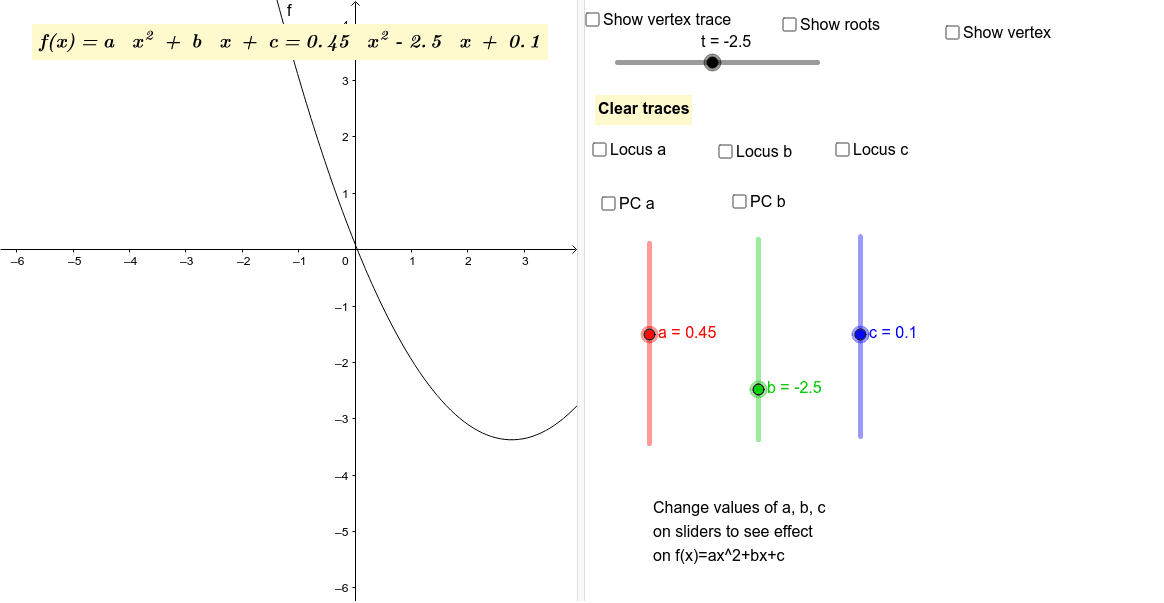
This example demonstrates how the vertex of the quadratic function f(x)=ax^2+bx+c changes as the parameters a, b, and c vary. Key math concepts include properties of quadratic functions, vertex formula, and the impact of parameters on the function graph. Construction highlights: Utilizes GeoGebra commands Root, Locus, CurveCartesian, Circle, and objects like c, a, b, f, r_1, r_2, VT, Rts, Directions, fForm, V, Root1, Root2, ClrTraces, la, lb, lc, loca, locb, locc, VV, t, d, A, e, g, PCa, h, PCb, PCA, PCB, i, PP. Suitable for high school students learning function graph transformations and parameter optimization.
GeoGebra Commands & Parameters
Root(f) → r_1, r_2Locus(V, a) → locaLocus(V, b) → locbLocus(V, c) → loccCurveCartesian((((-b)) / 2 * t), (((-b^(2))) / 4 * t) + c, t, -100, 100) → dCircle((0, c), 0.075) → eCircle((0, c), 0.075) → gCurveCartesian((-1 / ((2 * a)) * t), (-1 / ((4 * a)) * t^(2)) + c, t, -100, 100) → h