
Example 6b: Everyday Observations in Geometric Construction
Loading the math board and drawing, please wait…
In collections
Realidades de GeoGebra
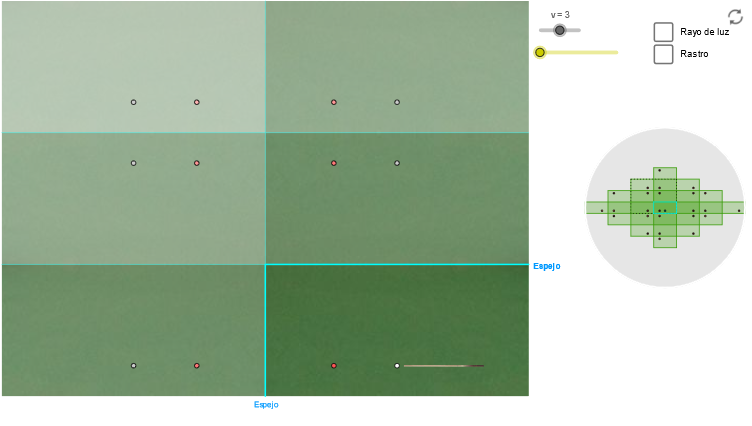
① This example demonstrates everyday geometric observations through a rich construction of points, lines, circles, and polygons, highlighting symmetry and reflection phenomena in an interactive GeoGebra environment. ② Core mathematical concepts include axial symmetry (reflection), midpoints, perpendicular lines, circles and arcs, polygons, and their interrelations; it also incorporates integers, inequalities, and step functions, showing cross-disciplinary integration. ③ Construction highlights: from the summary, commands such as OrthogonalLine, Mirror, Midpoint, Segment, Intersect, Circle, Point, Ray, If, Polar, CircumcircleArc, UnitVector, Line, UnitOrthogonalVector, and Angle are used, with objects like C, E_1, E_2, E_3, b, s, M, F_1, a4, G_1, a, f_2, I, a1, C_1, a2, a3, B, N_2, A1, p_1, G, G', g, B1, C1, D1, Q_2, A2, E1, F1, B2, C2, D2, E2, F2, B3, C3, A3, D3, forming a complex symmetric network. ④ Suitable for middle/high school geometry lessons, introductory geometric construction courses, and teacher demonstrations of symmetry and reflection, as well as student exploration of transformations and construction logic.
GeoGebra Commands & Parameters
OrthogonalLine(E_2, xAxis) → bOrthogonalLine(E_3, b) → sMirror(E_1, s) → MMidpoint(E_1, M) → F_1Segment(F_1, E_1) → a4Mirror(F_1, M) → G_1Segment(G_1, E_1) → aOrthogonalLine(E_1, a) → f_2Intersect(f_2, b) → ISegment(E_1, I) → a1Intersect(b, s) → C_1Segment(I, C_1) → a2Segment(F_1, C_1) → a3Circle(B, 3.8) → p_1Point(p_1) → GMirror(G, B) → G'Ray(B, G') → gRemoveUndefined(B1) → C1If(A1 ≟ Element[C1, 1], Element[C1, 2], Element[C1, 1]) → D1If(D1 ≟ Element[B1, 1], a1, If[D1 ≟ Element[B1, 2], a2, If[D1 ≟ Element[B1, 3], a3, a4]]) → E1Ray(D1, Vector[D1, Mirror[A1, OrthogonalLine[D1, E1]]]) → F1RemoveUndefined(B2) → C2If(A2 ≟ Element[C2, 1], Element[C2, 2], Element[C2, 1]) → D2If(D2 ≟ Element[B2, 1], a1, If[D2 ≟ Element[B2, 2], a2, If[D2 ≟ Element[B2, 3], a3, a4]]) → E2Ray(D2, Vector[D2, Mirror[A2, OrthogonalLine[D2, E2]]]) → F2RemoveUndefined(B3) → C3If(A3 ≟ Element[C3, 1], Element[C3, 2], Element[C3, 1]) → D3If(D3 ≟ Element[B3, 1], a1, If[D3 ≟ Element[B3, 2], a2, If[D3 ≟ Element[B3, 3], a3, a4]]) → E3Ray(D3, Vector[D3, Mirror[A3, OrthogonalLine[D3, E3]]]) → F3RemoveUndefined(B4) → C4If(A4 ≟ Element[C4, 1], Element[C4, 2], Element[C4, 1]) → D4Segment(D2, D3) → d3Segment(D1, D2) → d2Segment(A1, D1) → d1Segment(D3, D) → Q5Segment(D2, D) → Q5cSegment(D1, D) → Q5bSegment(B, D) → Q5aCircle(D, 0.12) → Q1Intersect(Q1, Q5, 1) → Q6Polar(D3, Q1) → Q2Intersect(Q1, Q2) → Q4, Q3CircumcircleArc(Q3, Q6, Q4) → Q7Intersect(Q7, Segment[D3, D4]) → Q8,Intersect(Q1, Q5c, 1) → Q6cPolar(D2, Q1) → Q2cIntersect(Q1, Q2c) → Q3c, Q4cCircumcircleArc(Q3c, Q6c, Q4c) → Q7cIntersect(Q7c, Segment[D2, D3]) → Q8c,Intersect(Q1, Q5b, 1) → Q6bPolar(D1, Q1) → Q2bIntersect(Q1, Q2b) → Q3b, Q4bCircumcircleArc(Q3b, Q6b, Q4b) → Q7bIntersect(Q7b, Segment[D1, D2]) → Q8b,Intersect(Q1, Q5a, 1) → Q6aPolar(B, Q1) → Q2aIntersect(Q1, Q2a) → Q3a, Q4aCircumcircleArc(Q3a, Q6a, Q4a) → Q7aIntersect(Q7a, Segment[B, D1]) → Q8a,If(Defined[Q8a], true, false) → choque0If(Defined[Q8b] ∧ (¬choque0), true, false) → choque1If(Defined[Q8c] ∧ (¬choque0) ∧ (¬choque1), true, false) → choque2If(Defined[Q8] ∧ (¬choque0) ∧ (¬choque1) ∧ (¬choque2), true, false) → choque3If(choque3, Q8, D4) → DFRay(DF, D) → F6RemoveUndefined(B8) → C8If(A8 ≟ Element[C8, 1], Element[C8, 2], Element[C8, 1]) → D8UnitVector(Vector[D, D8]) → G6Segment(D, D8) → d6Segment(D3, DF) → d4If(choque2, Q8c, D3) → DFcRay(DFc, D) → F15RemoveUndefined(B17) → C17If(A17 ≟ Element[C17, 1], Element[C17, 2], Element[C17, 1]) → D17Segment(D, D17) → d6cUnitVector(Vector[DFc, D17]) → G15Segment(D2, DFc) → d4cIf(choque1, Q8b, D2) → DFbRay(DFb, D) → F12RemoveUndefined(B14) → C14If(A14 ≟ Element[C14, 1], Element[C14, 2], Element[C14, 1]) → D14UnitVector(Vector[DFb, D14]) → G12Segment(D, D14) → d6bSegment(D1, DFb) → d4bIf(choque0, Q8a, D1) → DFaRay(DFa, D) → F9RemoveUndefined(B11) → C11If(A11 ≟ Element[C11, 1], Element[C11, 2], Element[C11, 1]) → D11UnitVector(Vector[D, D11]) → G9Segment(D, D11) → d6aSegment(B, DFa) → d4aSegment(A1, PP) → hUnitVector(Vector[A1, D1]) → G1Ray(B, DFa) → jaMirror(D, ja) → Da'Mirror(DFa, ja) → DFFaRay(DFFa, Da') → F8RemoveUndefined(B10) → C10If(A10 ≟ Element[C10, 1], Element[C10, 2], Element[C10, 1]) → D10Segment(DFa, D10) → d5aUnitVector(Vector[DFa, D10]) → G8UnitVector(Vector[D1, D2]) → G2Ray(D1, DFb) → jbMirror(DFb, jb) → DFFbMirror(D, jb) → Db'Ray(DFFb, Db') → F11RemoveUndefined(B13) → C13If(A13 ≟ Element[C13, 1], Element[C13, 2], Element[C13, 1]) → D13UnitVector(Vector[DFb, D13]) → G11Segment(DFb, D13) → d5bUnitVector(Vector[D2, D3]) → G3Ray(D2, DFc) → jcMirror(D, jc) → Dc'Mirror(DFc, jc) → DFFcRay(DFFc, Dc') → F14RemoveUndefined(B16) → C16If(A16 ≟ Element[C16, 1], Element[C16, 2], Element[C16, 1]) → D16Segment(DFc, D16) → d5cUnitVector(Vector[DFc, D16]) → G14Ray(D3, DF) → jMirror(D, j) → D'Mirror(DF, j) → DFFRay(DFF, D') → F5RemoveUndefined(B7) → C7If(A7 ≟ Element[C7, 1], Element[C7, 2], Element[C7, 1]) → D7Segment(A7, D7) → d5UnitVector(Vector[DF, D7]) → G5UnitVector(Vector[D3, DF]) → G4Intersect(s, yAxis) → EOrthogonalLine(E, s) → pOrthogonalLine(M, p) → rIntersect(s, g) → LOrthogonalLine(L, s) → kMirror(B, k) → B'If(choque2, If[h - d1 - d2 > d4c, If[h - d4c - d1 - d2 < d6c, D + ((h - d4c - d1 - d2) * G15), D + (d6c * G15)], D], If[choque1, If[h - d1 > d4b, If[h - d4b - d1 < d6b, D + ((h - d4b - d1) * G12), D + (d6b * G12)], D], If[choque0, If[h > d4a, If[h - d4a < d6a, D + ((h - d4a) * G9), D + (d6a * G9)], D], If[choque3 ∧ h ≥ sd, If[h - sd < d6, D + ((h - sd) * G6), D + (d6 * G6)], D]]]) → DDMirror(DD, s) → D'_1Mirror(D'_1, yAxis) → HMirror(H, r) → OLine(D, s) → eMirror(O, e) → ULine(U, e) → i_1Mirror(B, s) → NMirror(N, yAxis) → G_2Intersect(g, e) → FMirror(F, k) → F'Line(O, r) → b_1Mirror(F', s) → F''Circle(B, d) → cMirror(mesa, s) → mesa2bMirror(mesa2b, yAxis) → mesa3aMirror(O, p) → YMirror(mesa, p) → mesa2aMirror(mesa2b, r) → mesa3bMirror(mesa3b, p) → mesa4Intersect(r, b) → A_1Mirror(A_1, M) → B_1Segment(B_1, A_1) → j_1Mirror(C_1, E) → D_1Segment(D_1, C_1) → k_1Segment(B, G) → l_1Intersect(c, l_1, 1) → AUnitOrthogonalVector(v_1) → wIf(D4 ≟ Element[B4, 1], a1, If[D4 ≟ Element[B4, 2], a2, If[D4 ≟ Element[B4, 3], a3, a4]]) → E4Ray(D4, Vector[D4, Mirror[A4, OrthogonalLine[D4, E4]]]) → F4UnitVector(Vector[D3, D]) → uIf(choque2, If[h < d1, A1 + (h * G1), If[h - d1 < d2, D1 + ((h - d1) * G2), If[h - d1 - d2 < d4c, D2 + ((h - d1 - d2) * G3), If[h - d1 - d2 - d4c < d5c, DFc + ((h - d4c - d1 - d2) * G14), DFc + (d5c * G14)]]]], If[choque1, If[h < d1, A1 + (h * G1), If[h - d1 < d4b, D1 + ((h - d1) * G2), If[h - d1 - d4b < d5b, DFb + ((h - d4b - d1) * G11), DFb + (d5b * G11)]]], If[choque0, If[h < d4a, A1 + (h * G1), If[h < d4a + d5a, DFa + ((h - d4a) * G8), DFa + (d5a * G8)]], If[h < d1, A1 + (h * G1), If[h - d1 < d2, D1 + ((h - d1) * G2), If[h - d1 - d2 < d3, D2 + ((h - d1 - d2) * G3), If[h - sd < 0, D3 + ((h - d1 - d2 - d3) * G4), If[choque3, If[h - sd < d5, DF + ((h - sd) * G5), DF + (d5 * G5)], D3 + (d4 * G4)]]]]]]]) → PSegment(DF, P) → r5Segment(DF, DD) → r5'Mirror(P, k_1) → P'_2Mirror(P'_2, j_1) → P''_1Mirror(P''_1, a) → P'''Mirror(P'_2, a) → P''Mirror(P, a) → P'Mirror(DF, k_1) → DF'Mirror(DF', j_1) → DF''Mirror(DF'', a) → DF'''Intersect(E1, OrthogonalLine[D2, E1]) → H1Intersect(E1, OrthogonalLine[A1, E1]) → I1Intersect(E2, OrthogonalLine[D3, E2]) → H2Intersect(E2, OrthogonalLine[A2, E2]) → I2Intersect(E3, OrthogonalLine[D4, E3]) → H3Intersect(E3, OrthogonalLine[A3, E3]) → I3Angle(H1, D1, D2) → J1Angle(A1, D1, I1) → K1Angle(H2, D2, D3) → J2Angle(H3, D3, D4) → J3Angle(A2, D2, I2) → K2Angle(A3, D3, I3) → K3Segment(B, P) → r1Segment(B, D1) → r1aSegment(D1, P) → r2Segment(D2, D1) → r2aSegment(D2, P) → r3Segment(D2, D3) → r3aSegment(D3, P) → r4Segment(D3, DF) → r4aMirror(D1, p) → D1m1aMirror(D1, s) → D1m1bMirror(D2, p) → D2m1aMirror(D2, s) → D2m1bSegment(D1m1b, D2m1b) → mMirror(D3, E) → D3m2aMirror(D3m2a, M) → D3m2bMirror(D3m2a, r) → D3m3Mirror(D4, E) → D4m2aMirror(D4m2a, r) → D4m3Mirror(DF, E) → DFm2aMirror(DFm2a, r) → DFm3Segment(D3m3, DFm3) → iSegment(D1m1a, D2m1a) → qMirror(D2m1a, s) → D2m2aSegment(D2m2a, D3m2a) → lMirror(D2m1b, r) → D2m2bSegment(D2m2b, D3m2b) → a_1Mirror(B, p) → Bm1aMirror(B, s) → Bm1bMirror(B, E) → Bm2aMirror(Bm2a, M) → Bm2bMirror(Bm2a, r) → Bm3Mirror(DD, p) → ZSegment(B, DFa) → r1aaSegment(B, P) → r1ASegment(P, DFa) → r1AbSegment(DFa, DD) → r5ASegment(D1, P) → r1BSegment(D1, DFb) → nSegment(P, DFb) → r1BbSegment(DFb, DD) → r5BSegment(D2, P) → c_1Segment(D2, DFc) → d_1Segment(DFc, P) → e_1Segment(D16, DFc) → f_1Segment(DD, DFc) → r5CSegment(B, DFa) → m_1If(choque3, Q8, If[choque0, Q8a, If[choque1, Q8b, If[choque2, Q8c, D4]]]) → DTMirror(DT, p) → DTm1aSegment(D1m1a, DTm1a) → n_1Mirror(DT, s) → DTm1bSegment(D1m1b, DTm1b) → q_1Mirror(DTm1a, s) → DTm2aSegment(D2m2a, DTm2a) → r_1Mirror(DTm1b, r) → DTm2bSegment(D2m2b, DTm2b) → s_1If(D1 ≟ Element[B1, 2] ∨ D1 ≟ Element[B1, 4], 1, 2) → test1If((D2 ≟ Element[B2, 1] ∨ D2 ≟ Element[B2, 3]) ∧ test1 ≟ 1 ∨ (D2 ≟ Element[B2, 2] ∨ D2 ≟ Element[B2, 4]) ∧ test1 ≟ 2, 1, 2) → test2Segment(E_1, E_3) → g_1Segment(E_3, C_1) → h_1Mirror(K, C) → K'Mirror(Q_1, C) → C_2Mirror(W_1, C) → D_2Mirror(N_1, C) → F_2Mirror(M_1, C) → H_2Mirror(L_1, C) → I_2Mirror(Q, C) → Q'Mirror(R, C) → R'Mirror(P_1, C) → J_2Mirror(O_1, C) → K_2Mirror(R_1, C) → L_2Mirror(Z_1, C) → M_2Segment(C, K) → t_1Segment(K, Q) → a_2Segment(Q, J) → b_2Segment(J, C) → c_2Ray(N_2, Q_2) → e_2Circle(C + (0.5, 0.25), 3.5) → d_2Intersect(d_2, e_2, 1) → P_2Segment(N_2, P_2) → g_2Circle(C + (0.5, 0.25), 3.5) → h_2Line(R', I_2) → i_2Line(K_1, H_1) → j_2Mirror(O_2, j_2) → W_2Mirror(W_2, i_2) → Z_2Line(L_2, K_2) → k_2Mirror(Z_2, k_2) → A_3Line(Z_1, U_1) → l_2Mirror(S_2, l_2) → B_3Mirror(V_2, j_2) → C_3Mirror(C_3, i_2) → D_3Line(B_2, M_2) → m_2Mirror(S_2, m_2) → F_3Mirror(T_2, m_2) → G_3Mirror(Z_2, m_2) → H_3Mirror(H_3, i_2) → I_3Mirror(I_3, j_2) → J_3Line(U_1, K_2) → n_2Line(T_1, I_2) → p_2Line(Z_1, L_2) → q_2Line(O_1, R') → r_2Mirror(I_3, n_2) → K_3Mirror(J_3, n_2) → L_3Mirror(G_3, n_2) → M_3Mirror(L_3, p_2) → N_3Mirror(U_2, q_2) → O_3Mirror(V_2, q_2) → P_3Mirror(C_3, q_2) → Q_3Mirror(P_3, r_2) → R_3Segment(J, I_1) → s_2Segment(I_1, Z_1) → t_2Segment(Z_1, V_1) → a_3Segment(V_1, J) → b_3
AI Drawing Prompt Reference
In a coordinate plane, start with a horizontal reference line and define a perpendicular line through a given point, forming a small network of intersecting lines. Choose another point on one line and construct its reflection across a designated line to obtain symmetric points and connect them with segments, then create further intersections between the generated lines and segments. Draw a circle centered at a selected point with radius about 3.8, and use polar/related constructions from the circle to generate additional intersection points. Finally, form one or more circumcircle arcs passing through the relevant intersection points and connect/trim them by the corresponding segments, producing a symmetric reflection pattern.
The prompt above was compiled from the original drawing commands and is for reference only.