
Example 5: Congruence with Rigid Motions
Loading the math board and drawing, please wait…
In collections
Sequence of Rigid Motions
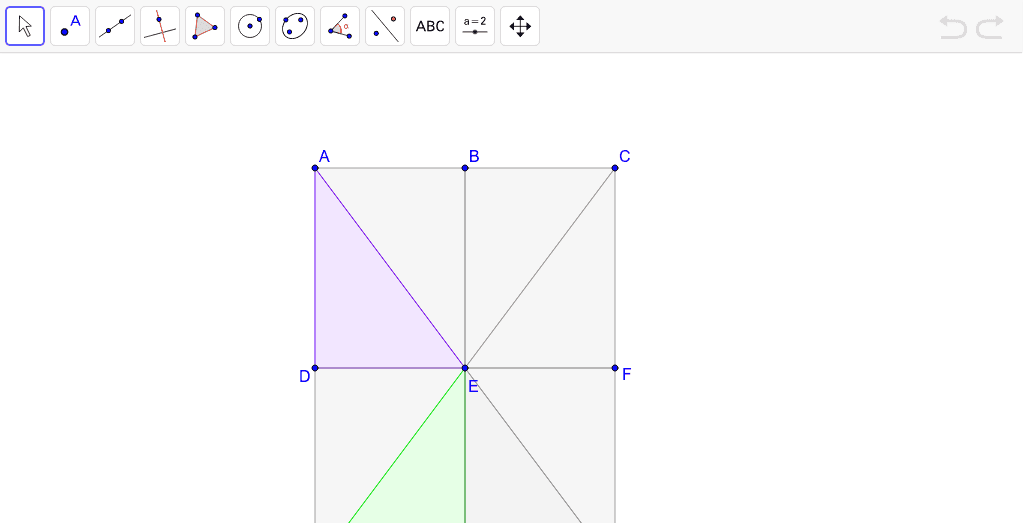
This example demonstrates congruence transformations using rigid motions. Key mathematical concepts include congruence, rigid motions, and polygons. Using GeoGebra commands like Polygon and Ellipse, a series of congruent polygons are constructed. Suitable for middle school and above students to learn about geometric transformations and congruence.
GeoGebra Commands & Parameters
Polygon(A, B, E) → poly1, e, a, bPolygon(A, D, E) → poly2, e_1, a_1, dPolygon(D, G, E) → poly3, e_2, d_1, gPolygon(G, H, E) → poly4, e_3, g_1, hPolygon(H, I, E) → poly5, e_4, h_1, iPolygon(E, F, I) → poly6, i_1, e_5, fPolygon(E, C, F) → poly7, f_1, e_6, cPolygon(E, B, C) → poly8, c_1, e_7, b_1
AI Drawing Prompt Reference
Draw a series of equilateral triangles formed by points A, B, C, D, E, F, G, H, and I. These triangles are connected through rotations and translations to form a continuous figure. The construction order starts with triangles A, B, E, then adds triangles A, D, E, D, G, E, G, H, E, H, I, E, F, I, E, C, F, E, B, C. Ensure all triangles remain equilateral and are connected by shared vertices or edges.
The prompt above was compiled from the original drawing commands and is for reference only.