
Euler Solution of ODE
Loading the math board and drawing, please wait…
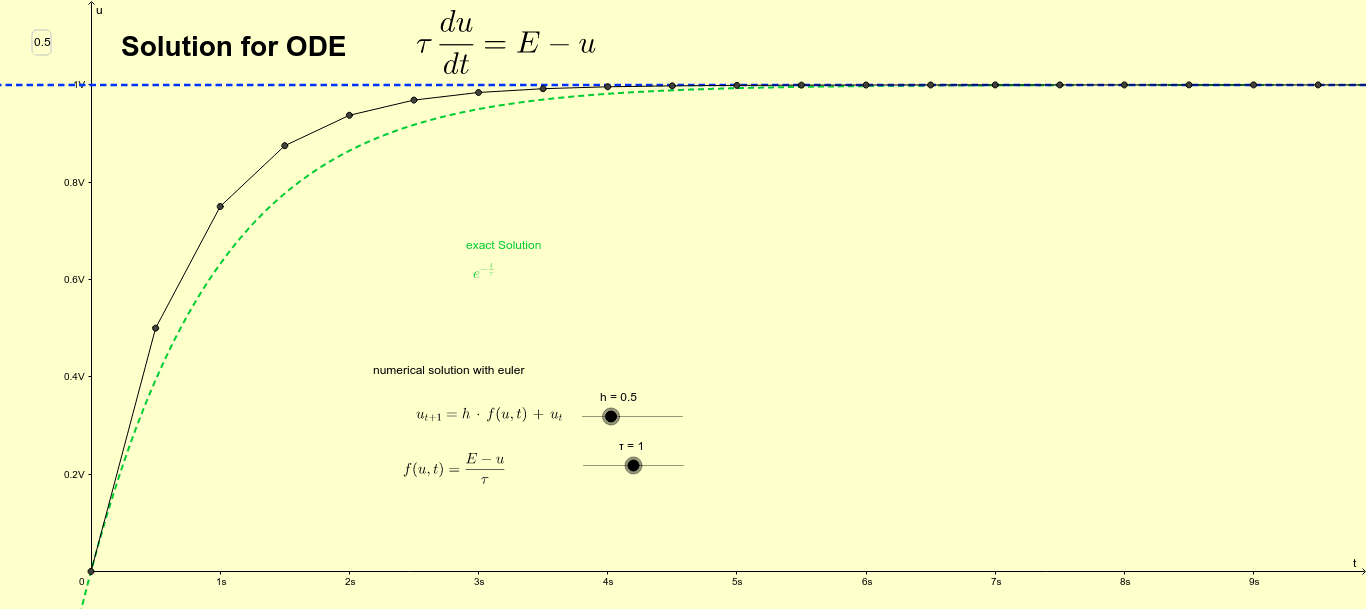
This example demonstrates the Euler method (forward Euler) for solving a simple ordinary differential equation (ODE). Students can learn that there are two variables influencing the solution: τ. By adjusting the input boxes, one can observe the changes in the solution. The core mathematical concepts involved include ordinary differential equations, difference and slope. The GeoGebra commands used include: Textfield, Line, Segment; objects: τ, E, ode, inputBox1, init, inputBox2, Init, a, u_0, u_1, h, f, inputBox3, step, b, A, d, c, B, e, g, C, i, j, D, k, l, F, m, n, G, p, q, H, r, s, I, t, a_1, J. Suitable for high school mathematics education.
GeoGebra Commands & Parameters
Textfield(E) → inputBox1Textfield(init) → inputBox2Line((0, E), xAxis) → aTextfield(h) → inputBox3Line(Init, (x(Init) + h, f(y(Init)))) → bSegment(Init, A) → dLine(A, (x(A) + h, f(y(A)))) → cSegment(A, B) → eLine(B, (x(B) + h, f(y(B)))) → gSegment(B, C) → iLine(C, (x(C) + h, f(y(C)))) → jSegment(C, D) → kLine(D, (x(D) + h, f(y(D)))) → lSegment(D, F) → mLine(F, (x(F) + h, f(y(F)))) → nSegment(F, G) → pLine(G, (x(G) + h, f(y(G)))) → qSegment(G, H) → rLine(H, (x(H) + h, f(y(H)))) → sSegment(H, I) → tLine(I, (x(I) + h, f(y(I)))) → a_1Segment(I, J) → b_1Line(J, (x(J) + h, f(y(J)))) → c_1Segment(J, K) → d_1Line(K, (x(K) + h, f(y(K)))) → e_1Segment(K, L) → f_1Line(L, (x(L) + h, f(y(L)))) → g_1Segment(L, M) → h_1Line(M, (x(M) + h, f(y(M)))) → i_1Segment(M, N) → j_1Line(N, (x(N) + h, f(y(N)))) → k_1Segment(N, O) → l_1Line(O, (x(O) + h, f(y(O)))) → m_1Segment(O, P) → n_1Line(P, (x(P) + h, f(y(P)))) → p_1Segment(P, Q) → q_1Line(Q, (x(Q) + h, f(y(Q)))) → r_1Segment(Q, R) → s_1Line(R, (x(R) + h, f(y(R)))) → t_1Segment(R, S) → a_2Line(S, (x(S) + h, f(y(S)))) → b_2Segment(S, T) → c_2Line(T, (x(T) + h, f(y(T)))) → d_2Segment(T, U) → e_2Line(U, (x(U) + h, f(y(U)))) → f_2Segment(U, V) → g_2Line(V, (x(V) + h, f(y(V)))) → h_2Segment(V, W) → i_2Line(W, (x(W) + h, f(y(W)))) → j_2Segment(W, Z) → k_2Line(Z, (x(Z) + h, f(y(Z)))) → l_2Segment(Z, A_1) → m_2Line(A_1, (x(A_1) + h, f(y(A_1)))) → n_2Segment(A_1, B_1) → p_2Line(B_1, (x(B_1) + h, f(y(B_1)))) → q_2Segment(B_1, C_1) → r_2Line(C_1, (x(C_1) + h, f(y(C_1)))) → s_2Segment(C_1, D_1) → t_2Line(D_1, (x(D_1) + h, f(y(D_1)))) → a_3Segment(D_1, E_1) → b_3Line(E_1, (x(E_1) + h, f(y(E_1)))) → c_3Segment(E_1, F_1) → d_3Line(F_1, (x(F_1) + h, f(y(F_1)))) → e_3Segment(F_1, G_1) → f_3Line(G_1, (x(G_1) + h, f(y(G_1)))) → g_3Segment(G_1, H_1) → h_3Line(H_1, (x(H_1) + h, f(y(H_1)))) → i_3Segment(H_1, I_1) → j_3Line(I_1, (x(I_1) + h, f(y(I_1)))) → k_3Segment(I_1, J_1) → l_3Line(J_1, (x(J_1) + h, f(y(J_1)))) → m_3Segment(J_1, K_1) → n_3Line(K_1, (x(K_1) + h, f(y(K_1)))) → p_3Segment(K_1, L_1) → q_3Line(L_1, (x(L_1) + h, f(y(L_1)))) → r_3Segment(L_1, M_1) → s_3Line(M_1, (x(M_1) + h, f(y(M_1)))) → t_3Segment(M_1, N_1) → a_4Line(N_1, (x(N_1) + h, f(y(N_1)))) → b_4Segment(N_1, O_1) → c_4Line(O_1, (x(O_1) + h, f(y(O_1)))) → d_4Segment(O_1, P_1) → e_4Line(P_1, (x(P_1) + h, f(y(P_1)))) → f_4Segment(P_1, Q_1) → g_4Line(Q_1, (x(Q_1) + h, f(y(Q_1)))) → h_4Segment(Q_1, R_1) → i_4Line(R_1, (x(R_1) + h, f(y(R_1)))) → j_4Segment(R_1, S_1) → k_4Line(S_1, (x(S_1) + h, f(y(S_1)))) → l_4Segment(S_1, T_1) → m_4Line(T_1, (x(T_1) + h, f(y(T_1)))) → n_4Segment(T_1, U_1) → p_4Line(U_1, (x(U_1) + h, f(y(U_1)))) → q_4Segment(U_1, V_1) → r_4Line(V_1, (x(V_1) + h, f(y(V_1)))) → s_4Segment(V_1, W_1) → t_4Line(W_1, (x(W_1) + h, f(y(W_1)))) → a_5Segment(W_1, Z_1) → b_5Line(Z_1, (x(Z_1) + h, f(y(Z_1)))) → c_5Segment(Z_1, A_2) → d_5Line(A_2, (x(A_2) + h, f(y(A_2)))) → e_5Segment(A_2, B_2) → f_5Line(B_2, (x(B_2) + h, f(y(B_2)))) → g_5Segment(B_2, C_2) → h_5