
Euclid: The Game – Level 17: Constructing Segments and Lines
Loading the math board and drawing, please wait…
In collections
Euclid: The Game
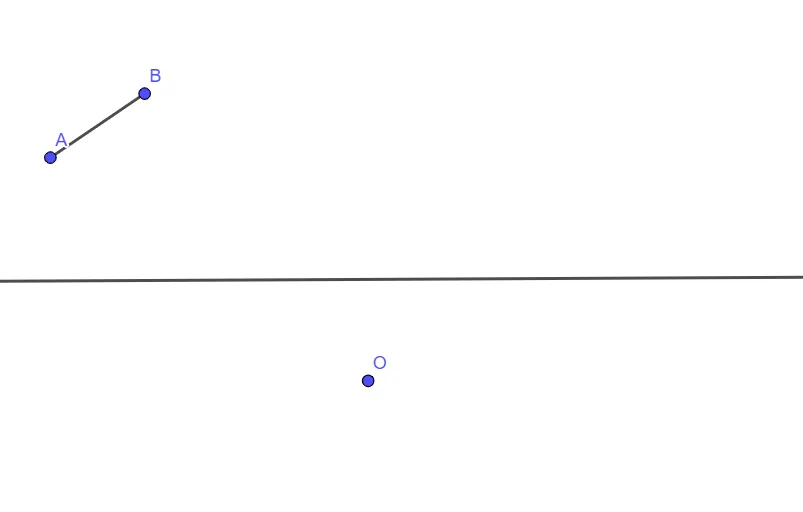
This example demonstrates how to build the required geometric configuration in Euclid: The Game using only fundamental drawing primitives—segments and lines—so that the level’s intended relationships (including cosine/trigonometric ideas and quadrilateral/parallel-figure structure) can be represented. Key math themes include trigonometric reasoning via cosine (capturing angle/direction constraints), quadrilateral geometry such as parallelogram-like relationships, and function-oriented thinking that aligns with power-function style constraints. Construction-wise, the GeoGebra command set is distilled from the construction summary: it primarily uses “Segment” and “Line” to create and connect the geometric objects A, B, C, D, together with auxiliary line/constraint objects f and g, while the point O serves as an important reference/anchor in the layout. The resulting figure structure emerges from how these segments and lines intersect, align, and extend. Suitable for middle school through early university learners, and ideal for GeoGebra practice focusing on step-by-step geometric construction and visualization of relationships tied to functions and trigonometry.
GeoGebra Commands & Parameters
Segment(A, B) → fLine(C, D) → g
AI Drawing Prompt Reference
On a coordinate plane, start by creating a line segment between two key points A and B as one fundamental element. Then select two other points C and D and draw a straight line passing through C and D as a second, independent primitive. Arrange the scene so that the relationships implied by how the segment and the line intersect or extend can support later geometric constraints—using their relative positions and directions to reflect angle/direction requirements and a parallelogram-like quadrilateral structure needed for cosine-based trigonometric reasoning and function-oriented thinking.
The prompt above was compiled from the original drawing commands and is for reference only.