
Euclid's Proof of the Pythagorean Theorem by Li
Loading the math board and drawing, please wait…
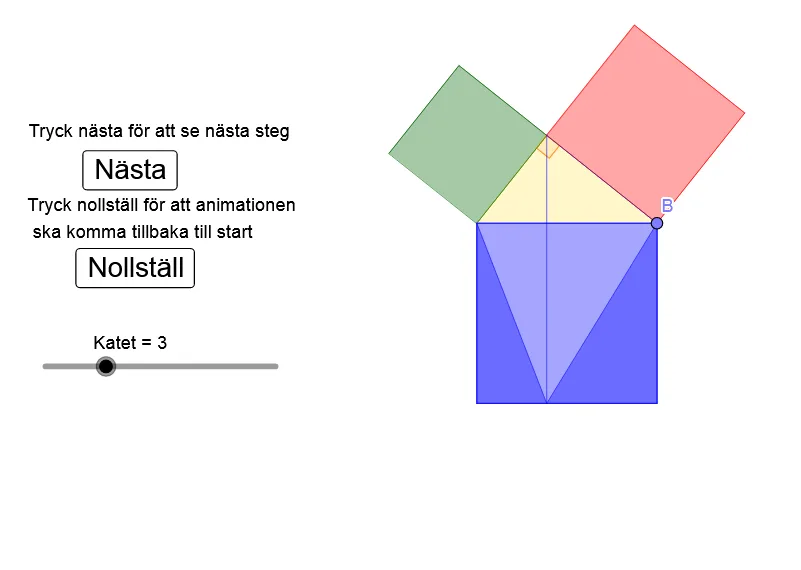
① This GeoGebra example dynamically demonstrates Euclid's classic proof of the Pythagorean theorem from the Elements, showing that the sum of the areas of the squares on the two legs of a right triangle equals the area of the square on the hypotenuse. ② Core mathematical concepts include right triangles, similar triangles, area conservation, rotation and translation transformations, and the geometric meaning of the Pythagorean theorem. ③ Construction highlights: using GeoGebra commands such as Intersect, Point, Line, Circle, Semicircle, Polygon, Angle, OrthogonalLine, Translate, Rotate, and Segment, the example constructs a right triangle and squares on each side, then uses auxiliary lines and rotated figures to partition the large square into parts equal in area to the two smaller squares, completing the proof. ④ Suitable for middle school to high school students learning geometric proofs, and useful for teachers demonstrating or students exploring multiple proofs of the Pythagorean theorem.
GeoGebra Commands & Parameters
Intersect(xAxis, yAxis) → APoint(xAxis) → BLine(A, B) → aCircle(A, Katet) → dSemicircle(A, B) → cIntersect(c, d, 1) → CPolygon(A, C, B) → Mangekant1, b, a_1, c_1Polygon(B, A, 4) → cc_1, e, f, g, h, D, EPolygon(A, C, 4) → cc, i, j, k, l, F, GPolygon(C, B, 4) → bb, m, n, p, q, H, IAngle(A, C, B) → αOrthogonalLine(C, g) → rIntersect(r, g) → JTranslate(J, Vector[(g1 * Vector[J, C])]) → J'Translate(B, Vector[(g3 * Vector[B, F])]) → B'Translate(J, Vector[(g4 * Vector[J, C])]) → J'_1Translate(A, Vector[(g6 * Vector[A, I])]) → A'Polygon(D, J', A) → TA1, a_3, d_2, j'Polygon(A, B', G) → TA3, g_1, a_4, b'Rotate(D, g2, A) → D'Rotate(J', g2, A) → J''Rotate(A, g2, A) → A'_1Polygon(D', J'', A'_1) → TA2, a'_1, d', j''Polygon(E, J'_1, B) → TB1, b_1, e_1, j'_1Rotate(B, (-g5), B) → B'_1Rotate(E, (-g5), B) → E'Rotate(C, (-g5), B) → C'Polygon(B'_1, E', C') → TB2, c', b'_1, e'Polygon(B, A', H) → TB3, h_1, b_3, a'Segment(J, C) → t
AI Drawing Prompt Reference
Draw a right triangle ABC with A as the right angle. Construct squares on each side of the triangle. Then, using rotation and translation, partition the larger square into areas equal to the two smaller squares, demonstrating Euclid's proof of the Pythagorean theorem. Start by drawing the intersection point A of the x-axis and y-axis, then draw line AB, followed by circle d centered at A, and find point C where d intersects c. Construct the three squares, and use rotation and translation to show that the area of the larger square equals the sum of the areas of the two smaller squares.
The prompt above was compiled from the original drawing commands and is for reference only.