
Equivalent Fractions with Area Model by Duane Habecker (2)
Loading the math board and drawing, please wait…
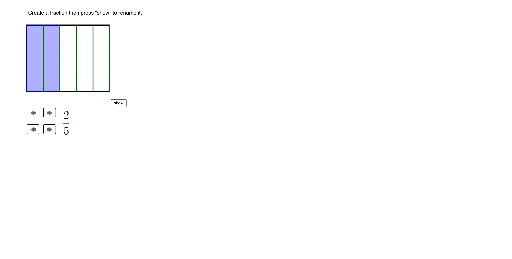
This example demonstrates how to find equivalent fractions using an area model. It involves core mathematical concepts such as fractions, area, and geometric representation. The construction uses GeoGebra commands like Polygon and Sequence to create and partition shapes, showing equivalent fractions by adjusting the numerator and denominator divisions. Suitable for upper elementary and middle school students learning basic fraction concepts and geometric applications.
GeoGebra Commands & Parameters
Polygon(A, B, B + (0, tall), A + (0, tall)) → Area1, a, b, f, gPolygon(C, D, D + (0, tall), C + (0, tall)) → Area2, c, d, h, iSequence(Segment[A + ((width / numberofpartitions * i), 0), A + ((width / numberofpartitions * i), tall)], i, 1, numberofpartitions) → VerticalLines1Sequence(Segment[C + ((width / numberofpartitions * i), 0), C + ((width / numberofpartitions * i), tall)], i, 1, numberofpartitions) → VerticalLines2Polygon(A, A + ((partitionwidth * setnumerator), 0), A + ((partitionwidth * setnumerator), tall), A + (0, tall)) → shadednumerator1, a_1, j, k, lPolygon(C, C + ((partitionwidth * setnumerator), 0), C + ((partitionwidth * setnumerator), tall), C + (0, tall)) → shadednumerator2, c_1, m, n, pSequence(Segment[C + (0, (partitionheight * i)), C + (width, (partitionheight * i))], i, 0, horizontalcuts) → HorizontalLines2