
Interactive Linear Equation Practice with Visual Answer Verification
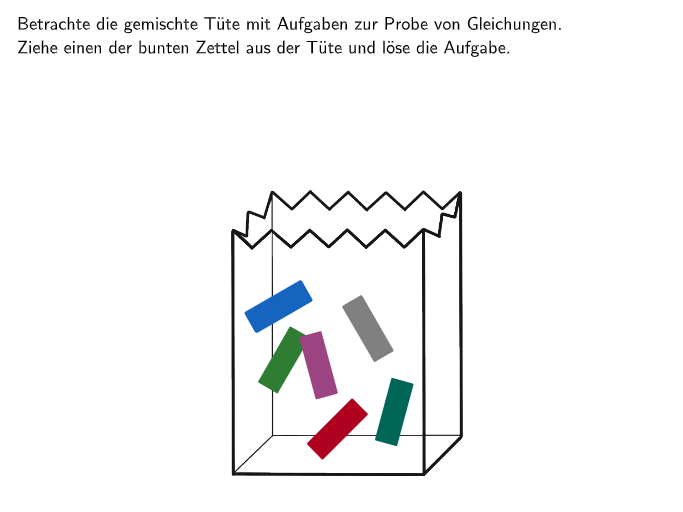
Loading the math board and drawing, please wait…
In collections
Gleichungen lösen mit Umkehroperationen
This GeoGebra lesson (presented as a “bunte Tüte voller Proben” interactive exercise) demonstrates how students can solve one-variable linear equations using inverse operations, while validating their choice through visual/geometric feedback. The key math ideas are one-step-at-a-time (inverse) operations on both sides of an equation, linear equation solving, and systematic answer checking. Construction and interaction rely on the objects and commands from the build summary: multiple candidate solutions (e.g., sol1a/sol1b, sol2a/sol2b, sol3a/sol3b, sol7/sol8/sol9) are provided via dropdown inputs (DropDown9/7/8 with input9/7/8); If controls branching logic, Shuffle randomizes candidate presentation, and Join/Append/Remove manage lists of options. Textfield displays prompts/notes. Geometric support uses Point, Polygon, and PointIn/IsInRegion to determine whether candidates fall in specified regions, while Length and Midpoint help compute measures and derived points. Element and Defined support referencing and validity checks. A validation loop is implemented with flags like correct1–correct9 and check3–check7 together with buttons (btnValidate2, btnNext2, btnNochmal, btnNext) for immediate feedback. Suitable for grades 5–6 as interactive practice and formative assessment.
GeoGebra Commands & Parameters
SelectedIndex(DropDown9) → input9SelectedIndex(DropDown7) → input7If(exnum ≟ 2, 2, 3) → sol9If(exnum ≟ 1, 2, 3) → sol7If(exnum ∈ {1, 4}, 1, If[exnum ∈ {2, 5}, 2, 3]) → extypeIf(exnum ≟ 3, check6, check5) → correct6SelectedIndex(DropDown8) → input8If(exnum ≟ 2, check3, check4) → correct5Join(Sequence[Shuffle[{1, 2, 3, 4, 5, 6, 7}], m, 1, 9]) → listExnumTextfield(input1) → Eingabefeld1Textfield(input2) → Eingabefeld2Textfield(input3) → Eingabefeld3Polygon(TüteBound1, TüteBound2, TüteBound3, TüteBound4) → TüteBounda, tütebound1, tütebound2, tütebound3, tütebount4PointIn(TüteBounda) → Z1aLength(Vector[Z1b, Z1c]) → dIf(exnum ≟ 1, 4, 3.7) → sol1If(exnum ≟ 1, 36, 14.8) → sol2If(exnum ≟ 1, 39, 8.7) → sol3If(exnum ≟ 1, check1, check2) → correct4Element({correct1 ∧ correct2 ∧ correct3 ∧ correct7 ∧ correct8, correct9, correct6}, extype) → correctPolygon(Translate[TüteBound1, (0.8, 0.4)], Translate[TüteBound2, (0.8, 0.4)], Translate[TüteBound3, (0.8, 0.4)], Translate[TüteBound4, (0.8, 0.4)]) → TüteBoundb, f, g, h, iTextfield(input1old) → InputBox1Textfield(input2old) → InputBox2Polygon(PtopLeftCornerFeedback, PtopRightCornerFeedback, PbottomRightCornerFeedback, PbottomLeftCornerFeedback) → rectangleCorrect, rectangleCorrectS3, rectangleCorrectS4, rectangleCorrectS2, rectangleCorrectS1Shuffle(Sequence[Random[0, 10], i, 1, 100]) → randomNosForX, {10, 3, 2, 1, 5, 3, 0, 3, 10, 3, 10, 6, 1, 2, 8, 4, 10, 8, 3, 5, 7, 8, 7, 10, 2, 5, 4, 6, 7, 8, 8, 8, 9, 6, 4, 6, 10, 9, 9, 9, 0, 0, 10, 8, 5, 3, 3, 3, 0, 5, 4, 3, 5, 3, 8, 7, 1, 0, 6, 7, 8, 3, 0, 9, 7, 7, 2, 0, 1, 6, 3, 9, 10, 6, 4, 9, 6, 3, 0, 4, 9, 2, 9, 10, 1, 0, 0, 0, 4, 5, 3, 3, 6, 4, 6, 6, 9, 3, 0, 4}Element(randomNosForX, Mod[questionCount, 100] + 1) → numXShuffle(Sequence[Random[0, 10], i, 1, 100]) → randomNosForY, {4, 4, 6, 7, 9, 5, 8, 9, 4, 4, 1, 8, 2, 5, 9, 3, 9, 6, 7, 8, 9, 5, 4, 2, 5, 7, 8, 5, 3, 2, 5, 5, 4, 8, 9, 4, 2, 0, 5, 2, 1, 10, 9, 10, 6, 2, 3, 5, 5, 1, 1, 5, 0, 9, 3, 4, 2, 8, 2, 8, 0, 2, 8, 6, 8, 6, 7, 5, 6, 0, 8, 0, 5, 3, 4, 10, 3, 2, 10, 3, 1, 8, 9, 1, 10, 1, 0, 1, 3, 5, 5, 1, 3, 8, 10, 6, 0, 6, 10, 0}Element(randomNosForY, Mod[questionCount, 100] + 1) → numYAppend(true, Sequence[If[randomNosForX(i) ≟ randomNosForX(i - 1), false, true], i, 2, 100]) → stayXAppend(true, Sequence[If[randomNosForY(i) ≟ randomNosForY(i - 1), false, true], i, 2, 100]) → stayYRemove(Sequence[If[stayX(i), randomNosForX(i), 0], i, 1, 100], Sequence[0, i, 1, 100]) → randomNosForXwithoutRepeatRemove(Sequence[If[stayY(i), randomNosForY(i), 0], i, 1, 100], Sequence[0, i, 1, 100]) → randomNosForYwithoutRepeatElement(randomNosForXwithoutRepeat, Mod[questionCount, Length[randomNosForXwithoutRepeat]] + 1) → numXwithoutRepeatElement(randomNosForYwithoutRepeat, Mod[questionCount, Length[randomNosForYwithoutRepeat]] + 1) → numYwithoutRepeatPoint(Line[Bu1, xAxis]) → Bu2PointIn(TüteBounda) → Z2aPointIn(TüteBounda) → Z3aPointIn(TüteBounda) → Z4aPointIn(TüteBoundb) → Z5aPointIn(TüteBoundb) → Z6aPointIn(TüteBoundb) → Z7aPolygon(D1, (x(D1), y(D2)), D2, (x(D2), y(D1))) → DecisionArea, d1, j, d2, kMidpoint(Z1a, Z1c) → Z1MMidpoint(Z2a, Z2c) → Z2MMidpoint(Z3a, Z3c) → Z3MMidpoint(Z4a, Z4c) → Z4MMidpoint(Z5a, Z5c) → Z5MMidpoint(Z6a, Z6c) → Z6MMidpoint(Z7a, Z7c) → Z7MIsInRegion(Z1M, DecisionArea) → zettel1decIsInRegion(Z2M, DecisionArea) → zettel2decIsInRegion(Z3M, DecisionArea) → zettel3decIsInRegion(Z4M, DecisionArea) → zettel4decIsInRegion(Z5M, DecisionArea) → zettel5decIsInRegion(Z6M, DecisionArea) → zettel6decIsInRegion(Z7M, DecisionArea) → zettel7decLength(Vector[Z1a, Z1b]) → cTextfield(input3old) → InputBox3Point(Line[Pi1, xAxis]) → Pi2Element({If[part ≟ 1, 3, 1], 1, 2}, extype) → versuchePoint(Line[Hakerl1a, xAxis]) → Hakerl1bDefined(((input1(h, c) * input2(h, c)) * input3(h, c))) → fixedDropDown7
AI Drawing Prompt Reference
Create an interactive geometry exercise demonstrating one-variable linear equation solving with visual feedback. Include multiple candidate solutions selected via dropdowns, geometric regions showing where solutions lie, and buttons for validation and feedback. Use points, polygons, length calculations, and conditional logic to control the interaction and display prompts.
The prompt above was compiled from the original drawing commands and is for reference only.