
Equivalent Fractions Circle Area Model
Loading the math board and drawing, please wait…
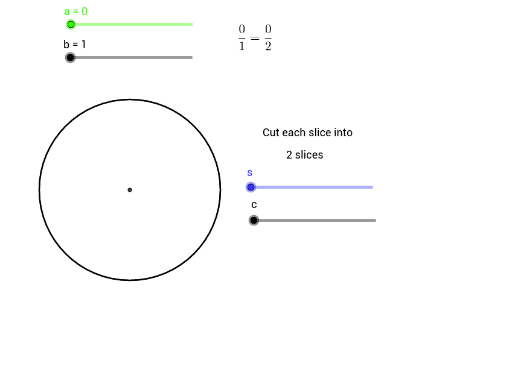
This example demonstrates equivalent fractions using circle area models. Key mathematical concepts include fraction equivalence, area proportion, and the relationship with π. Construction involves GeoGebra commands like Circle, CircleSector, and Segment to build area models, with Intersect used to verify equivalence. Suitable for elementary high school or middle school math classes to visually understand the connection between fractions and geometry.
GeoGebra Commands & Parameters
Intersect(xAxis, yAxis) → ACircle(A, 3) → c_6Point(xAxis) → CCircle(C, 1.5) → dOrthogonalLine(C, xAxis) → a_1Intersect(d, a_1, 2) → DIntersect(d, a_1, 1) → EOrthogonalLine(D, a_1) → eOrthogonalLine(E, a_1) → fPoint(xAxis) → FOrthogonalLine(F, e) → g_2Intersect(e, g_2) → GPoint(g_2) → HIntersect(c_6, yAxis, 1) → BRotate(B, (360 * ° / b), A) → B'CircleSector(A, B, B') → kRotate(B', (360 * ° / b), A) → B''Rotate(B'', (360 * ° / b), A) → B'''Rotate(B''', (360 * ° / b), A) → IRotate(I, (360 * ° / b), A) → I'Rotate(I', (360 * ° / b), A) → I''Rotate(I'', (360 * ° / b), A) → I'''Rotate(I''', (360 * ° / b), A) → JRotate(J, (360 * ° / b), A) → J'CircleSector(A, B', B'') → pCircleSector(A, B'', B''') → qCircleSector(A, B''', I) → rCircleSector(A, I, I') → s_6CircleSector(A, I', I'') → tCircleSector(A, I'', I''') → c_1CircleSector(A, I''', J) → f_1CircleSector(A, J, J') → k_1CircleSector(A, J', B) → p_1Segment(B, A) → iSegment(B', A) → jSegment(B'', A) → lSegment(B''', A) → mSegment(I, A) → nSegment(I', A) → b_1Segment(I'', A) → i_1Segment(I''', A) → j_1Segment(J, A) → l_1Segment(J', A) → m_1Circle(A, B) → q_1Rotate(B, (360 * ° / ((b * s))), A) → B'_1Rotate(B'_1, (360 * ° / ((b * s))), A) → KRotate(K, (360 * ° / ((b * s))), A) → K'Rotate(K', (360 * ° / ((b * s))), A) → K''Rotate(B', (360 * ° / ((b * s))), A) → B''_1Rotate(B''_1, (360 * ° / ((b * s))), A) → LRotate(L, (360 * ° / ((b * s))), A) → L'Rotate(L', (360 * ° / ((b * s))), A) → L''Rotate(B'', (360 * ° / ((b * s))), A) → B'''_1Rotate(B'''_1, (360 * ° / ((b * s))), A) → MRotate(M, (360 * ° / ((b * s))), A) → M'Rotate(M', (360 * ° / ((b * s))), A) → M''Rotate(B''', (360 * ° / ((b * s))), A) → NRotate(N, (360 * ° / ((b * s))), A) → N'Rotate(N', (360 * ° / ((b * s))), A) → N''Rotate(N'', (360 * ° / ((b * s))), A) → N'''Rotate(I, (360 * ° / ((b * s))), A) → I'_1Rotate(I'_1, (360 * ° / ((b * s))), A) → ORotate(O, (360 * ° / ((b * s))), A) → O'Rotate(O', (360 * ° / ((b * s))), A) → O''Rotate(I', (360 * ° / ((b * s))), A) → I''_1Rotate(I''_1, (360 * ° / ((b * s))), A) → PRotate(P, (360 * ° / ((b * s))), A) → P'Rotate(P', (360 * ° / ((b * s))), A) → P''Rotate(I'', (360 * ° / ((b * s))), A) → I'''_1Rotate(I'''_1, (360 * ° / ((b * s))), A) → QRotate(Q, (360 * ° / ((b * s))), A) → Q'Rotate(Q', (360 * ° / ((b * s))), A) → Q''Rotate(I''', (360 * ° / ((b * s))), A) → RRotate(R, (360 * ° / ((b * s))), A) → R'Rotate(R', (360 * ° / ((b * s))), A) → R''Rotate(R'', (360 * ° / ((b * s))), A) → R'''Rotate(J, (360 * ° / ((b * s))), A) → J'_1Rotate(J'_1, (360 * ° / ((b * s))), A) → SRotate(S, (360 * ° / ((b * s))), A) → S'Rotate(S', (360 * ° / ((b * s))), A) → S''Rotate(J', (360 * ° / ((b * s))), A) → J''Rotate(J'', (360 * ° / ((b * s))), A) → J'''Rotate(J''', (360 * ° / ((b * s))), A) → TRotate(T, (360 * ° / ((b * s))), A) → T'Vector(B'_1, A) → uTranslate(B'_1, Vector[(u * c)]) → UCircle(A, U) → r_1Segment(K, A) → n_1Segment(K', A) → s_1Segment(K'', A) → t_1Segment(B''_1, A) → a_2Segment(L, A) → b_2Segment(L', A) → c_2Segment(L'', A) → d_2Segment(B'''_1, A) → e_2Segment(M, A) → f_2Segment(M', A) → h_2Segment(M'', A) → i_2Segment(N, A) → j_2Segment(N', A) → k_2Segment(N'', A) → l_2Segment(N''', A) → m_2Segment(I'_1, A) → n_2Segment(O, A) → p_2Segment(O', A) → q_2Segment(O'', A) → r_2Segment(I''_1, A) → s_2Segment(P, A) → t_2Segment(P', A) → a_3Segment(P'', A) → b_3Segment(I'''_1, A) → c_3Segment(Q, A) → d_3Segment(Q', A) → e_3Segment(Q'', A) → f_3Segment(R, A) → g_3Segment(R', A) → h_3Segment(R'', A) → i_3Segment(R''', A) → j_3Segment(J'_1, A) → k_3Segment(S, A) → l_3Segment(S', A) → m_3Segment(S'', A) → n_3Segment(J'', A) → p_3Segment(J''', A) → q_3Segment(T, A) → r_3Segment(T', A) → s_3Intersect(r_1, n_1) → V,Intersect(r_1, s_1) → W,Intersect(r_1, t_1) → Z,Intersect(r_1, a_2) → A_1,Intersect(b_2, c_2) → B_1Intersect(r_1, b_2) → C_1,Intersect(r_1, c_2) → D_1,Intersect(r_1, d_2) → E_1,Intersect(r_1, e_2, 1) → F_1Intersect(r_1, f_2, 1) → G_1Intersect(r_1, h_2, 1) → H_1Intersect(r_1, i_2, 1) → I_1Intersect(r_1, j_2, 1) → J_1Intersect(r_1, k_2, 1) → K_1Intersect(r_1, l_2, 1) → L_1Intersect(r_1, m_2, 1) → M_1Intersect(r_1, n_2, 1) → N_1Intersect(r_1, p_2, 1) → O_1Intersect(r_1, q_2, 1) → P_1Intersect(r_1, r_2, 1) → Q_1Intersect(r_1, s_2, 1) → R_1Intersect(r_1, t_2, 1) → S_1Intersect(r_1, a_3, 1) → T_1Intersect(r_1, b_3, 1) → U_1Intersect(r_1, c_3, 1) → V_1Intersect(r_1, d_3, 1) → W_1Intersect(r_1, e_3, 1) → Z_1Intersect(r_1, f_3, 1) → A_2Intersect(r_1, g_3, 1) → B_2Intersect(r_1, h_3, 1) → C_2Intersect(r_1, i_3, 1) → D_2Intersect(r_1, j_3, 1) → E_2Intersect(r_1, k_3, 1) → F_2Intersect(r_1, l_3, 1) → G_2Intersect(r_1, m_3, 1) → H_2Intersect(r_1, n_3, 1) → I_2Intersect(r_1, p_3, 1) → J_2Intersect(r_1, q_3, 1) → K_2Intersect(r_1, r_3, 1) → L_2Intersect(r_1, s_3, 1) → M_2Segment(B'_1, U) → t_3Segment(K, V) → a_4Segment(K', W) → b_4Segment(K'', Z) → c_4Segment(B''_1, A_1) → d_4Segment(L, C_1) → e_4Segment(L', D_1) → f_4Segment(L'', E_1) → g_4Segment(B'''_1, F_1) → h_4Segment(M, G_1) → i_4Segment(M', H_1) → j_4Segment(M'', I_1) → k_4Segment(N, J_1) → l_4Segment(N', K_1) → m_4Segment(N'', L_1) → n_4Segment(N''', M_1) → p_4Segment(I'_1, N_1) → q_4Segment(O, O_1) → r_4Segment(O', P_1) → s_4Segment(O'', Q_1) → t_4Segment(I''_1, R_1) → a_5Segment(P, S_1) → b_5Segment(P', T_1) → c_5Segment(P'', U_1) → d_5Segment(I'''_1, V_1) → e_5Segment(Q, W_1) → f_5Segment(Q', Z_1) → g_5Segment(Q'', A_2) → h_5Segment(R, B_2) → i_5Segment(R', C_2) → j_5Segment(R'', D_2) → k_5Segment(R''', E_2) → l_5Segment(J'_1, F_2) → m_5Segment(S, G_2) → n_5Segment(S', H_2) → p_5Segment(S'', I_2) → q_5Segment(J'', J_2) → r_5Segment(J''', K_2) → s_5Segment(T, L_2) → t_5Segment(T', M_2) → a_6Circle(A, B) → hSegment(B, A) → d_1Intersect(r_1, d_1, 1) → N_2Segment(B, N_2) → e_1
AI Drawing Prompt Reference
Draw a circle with a radius of 3, then draw multiple sectors on this circle to represent equivalent fractions. Start by drawing a circle with a radius of 1.5, then use rotation and intersection operations to generate multiple sectors, each with an angle that is a multiple of 360 divided by b, where b is a slider-controlled value.
The prompt above was compiled from the original drawing commands and is for reference only.