
Equilibrium Problem Practice
Loading the math board and drawing, please wait…
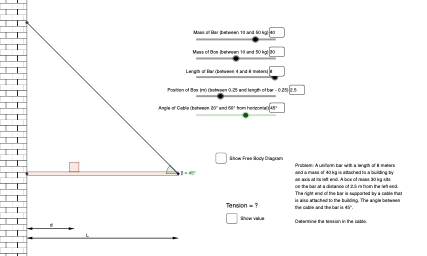
This example demonstrates an adjustable equilibrium problem involving a uniform bar with a mass on it, pivoted at its left end and supported at the right. It covers core math concepts like rotation, expected value, differential calculus, frequency distribution, interest calculation, and parallelograms. The construction utilizes GeoGebra commands such as Polygon, Circle, Rotate, Line, Intersect, Ray, Segment, Vector, Angle, and Textfield. Suitable for high school and above, combining physics mechanics with mathematical geometry.
GeoGebra Commands & Parameters
Polygon((0, -100), (0, 100), (-10, 100), (-10, -100)) → poly2, e, f, g, hCircle(B, T / 196) → pRotate(A, (-α), B) → A'Line(B, A') → iIntersect(i, e) → CRay(B, C) → mPolygon((0, 0), (l, 0), (l, -0.2), (0, -0.2)) → poly1, a, b, c, d_2Segment(B, C) → jPolygon(D, E, G, F) → poly3, d_1, e_1, g_1, f_1Vector(J, K) → uVector(H, I) → vIntersect(p, m, 1) → LVector(B, L) → wVector(A, N) → nVector(A, M) → qVector(B, O) → rVector(B, P) → sAngle(C, B, A) → βVector(Q, R) → kVector(R, Q) → u_1Vector(S, U) → v_1Vector(U, S) → w_1Textfield(m_B) → InputBox1Textfield(m_1) → InputBox2Textfield(l) → InputBox3Textfield(d) → InputBox4Textfield(α) → InputBox5